


 Back
Back





2023 Supreme(Kar) 1285
IN THE HIGH COURT OF KARNATAKA (DHARWAD BENCH)
ANANT RAMANATH HEGDE, J.
Veerabhadrayya and Ors. - Appellants
Versus
Smt. Kannyakumari and Ors. - Respondent
Regular First Appeal No. 100071 of 2017 (PAR/POS)
Decided on : 20-09-2023
For the Appellant :Smt. Surabhi Kulkarni, Advocate
For the Respondent:Sri. Nitin R. Bolabandi, Advocate
Rights to ancestral property include equitable shares among all heirs, correcting erroneous allocations in prior decrees.
Headnote:In matters of partition, the court referred to the relevant principles governing ancestral property rights and determined that the trial court erred in its decree, granting 1/3rd share to the plaintiffs instead of the rightful shares. The court framed the issue as to whether the trial court justifiably limited the distribution of shares to the plaintiffs while excluding others involved. The justification behind the allocation was evaluated against established norms of inheritance. Consequently, the court modified the decree outlining the rightful shares to be distributed, ensuring equitable ownership among heirs.
| Table of Content |
|---|
| 1. trial court's share allocation review (Para 1 , 2 , 3 , 4) |
| 2. arguments regarding entitlement to shares (Para 5 , 6) |
| 3. court's assessment of rightful shares in inheritance (Para 7 , 8 , 9 , 10 , 11) |
| 4. correction of the share allocation decision (Para 12) |
| 5. final decision on share distribution (Para 13) |
JUDGMENT :
Mr. Anant Ramanath Hegde, J. - Defendants No.1 to 4 are aggrieved by the decree for partition and separate possession, granted in O.S.No.10/2014 on the file of the Senior Civil Judge, Saundatti.
2. The trial Court granted 1/3rd share to the plaintiffs. The admitted genealogy is as under:
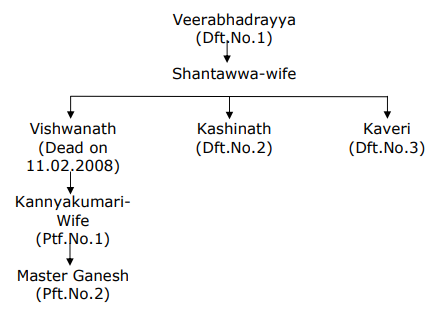
3. Veerabadrayya and Shantawwa are the husband and wife. They had three children, namely, Vishwanath, Kashinath and Kaveri. Vishwanath died on 11.02.2008. The suit for partition is filed by his wife Kannyakumari and son Master Ganesh. The suit is contested by the defendants on the premise that the plaintiffs are not entitled to share, as the properties are the self-acquired properties of defendants No.1 and 2.
4. The trial Court did not accept the contention of the defendants and granted decree for partition holding that the plaintiffs are entitled to 1/3rd share in the suit schedule properties. The trial Court has not awarded any share in favour of Shantawwa, W/o. Veerabhadrayya and Kaveri, D/o. Veerabhadrayya. No reasons are assigned as to why these two persons are not given any share.
5. Learned counsel for the appellants would submit that, in the event of partition in the family, the wife and the daughter of the holder are also entitled to the share, the trial Court could not have granted 1/3rd share in favour of the plaintiffs.
6. Learned counsel for the respondents would submit that, defendant No.3 - Kaveri has relinquished her share in the family properties at the time of her marriage. Thus, the trial Court is justified in not awarding any share to the daughter.
7. After considering the contentions raised at the Bar and after perusing the impugned judgment and decree, the following point arises for consideration:
"Whether the trial Court is justified in granting 1/3rd share to the plaintiffs and declining any share to the wife and daughter of Veerabhadrayya?"
8. On perusal of the judgment and decree and the evidence on record, it is evident that Veerabhadrayya acquired the properties in the family partition, which took place among his father and brothers. Thus, the properties are the ancestral properties. Though the properties are allotted to his share, after the birth, his children will acquire right in the properties. One of the coparceners Vishwanath died on 11.02.2008. Vishwanath had undivided 1/5th in the properties. Rest of his family members namely, the brother, sister and parents had 1/5th share at the time of death of Vishwanath.
9. After the demise of Vishwanath, his wife, son and his mother inherited his 1/5th share. Thus 1/5th share of Vishwanath has to be divided equally among his three heirs named above. His wife Kanyakumari will acquire 1/15th share, his son Ganesh will acquire 1/15th share and mother Shantawwa will acquire 1/15th share in the share of Vishwanath.
10. Shantawwa, the wife will also acquire 1/5th share in the property of Veerabhadrayya and another son Kashinath will acquire 1/5th share and the daughter Kaveri will also acquire 1/5th share. The contention that the daughter has relinquished her share is not supported by any documents.
11. As already noted, Shantawwa will acquire 1/15th share of Vishwanath, in addition 1/5th share in the property of Veerabhadrayya.
12. Under the circumstances, the trial Court erred in granting 1/3rd share to the plaintiffs. Hence the impugned judgment and decree passed by the trial Court ought to be modified.
13. Accordingly, the judgment and decree 30.08.2016 passed by the Senior Civil Judge, Saundatti, in O.S.No.10/2014 is modified by holding that;
i. The plaintiffs have got 1/15th share each in the suit schedule properties. The plaintiffs are entitled to initiate












