
 Back
Back





IN THE HIGH COURT OF KARNATAKA (DHARWAD BENCH)
ANANT RAMANATH HEGDE, J.
Ramachandra and ors. - Appellants
Versus
Sadashiv and ors. - Respondents
Regular First Appeal No.1168 of 2007 (PAR-).
Decided on : 28-03-2023
| Table of Content |
|---|
| 1. genealogy and property details established (Para 1 , 2 , 3 , 4) |
| 2. defendants argue lack of jurisdiction and prior partition (Para 5 , 7 , 8 , 9) |
| 3. court analysis confirms joint family property status (Para 10 , 11 , 12 , 13 , 14) |
| 4. appeal dismissed, trial court's decree upheld (Para 15) |
JUDGMENT :
Mr. Anant Ramanath Hegde, J. - Defendants No.1 to 8 in O.S.57/1997 on the file of the Senior Civil Judge, Gokak are before this Court assailing the judgment and decree granting 1/3 share in all the suit schedule properties in favour of the plaintiffs.
2. Admitted genealogy of the parties is as under:
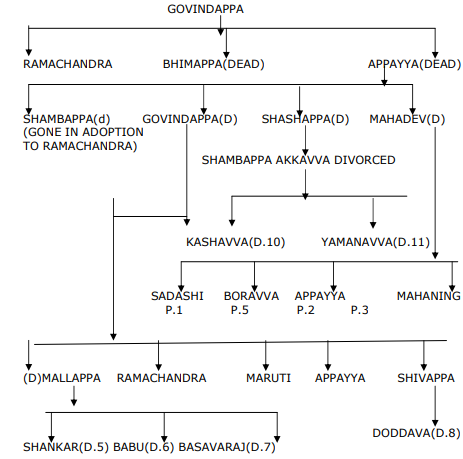
3. Govindappa was the propositus. He had three sons by names Ramachandra, Bhimappa and Appayya. It is not in dispute that Ramachandra had no issues and Bhimappa died issueless and the third son of Govindappa, namely Appayya had four sons, Shambappa, Govindappa, Shashappa and Mahadev. Among the four sons of Appayya, Shambappa was given in adoption to Ramachandra - who was the elder son of propositus Govindappa.
4. The suit for partition is filed by the wife and children of last son of Appayya viz., Mahadev. The suit is filed against the branch of Govindappa who are defendants 1 to 8 and branch of Shashappa -defendants 10 and 11. Bhimappa - son of adopted son of Shambappa is arrayed as defendant No.9. No relief is claimed against him. He is arrayed as a party as his name appeared in one of the property records. The suit was filed on the premise that suit schedule properties were the joint family properties of plaintiffs and defendants 1 to 8, 10 and 11.
5. The defendants contested the matter and defendants took a stand that there is already a partition in the family and prayed for dismissal of the suit.
6. The trial Court on appreciation of the evidence has concluded that all the properties are joint family properties and granted decree for 1/3 share in respect of the properties in favour of the plaintiffs and 1/3 share in favour of defendants 1 to 8 and 1/3 share in favour of defendants 10 and 11. Being aggrievedby the said judgment and decree, defendants 1 to 8 are in appeal. Defendants 10 and 11 have accepted the judgment and decree.
7. Sri Mahesh Wodeyar, learned counsel appearing for the appellants at the outset would urge that the suit for partition granted by the trial Court is one without jurisdiction. He would submit that item Nos.5 and 6 viz., Sy.No.482/2 measuring 4 acres 5 guntas and Sy.No.482/1a measuring 4 acres 11 guntas are the lands granted by the Land Tribunal and the Civil Court lacks jurisdiction to grant a decree for partition in respect of those lands. By referring to the order of the Land Tribunal, he would submit that the occupancy is granted to the parties based on Form No.1 and the Land Tribunal itself has demarcated the share of the parties to the proceedings and as such, he would contend that no further partition is permissible. He would also submit that insofar as item Nos.1 to 4 of schedule 'A' and item Nos.1 and 2 of schedule 'B', there is already a partition and evidence led by the defendants are not properly appreciated by the trial Court and the trial Court erred in decreeing the suit for partition.
8. Sri Ravi S. Balikai, learned counsel appearing for the respondents would submit that the partition has not taken place in the family. All the properties are joint family properties. The properties at item Nos.5 and 6 were the devasthanam inam lands and the properties are given for cultivation for the family as a consideration for the purpose of performing pooja and records would indicate that Govindappa was performing pooja and after his demise, his son Appayya was performing pooja and Form No.1 is filed by Mallappa - the eldest son of Govindappa and as such, grant of occupancy should be treated as grant in favour of entire family. It is the submission of Sri Ravi S Balikai that Form No.1 was filed by Govindappa - who is one of the son's of Appayya is not in his individual capacity and it is in the
AI


The heavy burden of proof upon the proponent of oral partition before it is accepted, as per the settled principle of law by the Apex Court.

A daughter can claim a share in ancestral properties despite prior claims of partition if evidence for such partition is not established.
The court established that evidence must substantiate claims of oral partition, prioritizing the registered Partition Deed as definitive proof for ancestral property entitlements under the Hindu Succ....
A plaintiff can only establish entitlement to partition if they demonstrate joint ownership and the failure to do so, particularly through admissions and evidence of prior partition, warrants dismiss....



An indispensable Tool for Legal Professionals, Endorsed by Various High Court and Judicial Officers
Please visit our Training & Support
Center or Contact Us for assistance

Scan Me!
India’s Legal research and Law Firm App, Download now!


For Daily Legal Updates, Join us on :



 Back to top


