
 Back
Back





IN THE HIGH COURT OF JUDICATURE AT MADRAS
N.SATHISH KUMAR, R.SAKTHIVEL, JJ.
Karuppannan – Appellant
Versus
Priya Alias Saranya – Respondent
A.S. No. 1263 of 2025, C.M.P. No. 32919 of 2025
Decided On : 17-02-2026
| Table of Content |
|---|
| 1. plaintiff's claim based on ancestral property rights. (Para 1 , 2 , 3) |
| 2. defendants' denial of ancestral property and share calculation. (Para 4 , 9 , 10) |
| 3. court's analysis on the nature of property and rightful shares. (Para 6 , 11 , 12 , 13 , 14 , 15) |
| 4. finding of trial court's error in share allocation. (Para 16) |
| 5. final ruling on share entitlement and modification of trial court decision. (Para 17) |
JUDGMENT :
N. SATHISH KUMAR, J.
1. Challenging the decree and judgment of the Trial Court granting preliminary decree declaring that the plaintiff is entitled to 3/8th share in the suit schedule properties and separate possession and also declaring that the settlement deed dated 27.01.2012 executed by Raja Gounder and third defendant in favour of the first defendant is null and void, the present appeal has been filed.
2. The parties herein are arrayed to as per their own ranking before the Trial Court. It is the case of the plaintiff that the plaintiff is the daughter of the first defendant. The second defendant is another daughter of the first defendant born through second marriage of the first defendant during the subsistence of the first marriage. The second defendant was having a brother named Raja had died intestate as bachelor. According to the plaintiff, the suit properties are ancestral properties of the plaintiff and the first defendant. The family geneology is as follows:-
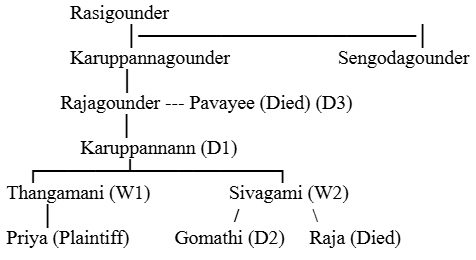
3. According to the plaintiff, the first defendant's great grandfather Rasi Gounder has two sons namely Karuppagounder(first defendant grand father) and Sengodagounder. They jointly sold their ancestral property in the Namakkal district and purchased the suit properties through various sale deeds in the year 1965 & 1968 and they were put into common hotchpot of the ancestral nucleus and thereafter, on 11.09.1970, the said Sengoda Gounder and Raja Gounder partitioned the ancestral joint family between themselves through a registered partition deed. Hence, the plaintiff’s grandfather Raja Gounder through the income derived from the ancestral property has purchased various properties through three sale deeds of the year 1986 and the plaintiff’s father Karuppannan purchased some properties through sale deeds dated 1988 and 1991. The said Raja Gounder and Karuppannan i.e. the 1st defendant has no individual source of income to purchase any property. The said properties were purchased from the income derived from the ancestral property. The said Raja Gounder and his wife Pavayee Ammal has executed a settlement deed pertaining to the suit property in the name of 1st defendant through a registered settlement deed dated 27.01.2012. The said settlement deed is void as the settlement mentioned properties are ancestral joint family properties and the executors are not the sole owners to execute settlement deed. Hence, settlement deed does not bind of affect the right of the plaintiff in any way. Hence, the plaintiff being the daughter of the first defendant seeks allotment of 3/8th share in the suit property and thus, the suit for partition and declaring the settlement deed dated 27.01.2012 as null and void.
4. The defendants admitting the relationship denied that the properties are not ancestral properties and contended that the properties are self acquired properties of the first defendant. The first defendant's father Raja Gounder and his wife Pavayee, third defendant have jointly executed a settlement deed on 27.01.2012 in favour of the first defendant in respect of the first defendant's father self acquired properties. Thus, the suit properties are separate properties of the first defendant and the plaintiff has no right to claim any share in the suit properties.
5. On the basis of pleadings and evidence, the Trial Court framed the following issues:
1) Whether the plaintiff is entitled for the relief of declaration to declare that she has 3/8th share in the suit properties as prayed for?
2) Whether the plaintiff is entitled to declare the settlem
AI
Ancestral property entitlement under Hindu Succession Act limits the plaintiff's share to 1/8, not 3/8, affirming the rights of coparceners post-amendment.

The mere description of property as ancestral does not establish its nature; evidence of purchase and settlement deeds is essential for determining ownership.
The trial Court must examine the plaint's averments to determine if a cause of action exists, rather than rejecting it based solely on the defendant's claims.
The main legal point established in the judgment is the interpretation of the Hindu Succession Act and the determination of entitlement to shares in ancestral and self-acquired properties.
A claimant must prove the ancestral nature of properties to claim entitlement under the amended Hindu Succession Act; mere assertions without evidence are insufficient.
Ancestral property is defined by long-term family possession, and joint patta establishes ownership, regardless of individual assignments.
The court established the principle that under the Tamil Nadu Amendment Act 1/1990, a daughter is entitled to her share in ancestral property, and any disposition or alienation without her consent is....
The court clarified that ancestral property is subject to established joint family ownership principles, and oral relinquishments of property rights require substantial evidence.

Daughters have the right to claim a share in ancestral property as coparceners under Sec. 6(1)(a) of the Hindu Succession Act, but their entitlement is limited by the proviso to Sec. 6(1) based on th....



An indispensable Tool for Legal Professionals, Endorsed by Various High Court and Judicial Officers
Please visit our Training & Support
Center or Contact Us for assistance

Scan Me!
India’s Legal research and Law Firm App, Download now!


For Daily Legal Updates, Join us on :



 Back to top


