
 Back
Back





IN THE HIGH COURT OF KARNATAKA (DHARWAD BENCH)
ANANT RAMANATH HEGDE, J.
Hanamantagouda - Appellant
Versus
Tayakka @ Jayashri and Ors. - Respondents
Regular First Appeal No. 100265 of 2016 (PAR).
Decided on : 03-10-2023
| Table of Content |
|---|
| 1. genealogy and property claim by tayakka. (Para 2 , 3) |
| 2. defendants' arguments against partition claim. (Para 4 , 5) |
| 3. court's assessment of evidence on prior partition. (Para 6 , 9 , 10) |
| 4. identifying points for consideration. (Para 7 , 8) |
| 5. dismissal of the appeal and confirmation of trial court's ruling. (Para 11) |
JUDGMENT :
Mr. Anant Ramanath Hegde, J. - The defendants are aggrieved by the decree for partition. The admitted genealogy is as under:
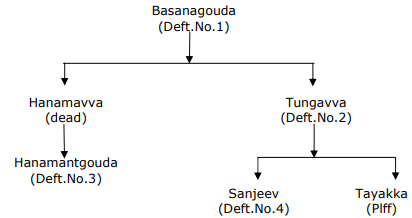
2. Basanagouda is the father of the plaintiff. Basanagouda had two wives, namely Hanamavva and Tungavva. Hanamavva was first wife. After the death of the first wife, he married second wife Tungavva. From first wife Hanamavva, he had a son by name Hanamantgouda. From second wife, he had two children, namely, Sanjeev and Tayakka. Tayakka is the plaintiff, Basanagouda is defendant No.1, Tungavva is defendant No.2, Hanamanthgouda is defendant No.3 and Sanjeev is defendant No.4 in O.S.No.22/2011.
3. The daughter from second wife Tayakka has filed a suit for partition claiming 1/5th share in the suit schedule properties. It is her contention that, the properties bearing Survey No.1/5 and 162 are the ancestral properties in the hands of her father Basanagouda and utilizing the income from the ancestral properties, he purchased the properties bearing Survey No.31/1 and 68/1. It is her contention that, she is having 1/5th share in the said properties. It is further pleaded that, item No.5 and 6 of suit schedule properties, namely residential houses, are also the properties inherited after the death of the father of defendant No.1.
4. The trial Court rejected the contention of the defendants relating to the limitation and previous partition held that the suit is in time and also concluded that there is no partition. Aggrieved by the judgment granting 1/5th share to the plaintiff in all the suit schedule properties, the defendant No.3 is in appeal.
5. It is urged on behalf of the appellant that, in the year 1991, there was a partition and in the said partition, the properties are divided among defendant No.1 and his son from the first wife and also the son from the second wife. Thus, it is urged as the partition has taken place in 1991, the plaintiff cannot claim share in the properties. It is also urged that the plaintiff could not have claimed any share because of the bar contained under Section 6 of the HINDU SUCCESSION ACT , 1956, as Section 6 will not enable the daughter to claim any share, in case partition has taken place prior to 2005.
6. Learned counsel for respondent No.1/plaintiff Sri.Sourabh Mirje would urge that, the contention relating to the previous partition is not established. In the cross-examination, the defendants have admitted that the arrangement made in the year 1991, reflected in Mutation Entry No.806, is only an arrangement to avail the benefit available to the small holders, as the Government scheme did not enable the big land holders to avail the benefit of the scheme. It is also his contention that, in the written statement the defendants have admitted that there is no partition in the family. It is his further contention that, the written statement would also reveal that the agricultural lands and two residential houses were the ancestral properties in the hands of the defendant No.1 and without there being any proof relating to separate income, the defendant No.1 cannot claim that the properties purchased by him are the self-acquired properties.
7. This Court has considered the contentions raised at the Bar and also perused the impugned judgment and decree.
8. On considering the contentions and perusal of the records, the following points arise for consideration:
i. Whether the appellant establish that item Nos.2 and 3 in the Schedule 'A' properties are the self-acquired properties of defendant No.1?
ii. Whether the defendant No.3 established that there was a partition in the year 1991?
9. As far as the question relating to the self-acquisition of it
AI
A daughter can claim a share in ancestral properties despite prior claims of partition if evidence for such partition is not established.

Joint family properties cannot be classified as self-acquired. Partition rights extend to all legitimate heirs, including daughters, affirming their claim to a share.


A claimant must prove the ancestral nature of properties to claim entitlement under the amended Hindu Succession Act; mere assertions without evidence are insufficient.
The principles of self-acquired versus joint family property were affirmed, establishing the burden of proof on those claiming joint ownership, and determining that mere possession does not suffice f....



An indispensable Tool for Legal Professionals, Endorsed by Various High Court and Judicial Officers
Please visit our Training & Support
Center or Contact Us for assistance

Scan Me!
India’s Legal research and Law Firm App, Download now!


For Daily Legal Updates, Join us on :



 Back to top


