
 Back
Back





IN THE HIGH COURT OF KARNATAKA (DHARWAD BENCH)
ANANT RAMANATH HEGDE, J.
Channappa and Ors. - Appellants
Versus
Chandrawwa and Ors. - Respondents
Regular First Appeal No. 1643 of 2005 (PAR-).
Decided on : 29-08-2023
| Table of Content |
|---|
| 1. overview of appeal and court decision. (Para 1 , 6 , 16) |
| 2. ownership and genealogy of suit properties. (Para 2 , 3) |
| 3. arguments regarding prior partition and property acquisition. (Para 4 , 7 , 8) |
| 4. court's rationale on property ownership and lack of partition evidence. (Para 5 , 11 , 12 , 13 , 14) |
| 5. final judgment on the legality of the trial court's decree. (Para 15) |
JUDGMENT :
Mr. Anant Ramanath Hegde, J. - Defendants No.1 and 2 in O.S.No.66/1995 are before this Court challenging the judgment and decree dated 02.09.2005, rendered in O.S.No.66/1995 on the file of the Principal Civil Judge (Sr.Dn.), Jamkhandi.
2. The suit is one for partition and separate possession. The admitted genealogy is as under:
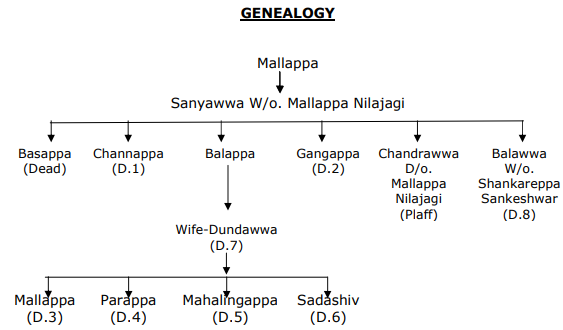
3. One Sanyawwa W/o.Mallappa Nilajagi, was the owner of the suit properties. This aspect is not in dispute. She had four sons and two daughters. Among four sons, the eldest son Basappa died issueless and he was a bachelor. The suit is filed by one of the daughter by name Chandrawwa. By the time the suit is filed, the third son Balappa was no more. The successors of Balappa, namely his wife and children were arrayed as defendants along with other defendants.
4. The suit was contested by the defendants on the premise that, the partition has already taken place in the family and in the said partition, Sanyawwa, the mother of the plaintiff, has given money to the plaintiff and plaintiff has purchased two properties from that money paid by the mother and as such, plaintiff is not entitled to the share in the suit properties. Alternatively, it is also contended that, assuming that there is no partition, the suit without including the two properties purchased in the name of the plaintiff, which were funded by the mother of the plaintiff, is not maintainable.
5. The trial Court after considering the rival contentions has held that the previous partition is not established. The trial Court also gave a finding that the properties standing in the name of the plaintiff are not the properties belonging to the joint family. Accordingly, the suit is decreed.
6. Aggrieved by the aforementioned judgment and decree, defendants No.1 and 2 are in appeal.
7. Learned counsel appearing for the appellants/defendants No.1 and 2 would contend that;
7.1. The plaintiff is a divorcee and after the divorce, she was staying with her mother and the mother taking sympathy towards her daughter, who is a divorcee, has contributed her money to purchase the properties in the name of the plaintiff and as such, plaintiff is not entitled to share in the joint family properties.
7.2. The contribution of fund by the mother of the plaintiff is treated as a share given to the plaintiff by the mother during her life time.
7.3. In the alternative, assuming that there is no partition, the properties purchased in the name of the plaintiff with the aid of the funds provided by the plaintiff's mother should be treated as joint family properties and the suit without including those properties standing in the name of the plaintiff is not maintainable.
8. Learned counsel for the respondent would contend that the trial Court is justified in dismissing the suit and it is also her contention that the properties are purchased 18 years after the death of the mother, as such, the contention that the mother has contributed fund to purchase the properties by the plaintiff is not acceptable.
9. This Court has considered the contentions raised at the bar.
10. The following point would arise for consideration:
"Whether the trial Court is justified in decreeing the suit of the plaintiff?
11. As could be noticed from the admitted genealogy, the properties originally belonged to Sanyawwa. There is no dispute over this fact. Sanyawwa died somewhere in the year 1975, as could be noticed from the admission in the cross-examination of DW1. The properties in the name of plaintiff were purchased 19 years after the death of Sanyawwa and there is no evidence to show that the plaintiff's mother has
AI


A daughter can claim a share in ancestral properties despite prior claims of partition if evidence for such partition is not established.

A party claiming self-acquisition of property within a joint family must provide substantial evidence; failure to do so, combined with existing partition evidence, undermines their claims.

Joint family properties must show evidence of shared ownership; individual earnings negate claims to partition.
The absence of evidence proving the joint family status of properties allows a presumption that they are individual assets; thus, plaintiffs' claim for partition is dismissed.
A plaintiff can only establish entitlement to partition if they demonstrate joint ownership and the failure to do so, particularly through admissions and evidence of prior partition, warrants dismiss....
Joint family properties cannot be classified as self-acquired. Partition rights extend to all legitimate heirs, including daughters, affirming their claim to a share.
The plaintiff must prove joint family property status to succeed in partition claims; mere assertion is insufficient. The burden of proof emphasizes the need for substantial evidence.
Oral relinquishments of joint family property rights are insufficient without written documentation; statutory rights persist despite prior agreements made by family members.



An indispensable Tool for Legal Professionals, Endorsed by Various High Court and Judicial Officers
Please visit our Training & Support
Center or Contact Us for assistance

Scan Me!
India’s Legal research and Law Firm App, Download now!


For Daily Legal Updates, Join us on :



 Back to top


