
 Back
Back





IN THE HIGH COURT OF KARNATAKA (DHARWAD BENCH)
ANANT RAMANATH HEGDE, J.
Smt Gangavva @ Suvarna and Ors. - Appellants
Versus
Smt Iravva and Ors. - Respondents
Regular First Appeal No. 3072 of 2011 (SP-).
Decided on : 04-10-2023
| Table of Content |
|---|
| 1. plaintiff claims partition of joint family properties. (Para 1) |
| 2. genealogy and property division among family members. (Para 3 , 4 , 5 , 7) |
| 3. claim regarding nature of properties as ancestral vs. self-acquired. (Para 6 , 10) |
| 4. arguments presented regarding the ownership of the properties. (Para 12 , 13) |
| 5. proof of joint family grant affecting property rights. (Para 15 , 16 , 17 , 19) |
| 6. plaintiff's entitlement to share in property. (Para 18 , 20) |
| 7. final decree on shares among parties. (Para 21 , 22) |
JUDGMENT :
Mr. Anant Ramanath Hegde, J. - This appeal is by the plaintiff. The suit for partition is dismissed.
2. The genealogy of the parties is as under:
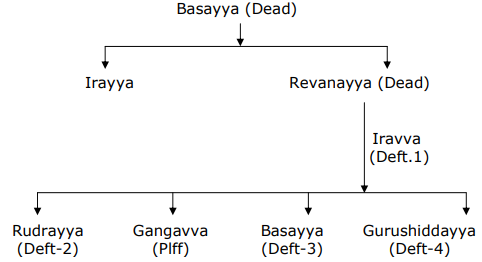
3. One Basayya was the propositus. He had two sons, Irayya and Revanayya. Revanayya married Iravva and from the marriage the couple had three sons namely Rudrayya, Basayya and Gurushiddayya and one daughter Gangavva.
4. The suit is filed by Gangavva against her mother Iravva and brothers Rudrayya, Basayya and Gurushiddayya. The date of death of Revanayya is not furnished in the pleadings but it is admitted that Revanayya died many years prior to filing of the suit. The suit properties are the properties bearing Sy.No.114/C2 measuring 35 guntas and Sy.No.114/C3 measuring 35 guntas and Sy.No.114/C4 measuring 35 guntas in Rayanal village, Taluk Hubballi.
5. The suit is filed on the premise that the properties were allotted to the share of the branch of Revanayya after the death of Revanayya, in a partition between Irayya and branch of Revanayya. The plaintiff claims after the division of the properties between Irayya and branch of Revanayya there is no further division of properties among the plaintiff and the defendants.
6. The defendants disputed the claim of the plaintiff on the premise that the properties are not ancestral properties. It is their case that the properties were granted to their father's brother namely Irayya and Irayya out of love and affection, transferred the properties exclusively in the names of Rudrayya, Basayya and Gurushiddayya on 13.03.1994 and thus, the defendants prayed for dismissal of the suit.
7. The trial Court has accepted the defence that the properties are the self-acquired properties of Irayya and exclusively transferred to defendants No.2 to 4.
8. In the suit, the plaintiff has also impleaded her mother as defendant No.1 and one Mr. Roshanlal as defendant No.5 and Durgappa as defendant No.6. It is stated that Roshanlal and Durgappa were agreement holders who proposed to purchase the properties from defendants No.2 to 4.
9. The mother Iravva remained exparte. Rudrayya defendant No.2 contested the suit. Defendants No.3 and 4 remained exparte. The trial Court has accepted the plea of defendant No.2 that the suit schedule properties are self-acquired properties of Irayya and on that basis has dismissed the suit.
10. The trial Court has also accepted the defence of respondent No.2 that the suit is bad for non-joinder of necessary parties as Irayya, the original grantee is not made a party.
11. Aggrieved by the aforesaid judgment and decree, the plaintiff is in appeal.
12. Sri.Mallikarjunswamy B Hiremath, the learned counsel appearing for the appellants would urge that the properties are not exclusive properties of Irayya, they were joint family properties allotted in the name of Irayya and the joint family comprised Irayya and his brother Revanayya. It is also the contention that when the properties were granted, his brother Revanayya was alive and Irayya and Revanayya were living together and acknowledging the fact that the properties are granted jointly, Irayya effected partition between himself and children of Revanayya excluding the plaintiffs' mother and the plaintiff. Thus, he would urge that the trial Court has erred in holding that the properties are self-acquired properties of Irayya.
13. Learned counsel for the respondents would submit that the trial Court is justified in dismissing the suit as the suit properties are self-acquired
AI
Joint family properties cannot be classified as self-acquired. Partition rights extend to all legitimate heirs, including daughters, affirming their claim to a share.
A daughter can claim a share in ancestral properties despite prior claims of partition if evidence for such partition is not established.


The court ruled that an oral partition established the properties as separate and self-acquired, barring claims for partition after 18 years and validating a gift deed executed by the coparcener.
A claimant must prove the ancestral nature of properties to claim entitlement under the amended Hindu Succession Act; mere assertions without evidence are insufficient.

Joint family properties are established through contributions from family income, and the validity of a gift deed in such cases necessitates consent from all joint owners.
A joint family property remains so despite claims of prior partition; a coparcener retains rights to inheritance under the Hindu Succession Act.

The absence of evidence proving the joint family status of properties allows a presumption that they are individual assets; thus, plaintiffs' claim for partition is dismissed.



An indispensable Tool for Legal Professionals, Endorsed by Various High Court and Judicial Officers
Please visit our Training & Support
Center or Contact Us for assistance

Scan Me!
India’s Legal research and Law Firm App, Download now!


For Daily Legal Updates, Join us on :



 Back to top


