


 Back


2025 Supreme(Kar) 1125
IN THE HIGH COURT OF KARNATAKA AT BENGALURU
ANANT RAMANATH HEGDE, J.
Kuntagirinaika, Since Dead His Lrs - Appellant
Versus
Dasanaika @ Dharmanaika, S/O Dasanaika - Respondent
Regular Second Appeal No. 362 of 2013 (PAR)
Decided on : 09-09-2025
For the Appellant :Smt Anusha Asundi, Advocate For Sri. A Madhusudhana Rao, Advocate
For the Respondent:Smt H R Renuka Advocate
In partition suits, property in a woman's name is presumed self-acquired unless proven otherwise, but if acquired with joint family income, it is joint family property.
Headnote:(A) Hindu Succession Act, 1956 - Section 14 - Partition of joint family properties - Claim for partition by youngest son upheld; first defendant asserts property is self-acquired and not joint family - Courts concluded properties belong to joint family - Challenge regarding execution of Will dismissed as findings on proof of Will lacking judicial scrutiny. (Paras 5-19)
(B) Burden of proof - In partition suits, burden shifts to defendants to show properties are self-acquired once plaintiff establishes joint family. (Para 7)
(C) Legal principles established - Property in the name of a woman is presumed to be her self-acquired unless disproven; however, if acquired with joint family income, it constitutes joint family property. (Paras 18-20)
Facts of the case:
The appeal involves familial disputes over property inheritance after the death of the propositus. The plaintiff claims joint family property while the eldest son argues certain properties are self-acquired. The trial and first appellate courts ruled in favor of partitioning as joint family property with adjustment for item No.5.
Findings of Court:
The properties were primarily held to be joint family holdings except for item No.5, which was attributed to the mother with certain shares delineated.
Issues: The main issues included the classification of item No.5 property and whether the execution of a Will was adequately proven.
Ratio Decidendi: The court held that properties in the name of a woman carry a presumption of self-acquisition, but this presumption can be rebutted by demonstrating they were acquired with joint family income. The findings on the Will's execution needed a conclusive judicial assessment.
Result: Appeal allowed-in-part; sharing arrangements established for the contested properties.
| Table of Content |
|---|
| 1. parties are related in a joint family case. (Para 2) |
| 2. defendant claims item is self-acquired. (Para 3 , 4 , 9 , 10 , 12) |
| 3. trial court ruled properties as joint family. (Para 5 , 6) |
| 4. need to determine self-acquired vs joint family property. (Para 15 , 16 , 17 , 18) |
| 5. property acquisition evidence debated. (Para 19 , 21 , 22 , 24) |
| 6. will execution linked to property ownership. (Para 25 , 29 , 30) |
| 7. final order regarding property distribution. (Para 31) |
JUDGMENT :
This appeal is against concurrent finding in a suit for partition and separate possession. The relationship of the parties is not in dispute. The genealogy reads as under:
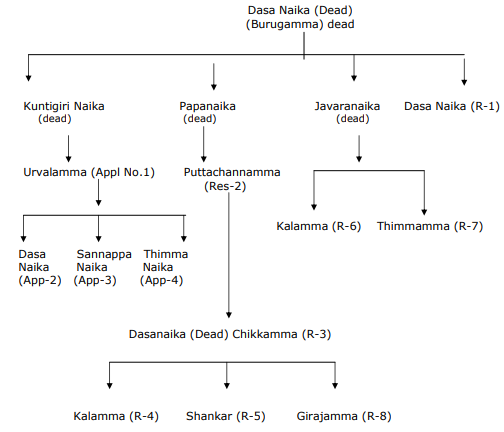
2. One Sri.Dasanaika was the propositus, his wife was Smt.Burugamma. The couple had four sons Sri.Kuntigirinaika, Sri.Papanaika, Sri.Javaranaika and Sri.Dasa Naika. The suit is filed by youngest son Sri.Dasa Naika, claiming that all the properties are joint family properties inherited after the demise of Sri.Dasanaika the propositus and claimed 1/4th share.
3. Defendant No.1-Kuntagirinaika i.e., eldest son of the propositus urged that item No.5 is the self acquired property of his mother Burugamma, who purchased the property under the registered sale deed dated 01.07.1963, marked as Ex.P.6. The property was purchased for a consideration of Rs.50/-, which according to defendant No.1 is the self earning of his mother Burugamma, who was a vegetable vendor. He further contended that his mother Burugamma executed a registered Will dated 04.10.1991 bequeathing the said property in his favour. Thus, defendant No.1 would urge that the claim for partition in the said property is not maintainable.
4. Defendant No.1 also took a defense of previous oral partition. Thus, he prayed for dismissal of the suit.
5. The Trial Court has concluded that all the properties are joint family properties and granted a decree for partition holding that the plaintiff is entitled having 1/4th share.
6. Aggrieved by the judgment and decree, legal representatives of the deceased Sri.Kuntagirinaika filed First appeal, which is also dismissed confirming the judgment and decree.
7. This appeal was admitted on 25.09.2013 to answer the following substantial question of law.
"In a suit for partition, as the plaintiff seeks partition on the assertion that they are members of the joint family and where properties are divisible amongst the heirs, is not the burden on the plaintiff to prove it initially, or when does the burden shift on the defendant to prove that some of the properties are self-acquired?"
8. Learned counsel for the appellants would contend that contesting defendant No.1 raised a plea relating to execution of Will by his mother, Burugamma. Will is produced and the evidence is led to prove the execution of Will. However, the Trial Court has not recorded any finding on the proof of execution of Will. The Trial Court preceded on the assumption that item No.5 property is the joint family property though purchased in the name of Burugamma, as such there is no need to record any finding relating to execution of the Will. First Appellate Court also committed the same mistake is the submission.
9. It is further urged that the property in the name of Burugamma is presumed to be the self acquired property unless proven otherwise. The presumption is stronger since the property is in the name of a woman. It is also urged that property acquires the characteristic of 'Stree dhana'. Reference is made to Section 14 of the HINDU SUCCESSION ACT , 1956 and urged that the property in the name of Burugamma is her absolute property and she was capable of disposing of the said property in the manner she liked and defendant No.1 being the differently abled person, was living with the mother and the mother executed the Will bequeathing the said property in favour of the defendant No.1. It is urged that the finding of the Trial Court that the property at item No.5, is the joint family property is not supported by any evidence and the find







