
 Back
Back





IN THE HIGH COURT OF BOMBAY
G.A. Sanap, J.
Sachin - Appellant
Versus
Divisional Commissioner - Respondent
Criminal Writ Petition No. 253 of 202 3
Decided On : 10-07-2023
EXTERNMENT - Maharashtra Police Act, 1951 - Sec. 56(1)(a), Sec. 56(1)(b) - The court discussed the provisions of Sec. 56 of the Maharashtra Police Act, 1951, which allows for the externment of individuals whose actions are deemed to cause alarm or danger to persons or property. The court emphasized the necessity of objective material to support subjective satisfaction for externment orders. It highlighted the importance of a live link between past crimes and the current externment proceedings, and the need for proper verification of witness statements. The court found that the externment order lacked sufficient justification and was excessive, leading to its quashing.
Fact of the Case:
The petitioner sought to quash an externment order issued by the Deputy Commissioner of Police, which was upheld by the Divisional Commissioner. The externment was based on several past crimes and confidential witness statements, but the petitioner argued that many of the crimes were stale and under investigation, and that the witness statements were not properly verified.
Finding of the Court:
The court found that the externment order was flawed due to the reliance on stale crimes without a live link to current threats. It noted that the subjective satisfaction of the authorities was not supported by objective material, and the verification of witness statements was inadequate. The court concluded that the externment order was excessive and lacked proper justification.
Issues: Whether the externment order was justified based on the crimes cited, whether there was a live link between those crimes and the externment, and whether the petitioner was given a fair opportunity to respond to the allegations against him.
Ratio Decidendi: The court held that for an externment order to be valid, there must be a clear connection between the past actions of the individual and the current threat posed, supported by objective evidence. The court also emphasized the need for proper verification of witness statements and the requirement for authorities to provide adequate reasons for the severity of the externment.
Final Decision: The court quashed the externment order and the confirming order from the Divisional Commissioner, ruling that both were unsustainable due to lack of justification and excessive nature.
JUDGMENT/ORDER
1. Rule. Rule made returnable forthwith. Heard finally with the consent of learned Advocates for the parties.
2. In this writ petition, the petitioner has prayed for quashing the order of externment passed by the respondent No.2- Deputy Commissioner of Police, Zone-1, Amravati dtd. 3/3/2022 and the order in appeal dtd. 17/2/2023 passed by the respondent No.1-Divisional Commissioner, Amravati, District Amravati. The respondent No.2 initiated the proceedings for externment of the petitioner from Amravati District by invoking the provisions of Sec. 56(1)(a) & (b) of the Maharashtra Police Act, 1951 (hereinafter referred to as "the Act of 1951"). The respondent No.2 to record his subjective satisfaction, relied upon the following crimes. The said crimes are set out hereinbelow in tabulated form:
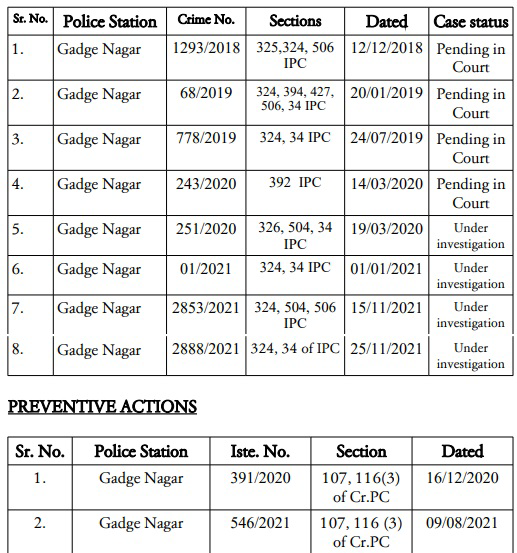
3. Besides above crimes, the respondent No.2 placed heavy reliance upon the confidential in-camera statements of two witnesses. On the basis of the crimes and the confidential in-camera statements of the witnesses, the respondent No.2 recorded a satisfaction that the activities of the petitioner are fully covered under the provisions of Sec. 56(1)(a) & (b) of the Act of 1951 and as such warranting his externment.
4. The respondent No.2 conducted necessary inquiry. He issued a notice to the petitioner on 15/2/2022 to show cause as to why he should not be externed from the Amravati District. The respondent No.2, based on the material collected, passed the order of externment on 3/3/2022. The petitioner challenged the said order by filing an appeal before the respondent No.1. The respondent No.1 vide order dtd. 17/2/2023, dismissed the appeal and confirmed the said order.
5. I have heard Mr. S. B. Gandhe learned Advocate for the petitioner and Ms Mayuri H. Deshmukh, learned APP for the respondents/State. Perused the record and proceedings.
6. Learned Advocate for the petitioner submitted that orders passed by the respondent Nos. 1 and 2 cannot be sustained at all as on the date of the notice and the order of externment out of the eight crimes the four crimes were under police investigation. Learned Advocate submitted that four stale crimes were taken into consideration to record the subjective satisfaction. Learned Advocate submitted that these crimes could not have been considered for recording the subjective satisfaction. There was no live link between those crimes as well as the externment proceeding initiated in the year 2022. Learned Advocate further submitted that the statements of the confidential witnesses were not properly verified to place reliance on the same. Learned Advocate further submitted that in the show cause notice dtd. 15/2/2022 the substance of statement of the witnesses, was not stated. The petitioner, therefore, did not get an opportunity to deal with the show cause notice properly. Learned Advocate submitted that the petitioner had replied the notice vide reply notice dtd. 28/2/2022. Learned Advocate further submitted that two chapter cases, wherein the petitioner has executed bonds were taken into consideration. Learned Advocate further submitted that the order of externment from the entire Amravati District and that too for a period of two years was excessive. Learned Advocate pointed out that no reasons have been recorded in the order for warranting the externment of the petitioner from entire Amravati District and that too for a period of two years. On all these grounds the learned Advocate submitted that the order of externment passed by the respondent No.2 and confirmed in appeal by respondent No.1 deserves to be quashed and set aside.
7. Learned Additional Public Prosecutor for the respondents submitted that continuous indulgence in the commission of serious crimes till the issuance of show cause notice weighed with the respondent No. 2 to record the satisfaction that the movements and acts likely to cause danger or harm to the person or property. Learned APP on the basis of the statements of the confi
AI
An externment order under the Maharashtra Police Act must be based on objective material demonstrating a live link between past actions and current threats, with proper verification of witness statem....


An externment order must be based on objective material, comply with legal requirements, and be justified by extraordinary circumstances. It must also consider the execution and breach of bonds for g....
The main legal point established in the judgment is that an externment order must be based on subjective satisfaction arrived at on the basis of objective material, and strict compliance with the leg....
The subjective satisfaction for externment must be based on objective material, and the order must pass all legal tests, including strict compliance with the relevant act and consideration of extraor....
Externment orders must demonstrate a clear live-link between recent activities and the necessity for such measures.

Order of externment is an extraordinary measure – As in case of any other administrative order, judicial review is permissible on the grounds of mala fide, unreasonableness or arbitrariness.



An indispensable Tool for Legal Professionals, Endorsed by Various High Court and Judicial Officers
Please visit our Training & Support
Center or Contact Us for assistance

Scan Me!
India’s Legal research and Law Firm App, Download now!


For Daily Legal Updates, Join us on :



 Back to top


