
 Back
Back





IN THE HIGH COURT OF BOMBAY
G.S.Patel, Kamal Khata, JJ.
Sheth Developers Pvt Ltd - Appellant
Versus
Municipal Corporation of City of Thane - Respondent
Writ Petition No. 12362 of 2023
Decided On : 01-11-2023
| Table of Content |
|---|
| 1. background on the buy-back policy disputed. (Para 3 , 4 , 5 , 6) |
| 2. actions of tmc regarding buy-back policy. (Para 12 , 14 , 19) |
| 3. assert the doctrine of promissory estoppel preventing tmc from acting arbitrarily. (Para 17 , 26 , 29 , 35 , 51 , 53) |
| 4. court's observations on government assurances. (Para 21 , 22 , 30 , 55) |
| 5. discusses the procedural obligations of tmc in administrative law. (Para 25) |
| 6. legal doctrines of promissory estoppel and legitimate expectations. (Para 28 , 39 , 54) |
| 7. final ruling on the case. (Para 56 , 57) |
JUDGMENT/ORDER
G.S.PATEL, J. - Rule. by consent returnable forthwith.
2. There is an Affidavit in Reply on behalf of Respondents Nos 1 to 3, the Thane Municipal Corporation ("TMC").
3. The dispute pertains to the decision of the TMC to purportedly keep in "abeyance" its proclaimed Buy-Back Policy ("BBP"). This was a policy for the buy-back of lands acquired under Development Control Regulations ("DCR") and of plots reserved under the sanctioned Development Plan ("DP") for public use. The policy was always subject to certain terms and conditions.
4. This Petition under Article 226 of the Constitution of India assails not only the general direction to keep this policy in abeyance but the failure of the TMC to honour the terms of that policy after the TMC has received benefit under it and after the Petitioners have acted on the assurances contained in their policy, significantly altering their position to their prejudice. Of necessity, at least part of the Petition invokes principles of promissory estoppel or legitimate expectations.
5. By and large, the facts are not contentious. On 1/10/2003, the Petitioners acquired development rights over 1, 15, 018 sq mts of land from Voltas Ltd ("Voltas"). The two parties had a Development Agreement. This was registered.
6. On 2/5/2016, the Maharashtra Government notified an 'Accommodation Reservation Policy'. This policy was intended to transfer the burden of developing reserved plots to private land owners or developers in consideration of certain incentives. To explain more clearly what this means, various plots in the command area of the TMC, which is the planning authority under the Maharashtra Regional And Town Planning Act, 1966 ("the MRTP Act") were reserved for various public purposes, amenities and so forth in the sanctioned DP. Ordinarily, these reservations would have had to be developed by the TMC for public use.
7. If there was not an actual acquisition for monetary compensation of a reservation, with all its attendant of lapsing, the owner/developer would obtain development benefits in lieu of the reservation. There are cases where the condition is that the developer is to construct the amenities (typically a municipal market, for instance, or a playground, a dispensary, bus station, fire stations and so on) and hand these over free of cost to the TMC, in consideration of which the developer gets additional buildable area.
8. The present policy of 2/5/2016 allowed the owners/developers to retain a part of the reserved plot for private development and provided additional Floor Space Index ("FSI") or Transferable Development Rights ("TDR") benefits for the reserved area. While this remained in the form of a policy, it was later incorporated in the finally sanctioned UNIFIED DEVELOPMENT CONTROL AND PROMOTION REGULATIONS 2020 for Maharashtra State ("UDCPR 2020") under Regulation 11(1). A copy of the policy is at Exhibit "B" to the Petition.
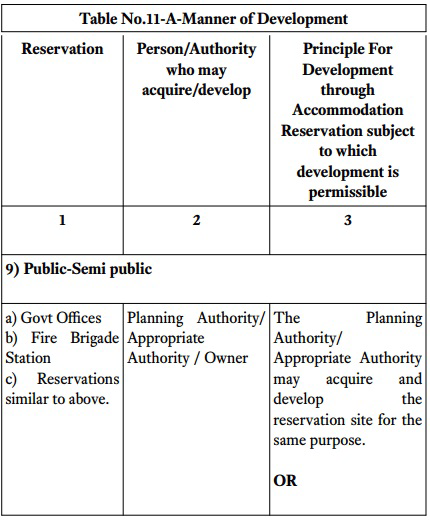
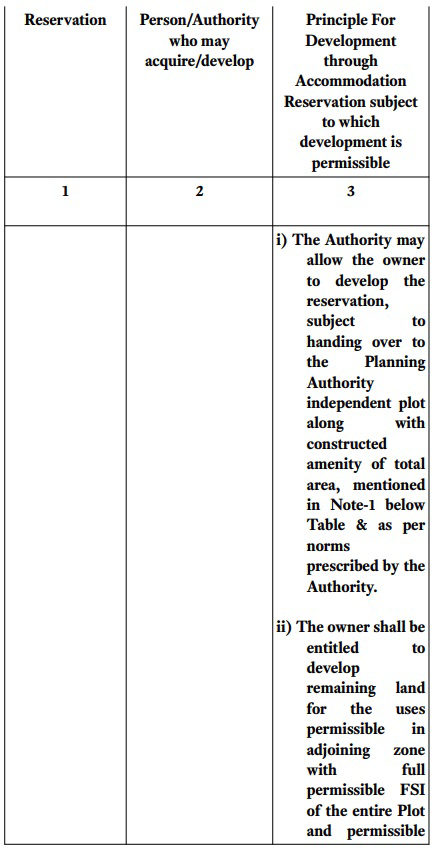
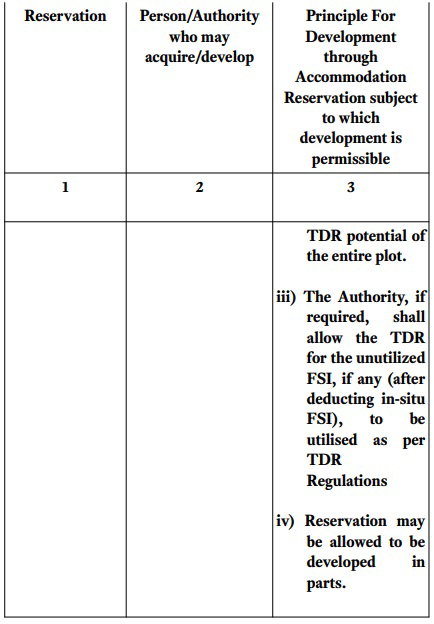
9. We come directly to Regulation 11 of the UDCPR 2020 at Exhibit "C". Regulation 11(1) is captioned as "Manner of Development of Reserved Sites in Development Plan (Accommodation Reservation Principles)". In Table 11-A, the manner of development of various types of facilities are set out. In almost all of them, there is an option available to the Planning Authority. For example, where there is a recreational reservation, instead of acquiring and developing the land, the authority will retain 70% of
AI

The main legal point established in the judgment is the binding nature of promissory estoppel on the Municipal Corporation of Greater Mumbai (MCGM) and the invocation of legitimate expectations to co....

Important points:In exercise of the powers conferred by Section 7 of the Kerala Land Assignment Act, 1960 (Act 30 of 1960), and in supersession of the rules for assignment of Government lands issued ....

The court held that the Corporation of Kozhikode's decision to sell a portion of the property acquired for public road to respondents 3 to 5 was not tainted with malafides and was in accordance with ....

The doctrine of proportionality and reasonableness applies to judicial review of administrative action, guiding the assessment of infringement and the proportionality of the official decision.

Review jurisdiction is limited to correcting apparent errors and cannot serve as an appeal; land reserved for public purposes under the prior act remains non-alienable unless specific actions under t....
Notification permitting 75% TDR utilisation via premium payment upheld; complies with MRTP Act procedure, within rule-making powers under Section 22(m), not ultra vires or manifestly arbitrary, addre....



An indispensable Tool for Legal Professionals, Endorsed by Various High Court and Judicial Officers
Please visit our Training & Support
Center or Contact Us for assistance

Scan Me!
India’s Legal research and Law Firm App, Download now!


For Daily Legal Updates, Join us on :



 Back to top


