


 Back
Back





2024 Supreme(Cal) 1587
IN THE HIGH COURT AT CALCUTTA
Rajasekhar Mantha, Ajay Kumar Gupta, JJ.
Smt. Lipika Das & Ors. LRs of (Dhirendra Nath Chandra since deceased) – Petitioner
Versus
Kakali Dasgupta & Ors. LRs of (Jitendra Nath Dutta since deceased) – Respondent
F.A. No. 261 of 1997 With CAN 12 of 2023
Decided On : 30-09-2024
For the Appellant : Mr. Sanjib Bandyopadhyay Mr. Manoj Kumar Mondal
For the Respondent: Mr. Aniruddha Chatterjee, Mr. Rahul Karmakar, Ms. Gargi Goswami
JUDGMENT :
Rajasekhar Mantha, J.
1. The appeal is directed against the judgment and decree passed in T.S. No. 92 of 1983, dated 28th August, 1995, by the 4th Assistant District Judge, Alipore.
I. FACTS OF THE CASE
2. The appellants are the legal heirs of the original defendants and the respondents are the legal heirs of the original plaintiff, in the suit before the learned Trial Court. They are all decendants of one Late Prafulla Chandra Dutta.
3. Prafulla Chandra Dutta owned two plots of land- one at 86/3/1, Beltala Road, P.S. Bhowanipore, District 24 Parganas and another, at the Northern and Southern parts of the premises no. 7/2/1, Garcha Second Lane, Dover Terrace P.S. Gariahat, District- 24 Parganas. He was a clerk at the P&T department. It is therefore unlikely that he had enough income to buy the aforesaid properties. In a Trust deed of the year 1961 he stated and acknowledged that his wife contributed substantially from her Stridhan in the purchase of the said properties.
4. Prafulla’s wife was Uma Rani. They had 6 daughters namely Roma Rani, Sushama Rani, Bela Rani, Maya Rani, Rina Rani and Deepa Rani. They also had 2 sons Jitendra Nath and Rabindra Nath.
5. For the effective management and administration of the two properties during his lifetime and thereafter, he drew up a family management dated 31st May, 1961 and settled the same into a trust called the “Prafulla Chandra Family Trust” (the said Trust or family arrangement).
6. Curiously, in the Paper-books prepared by the plaintiff/respondents, a distorted and incomplete typed copy of the said family arrangement of 1961 has been annexed. Clause 3 of the said document is incomplete. Even more curiously the said original family settlement that was initially available, has gone missing, from the Trial Court records, in course of final hearing.
7. The table below indicates the scheme of the said trust/family arrangement:-
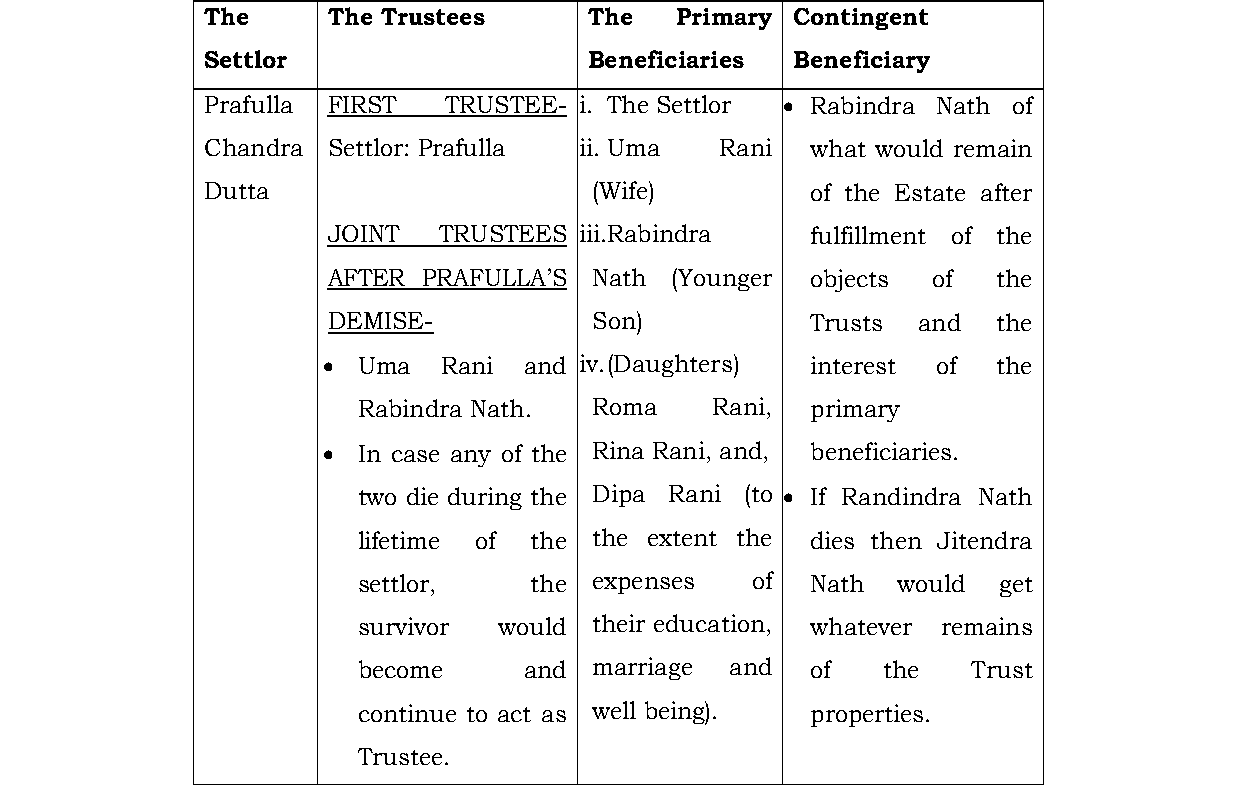
8. It transpires from the evidence on record that Jitendra Nath fell out bitterly with his father and mother, when he married the daughter of a tenant in the properties against the latter’s wishes. He was working as a group C employee in the ZSI and was transferred to Jodhpur in Rajasthan immediately after his marriage, in the year 1960.
9. The Settlor did not trust Jitendra Nath, the elder son/plaintiff, to take care of his wife or his daughters or the younger son. Clauses 4 and 6 clearly specify that Jitendra Nath was well settled. Prafulla did not want Jitendra Nath to have any right in the properties. Jitendra Nath lived with his family, separately from his father’s family. Prafulla ensured that Jitendra could not ever be a Trustee. It is only after the fulfillment of the objects of the Trust, and the demise of Rabindra Nath that any residual estate was to go to Jitendra Nath. If Rabindra Nath survived, he was to become the absolute owner of the trust properties, to the complete exclusion of Jitendra Nath.
10. Unfortunately for Prafulla, his younger son Rabindra Nath predeceased him in 1965. Prafulla was still the sole trustee. The Family Trust of 1961 would therefore not have “joint trustees” after his death. His wife Uma Rani would remain sole trustee. Due to the expression Joint Trustees in the Trust Deed Prafulla thought that his wife would be unable to function as Trustee. This was clearly a misconception. Clause no. 3 of the 1961 deed stipulated that Uma Rani would become the Sole Trustee in case Rabindra Nath died.
11. To purportedly remedy the above, he executed a rectification deed to the parent Trust deed on 17th September, 1965. The rectification deed clarified and declared that the word “trustees”, in the deed of 1961 be read as “Trustee” to enable Uma Rani to act as sole trustee to carry on the objects and purposes of the Trust. The amendment was quite unnecessary.
12. During his lifetime, Prafulla got four of his daughters Rama, Sushama, Bela and Maya married. After his death, Uma Rani performed Rina Rani’s marriage in 1969-70 and Dipa Rani’s we












