Back
Back





2024 Supreme(Chh) 480
IN THE HIGH COURT OF CHHATTISGARH AT BILASPUR
RAKESH MOHAN PANDEY, J.
Bodhiram, S/o. Samelal – Appellant
Versus
Chandrika Bai, Widow of Late Sukhiram – Respondent
SA No. 350 of 2005
Decided on : 14-10-2024
For the Appellant :Mr. B. P. Sharma, Advocate with Mr. M. L. Sakat, & Ms. Samiksha Gupta, Advocates
For the Respondents: Mr. Dharmesh Srivastava, Mr. Pranjal Shukla, Panel Lawyer
IMPORTANT POINT
The presumption of legitimacy under Section 112 of the Indian Evidence Act cannot be rebutted by oral evidence if the child is born more than 280 days after the father's death.
Headnote:
(A) Indian Evidence Act, 1872 – Section 112 – Civil Procedure Code, 1908 – Section 96 – Legitimacy of a child born posthumously – The court held that the presumption of legitimacy under Section 112 cannot be rebutted by oral evidence when the child is born more than 280 days after the father's death. The appeal was allowed, declaring the plaintiff as the exclusive owner of the suit property. (Paras 22, 23, 24)
(B) Appeal maintainability – The court ruled that an appeal can only be preferred against a decree, not merely a finding, and the defendants were not aggrieved by any decree. (Paras 20, 21)
ORDER :
RAKESH MOHAN PANDEY, J.
1) This appeal was admitted on 22.12.2005 and the following substantial question of law was framed:-
“Whether the learned lower appellate Court was justified in holding that Dukhi Ram is the legitimate son of Samay Lal by drawing presumption under Section 112 of the Evidence Act particularly in the light of the established fact that the mother of Dukhi Ram did not remain unmarried at the time of giving birth to Dukhi Ram?”
2) Later on, an additional substantial question of law was formulated on 30.09.2024 as under:-
“Whether the first appeal preferred by the defendants under Section 96 of the CPC before the learned Court below was maintainable particularly when no judgment and decree was passed against them?”
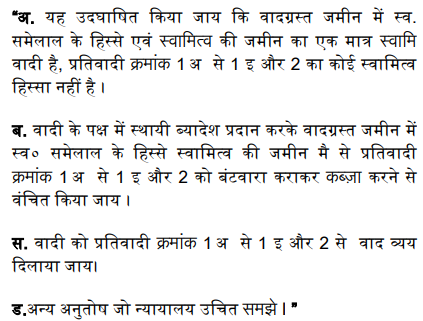
3) The appellant/plaintiff filed a civil suit for declaration of title and permanent injunction over the suit property described in Schedule - A to E of the plaint inter-alia on the ground that he is the sole legal heir of Late Samelal. The total area of suit land is 10.14 acres. It is further pleaded that late Dukhiram was born 300 days after the death of his father, namely, Late Samelal, therefore, legally, he was not the biological son of Late Samelal and he has no right over the suit property.
4) In the written statement, the defendants pleaded that at the time of the death of Late Samelal, the mother of Late Dukhi Bai, namely, Smt. Dulari Bai was pregnant and the late Dukhiram was in her womb.
5) The learned trial Court framed issues and held that the plaintiff is not the sole successor and owner of the suit property. Late Dukhiram/original defendant No.1 is not a biological son of Late Samelal, and the suit was also found barred by the limitation. Other issues were not found proved, and thus, the suit was dismissed.
6) The defendants who are legal heirs of the late Dukhiram filed a civil appeal according to the provisions of Section 96 of the CPC before the learned First Additional District Judge (FTC) Kabirdham, which was registered as Appeal No. 14A/2004.
7) The defendants raised grounds that Samelal died on 27.03.1956 and at that time late Dukhiram was in the womb of Dularibai therefore, Late Samelal was his biological father.
8) It is also stated in the memo of appeal that witnesses, namely, Radhabai (DW/2), Gulababai (DW/3), Milapabai (DW/4) and Dularibai (DW/5), have admitted the fact that at the time of the death of Late Samelal, Dukhiram was in the womb of Dularibai. Learned First Appellate Court after taking into consideration the oral and documentary evidence held that Late Dukhiram was the biological son of Late Samelal, and therefore, he has right over the suit property.
9) Mr. B. P. Sharma, learned counsel appearing for the appellant/plaintiff would submit that late Samelal died on 27.03.1956, whereas the date of birth of Late Dukhiram is 09.01.1957. He would further submit that Late Dukhiram was born 293 days after the death of Late Samelal and according to the provisions of Section 112 of the Evidence Act, he cannot be held as biological son of Late Samelal. He would also submit that the defendants failed to prove the fact that Late Dukhiram was born within 280 days from the date of death of Late Samelal and thus, the learned first appellate Court committed an error of law in deciding this issue.
10) Mr. Sharma would argue that the suit was filed by the plaintiff and the same was dismissed by the learned trial Court. He would further argue that no counter claim was filed by the defendants, in spite of this fact, the defendants filed the first appeal according to the provisions of Section 96 of the CPC before the learned First Appellate Court whereas there was no judgment and decree against the defendants, therefore, the appeal preferred by the defendants was not maintainable at all and the judgment and decree passed by the learned first appellate Court is a nullity. In support thereof, he placed reliance on the judgment passed by the Hon’ble Supreme Court in the matter of Hardevin