
 Back
Back





IN THE HIGH COURT OF CHHATTISGARH AT BILASPUR
RAJANI DUBEY, SANJAY KUMAR JAISWAL, JJ.
Smt. Neha Chandra, W/o Vikash Chandra – Appellant
Versus
Vikash Chandra, S/o Aanand Kumar Chandra – Respondent
FA(MAT) No. 132 of 2023
Decided on : 25-10-2024
(A) Hindu Marriage Act, 1955 – Sections 13(1-A) and 13(1B-ii) – Divorce – Decree granted on grounds of conversion to Christianity and abandonment of Hindu rituals – The trial court found that the appellant/wife had not followed Hindu practices for over ten years and had demeaned the respondent's religious beliefs. (Paras 1, 5, 9, 26, 28)
(B) Conversion and Mental Cruelty – The court noted that the appellant's refusal to participate in Hindu rituals and her derogatory remarks towards Hinduism constituted mental cruelty towards the respondent. (Paras 27, 28)
Facts of the case:
The marriage was solemnized on 07.02.2016 under Hindu rites. The respondent filed for divorce citing the appellant's conversion to Christianity and abandonment of Hindu practices.
Findings of Court:
The trial court found sufficient evidence of the appellant's conversion and lack of adherence to Hindu rituals, granting the divorce. Issues: The main issues included whether the appellant had converted to Christianity and whether her actions constituted grounds for divorce under the Hindu Marriage Act.
Ratio Decidendi: The court upheld the trial court's findings, emphasizing that conversion to another faith without consent is a valid ground for divorce under the Hindu Marriage Act.
Result: Appeal dismissed; respondent directed to pay Rs.5 lacs as permanent alimony.
JUDGMENT :
Per Rajani Dubey, J.
1. This appeal is directed against the judgment and decree dated 05.04.2023 (Annexure A-1) passed by the learned Principal Judge, Family Court Bilaspur, District- Bilaspur (C.G.) in Civil Suit No. 29-A/2021 whereby the application under Section 13(1-A) 13(1B-ii) of the Hindu Marriage Act filed by the respondent/husband for grant of decree of divorce, was allowed.
2. Before learned trial Court, it is an admitted fact that both the appellant and the respondent are governed by the Hindu religion and marriage between the parties was solemnized on 07.02.2016 at Bilaspur in accordance with Hindu rites and rituals.
3. Applicant/respondent herein filed application under Section 13(1-A) 13(1B-ii) of Hindu Marriage Act against the non-applicant/ appellant herein on this ground that the Applicant/respondent has been residing in Delhi since 2005 and is employed in a private company. He lives in a rented house. Non-applicant/appellant is employed as a teacher in Saint Xavier’s School. After marriage, the non-applicant went to Delhi for a few days but by quarelling over petty matters, she deprived the applicant of marital happiness. She abandoned the Hindu religion and adopted Christianity. She also suspected the fidelity of the applicant/respondent. Non-applicant/wife did not want to live in Delhi whereas the applicant/husband is the only son in his family. Non-applicant/wife did not follow the Hindu rituals and also threatened the applicant/husband to implicate him in a false case.
4. In her reply, non-applicant/wife denied all the allegations levelled by the applicant/husband against her and stated that the applicant/husband and his family members used to follow the Christianity and due to which, she got acquainted with him. She did not abandon the traditions of Hindu religion and also she never suspected the fidelity of the applicant/husband. Further, she wants to live with the applicant/husband. She was tortured by the applicant/husband for demand of dowry. The applicant/husband himself abandoned her. She is willing to live in a joint family.
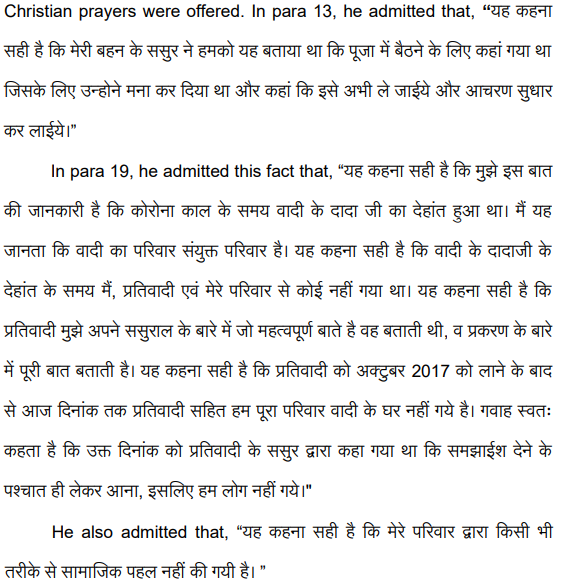
5. Learned trial Court after appreciating the oral and documentary evidence and further on this ground that the non-applicant/wife converted herself from Hindu religion to Christian religion, granted decree of divorce in favour of the the respondent/husband. Hence, this appeal has been filed by the appellant/wife.
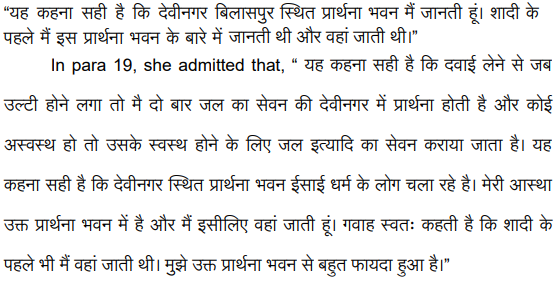
6. Learned counsel for the appellant submits that the impugned judgment and decree dated 05-04-2023 (Annexure A-1) passed by the learned Family Court is bad in law as well as the facts and circumstances of the case, and therefore is liable to be set aside. The learned Family Court did not appreciate the evidence in its proper perspective. Learned Family Court did not consider the statements of the appellant and her witnesses properly which is perverse and against the law. The learned Family Court ought to have considered that only her going to place of Lord Jesus and believing that she would cure from the sick and bad health, is not a ground proving that the appellant/wife has converted herself from Hindu religion to Christian religion.
She further submits that the learned Family Court ought to have considered that as to what is the proceeding of converting from Hindu religion to Christian religion and whether wife/appellant entered to the Baptism Proceeding? "Baptism" is a necessary proceeding in entering Christian religion. It is most important custom of Christianity. But, it was not proved by the respondent/husband that wife/appellant has entered to the Baptism proceeding. Therefore, the learned Family Court ought to have considered the documents filed by the appellant/wife showing that she is a follower of Hindu religion. Hence, the impugned judgment and decree are liable to be set aside.
Reliance has been placed on the judgment of Hon’ble Supreme Court in the matter of Dr. Ramesh Yeshwant Prabhoo Vs. Prabhakar Kashinath Kunte and others with another connected
AI
Conversion from Hinduism to another faith without consent constitutes valid grounds for divorce under the Hindu Marriage Act, supported by evidence of abandonment of Hindu practices.

Divorce – Conversion by spouse is a valid ground for dissolution of marriage.

Conversion under the Hindu Marriage Act is a valid ground for divorce, but mere attendance at religious practices cannot alone prove conversion.


Conduct demonstrating conversion can suffice for invoking Hindu Marriage Act provisions even without formal ceremonies.

Hindu Marriage Act, 1955 will apply only where both spouses are Hindu.
The court established that a long separation and refusal to cohabit amount to mental cruelty, justifying the dissolution of marriage under the Hindu Marriage Act.
The conduct of a spouse can provide sufficient grounds for the other spouse to withdraw from the society, as per Section 9 of the Hindu Marriage Act, 1955.

Husband's unproven allegations of wife's religious insistence, cohabitation refusal, and separate living demand do not constitute cruelty; his rebuff of her reconciliation efforts bars divorce as own....



An indispensable Tool for Legal Professionals, Endorsed by Various High Court and Judicial Officers
Please visit our Training & Support
Center or Contact Us for assistance

Scan Me!
India’s Legal research and Law Firm App, Download now!


For Daily Legal Updates, Join us on :



 Back to top


