
 Back
Back





IN THE HIGH COURT OF CHHATTISGARH AT BILASPUR
NARESH KUMAR CHANDRAVANSHI, J.
Man Kunwar Bai, D/o. Late Latel Gadaria - Appellant
Versus
Mana Bai, (Dead) Through Lrs- Kanwal Pal, S/o. Kusuwa Pal and Ors. – Respondents
SA No. 26 of 2013
Decided On : 24-07-2024
(A) Code of Civil Procedure, 1908 - Section 100 - Ancestral property - The plaintiff sought partition of ancestral property and self-acquired property of her father. The trial Court granted shares, but the appellate Court reversed this, citing the plaintiff's absence from her parental home for 15 years as a reason. The appellate Court's reasoning was found to be perverse as the plaintiff's right to ancestral property is not extinguished by absence. (Paras 6, 20, 22)
(B) Limitation - The court held that the right to seek partition of ancestral property is not barred by limitation due to the plaintiff's absence from the maternal home. (Paras 20, 22)
Facts of the case:
The plaintiff, a daughter, sought partition of ancestral property after being denied her share by her relatives. The trial Court ruled in her favor, but the appellate Court reversed this decision based on her long absence from her parental home.
Findings of Court:
The appellate Court's reversal was found to lack legal basis, and the trial Court's decree was restored, affirming the plaintiff's rights to her share of the property.
Issues: Whether the plaintiff's absence from her parental home extinguishes her right to claim a share in the ancestral property.
Ratio Decidendi: The court ruled that a co-sharer’s right to ancestral property is inherent and cannot be extinguished by mere absence. The appellate Court's reasoning was deemed perverse and illegal. (Paras 20, 22)
Result: The appeal is allowed, and the trial Court's decree is restored.
JUDGMENT :
(Naresh Kumar Chandravanshi, J.)
1. This second appeal has been preferred by the appellant/plaintiff under Section 100 of the Code of Civil Procedure, 1908, challenging the judgment and decree dated 06.10.2012 passed in Civil Appeal No.100A/2012 by Upper District Judge, Kabeerdham (Kawardha) (CG), whereby the learned first appellate Court has set aside the judgment and decree dated 26.02.2010 passed in Civil Suit No.31A/2009 by Civil Judge Class-II, Kabeerdham whereby, learned trial Court granted decree in favour of the plaintiff by holding that the plaintiff is entitled for 1/6th share of the property mentioned in Schedule A and 1/3rd share of property mentioned in Schedule B and entitled for the partition accordingly.
2. Facts of the case in nutshell are that the parties are relatives and their family tree has been shown as under:-
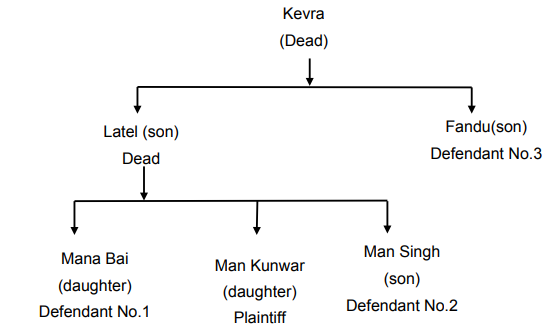
Kevra had two sons namely Lathel and Fandu. Latel has two daughters namely Manabai and Mankunwar(plaintiff) and one son namely Mansingh. Kevra was the owner of the land bearing Khasra No.70 area 0.23 acre, Khasra No.185 area 2.68 acre total 2.91 acre situated at village Surajpura (Schedule A in the plaint) and after his death, the property was transferred in the names of his sons Lathel and Fandu. There has been partition between two brothers in respect of aforesaid property about thirty years ago, in which, Latel and Fandu each had got half share, but since there was no division of accounts in land record (khata batwara), the names have been recorded jointly in revenue records. By earning income from his share of agricultural land and from his own income, Latel had acquired 09.86 acres of land mentioned in Schedule "B", in which the names of the plaintiff and defendants 01 and 02 were recorded after Latel's death. In the year 2008, Mankunwar (Plaintiff) approached defendants 1 to 3 for rightful share of suit land of Schedule ‘A’ & ‘B’, but the defendants refused to give her share and also threatened that they will sell the whole property. Thereafter, the plaintiff filed suit for declaration of her title and partition of suit property as shown in Schedule A and B annexed with the plaint.
3. The Defendants 1 to 3 filed their written statement denying the substantive contentions of the plaintiff and pleaded that suit land of Schedule A & B are the ancestral property. After death of Latel, the plaintiff had obtained the ornaments of her mother against her share and waived off her right over suit land, hence, she is not entitled for any share in the property.
4. The learned trial Court after framing issues, examined the witnesses adduced by both the parties and after considering the evidence brought on record, decreed the suit of the plaintiff holding that the plaintiff is entitled for 1/6th share of the property of Schedule A (as no khata batwara has been got done between Latel and Fandu) and 1/3rd share of Schedule B.
5. The respondents/defendants 1 & 2 challenged the judgment and decree passed by the trial Court by filing First Appeal bearing No.100-A/2012 before the first appellate court, wherein, the judgment and decree passed by the trial Court was reversed vide impugned judgment dated 06.10.2012 holding therein that, the plaintiff has not visited her parental home for the last 15 years and she has failed to prove that partition was effected between Latel and Fandu, and therefore, she would not be entitled for any share in the property of her father by way of partition in the suit property. Being aggrieved by the same, the appellant/plaintiff has preferred the second appeal.
6. This second appeal has been admitted for hearing on the following substantial question of law:-
“Whether the lower appellate Court was justified in reversing the finding of the trial Court only on the ground that the plaintiff has not visited her parental home for the last 15 years and therefore she would not be entitled for any share in the property of her father by way of partition in the suit property?”
AI
A co-sharer’s right to ancestral property is inherent and cannot be extinguished by absence from the parental home.

The presumption of joint family property necessitates proof of individual ownership; without such proof, a child has a right to claim share in ancestral property.

The main legal point established in the judgment is the importance of evidence in establishing the nature of the suit property and the entitlement to seek relief by way of partition, as well as the i....

In a partition suit, registered documents act as constructive notice, initiating the limitation period. Prolonged exclusive possession of ancestral property by a co-owner establishes ouster. Addition....
Properties claimed as self-acquired were determined to be ancestral; the appeal for partition was dismissed due to lack of joint possession evidence and non-joinder of necessary parties, also barred ....
The court ruled that an oral partition established the properties as separate and self-acquired, barring claims for partition after 18 years and validating a gift deed executed by the coparcener.

The main legal point established in the judgment is the determination of ancestral properties available for partition and the validity of gift settlement deeds.
The burden of proof regarding partition, the reliance on revenue records and patta, and the presumption of joint-ness in the absence of proof of partition were central legal principles established in....
The main legal point established in the judgment is that properties derived by the father through a partition deed are to be treated as his self-acquired properties, as per Section 8 of the Hindu Suc....



An indispensable Tool for Legal Professionals, Endorsed by Various High Court and Judicial Officers
Please visit our Training & Support
Center or Contact Us for assistance

Scan Me!
India’s Legal research and Law Firm App, Download now!


For Daily Legal Updates, Join us on :



 Back to top


