
 Back
Back





HIGH COURT OF CHHATTISGARH AT BILASPUR
RAJANI DUBEY, AMITENDRA KISHORE PRASAD, JJ.
Pyari Kaushik, D/o Aajuram Kaushik - Appellant
Vs.
State of Chhattisgarh - Respondent
CRA No. 1448 of 2019
Decided On : 12-08-2025
| Table of Content |
|---|
| 1. appeal under cr.p.c. section 374(2) for conviction (Para 1) |
| 2. factual background of the case and trial court's conviction (Para 2 , 3 , 4) |
| 3. arguments against trial court's judgment (Para 5) |
| 4. state's arguments in support of conviction (Para 6) |
| 5. need to determine nature of the death (Para 7 , 8) |
| 6. witness testimonies regarding the incident (Para 9 , 10) |
| 7. medical examination results of the deceased (Para 11 , 12) |
| 8. analysis of evidence supporting homicide determination (Para 13 , 16 , 18) |
| 9. witness statements about accused and victim's relationship (Para 17 , 19 , 21) |
| 10. forensic evidence and its relation to the case (Para 22 , 23 , 30) |
| 11. recovery of evidence and its admissibility (Para 24 , 25 , 27 , 28) |
| 12. issues with dna evidence and its reliability (Para 31 , 32 , 37) |
| 13. procedural lapses in evidence collection and testing (Para 33 , 34 , 36) |
| 14. court's rationale for reversing conviction (Para 38 , 41) |
| 15. conclusion and acquittal of the appellants (Para 42 , 43 , 44) |
Judgment :
Per Rajani Dubey, Judge
1. This appeal under Section 374(2) of Cr.P.C. has been filed by the appellants against the judgment of conviction and order of sentence dated 08.08.2019 passed by learned Sessions Judge, Bemetara, District- Bemetara (C.G.) in Sessions Trial No.05/2019 whereby, the trial Court convicted the appellants and sentenced them as under:-
| Conviction | Sentence |
| U/s 302 of IPC | Life imprisonment and fine of Rs.50/- in default of payment of fine amount, to undergo additional imprisonment for two months each to the appellants |
| U/s 201 of IPC | R.I. for 7 years and fine of Rs.50/- in default of payment of fine amount, to undergo additional imprisonment for two months each to the appellants |
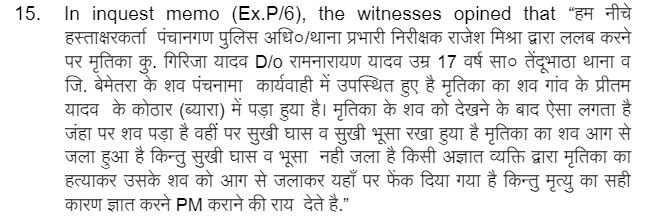
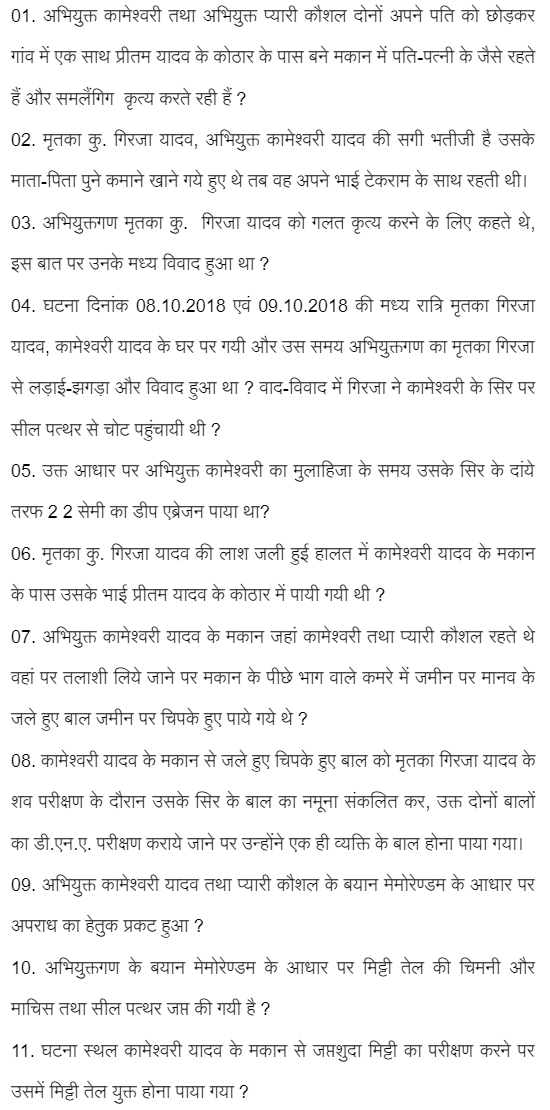
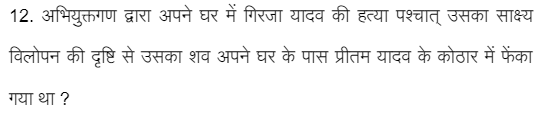
2. Case of the prosecution, is that at the instance of Tekram (P.W.-1), morgue (Ex. P/1) was recorded to the effect that on 09.10.2018, when he woke up around 4:00 A.M., he found that his sister namely Ku. Girja Yadav was not at home and the door was locked from outside. He raised alarm and upon hearing his voice, his neighbour Sangeeta Yadav (PW-10) opened the door. Thereafter, he searched his sister, but he could not find her and then he went for his classes. After classes, when he returned home, he did not find his sister Girja Yadav in home. While searching for her Narendra Rao told him that Girja Yadav was lying burnt in the courtyard of Pritam Yada. When Tekram Yadav (P.W.-1) went there, he found Girja Yadav lying burnt dead. He went to Bemetara police station and filed a morgue intimation. On 09.10.2018, Tekram Yadav (P.W.-1) informed his father Ramnarayan over phone about death of Girja Yadav. When Ramnarayan returned to the village with his wife, he came to know about the incident. The accused forcibly called Girja Yadav to their house on the night of 08.10.2018 and killed her and to hide her identity burnt her body and threw it in the courtyard. When Ramnarayan came and saw the body of Girja Yadav, the part below her waist was not burnt. At the place where the body was lying, there was dry grass and straw which was not burnt by the fire. Seeing the body, he suspected that the body might have been thrown in Pritam Yadav's courtyard after being burnt. Thereafter, the police recorded Dehati Nalishi and then FIR (Ex.P/25) was registered against unknown person. During investigation, it was found that the appellants were lesbian and appellant Pyari Bai was insisting the deceased to accompany her, to which the appellant Kameshwari had a quarrel with the deceased. It is further case of the prosecution that, night intervening 08-09.10.2018, the deceased Ku. Girja Bai went to the house of the appellants, with stone and assaulted the appellant Kameshwari Bai and thereafter, both the appellants committed murder of deceased by throttling and in order to cause disappearance of the dead body and to hide its identity, the dead body was burnt in their house and thrown in the nearby courtyard. In furtherance of investigation, body was sent for post mortem,
AI
The prosecution must prove guilt beyond a reasonable doubt, especially in circumstantial evidence cases, where the absence of direct evidence and procedural lapses in evidence handling may lead to ac....
The court emphasized that DNA evidence must be corroborated by substantive evidence and procedural integrity is essential for its admissibility in criminal cases.

(1) Rape and murder – In view of Section 357(A), Cr.P.C., family members of deceased-victim would be entitled to compensation even though accused have been acquitted.(2) Extra-Judicial confession – C....

The main legal point established in the judgment is the reliance on DNA profiling, circumstantial evidence, and the last-seen theory to establish the guilt of the accused in criminal cases.

Circumstantial evidence must establish an unbroken chain of guilt while ensuring all evidentiary rules are followed; failure in this renders conviction unsustainable.


DNA evidence requires proper documentation and chain of custody to be admissible; conviction cannot solely rely on such evidence without corroborating proof.

The prosecution must prove guilt beyond reasonable doubt, especially when the primary witness turns hostile, and reliance on inconsistent testimony and improperly handled DNA evidence is insufficient....

Conviction based on circumstantial evidence requires a complete chain proving guilt beyond reasonable doubt; mere suspicion is insufficient.



An indispensable Tool for Legal Professionals, Endorsed by Various High Court and Judicial Officers
Please visit our Training & Support
Center or Contact Us for assistance

Scan Me!
India’s Legal research and Law Firm App, Download now!


For Daily Legal Updates, Join us on :



 Back to top


