
 Back
Back





IN THE HIGH COURT OF GUJARAT AT AHMEDABAD
MAULIK J.SHELAT, P. M. RAVAL, JJ.
State Of Gujarat – Appellant
Versus
Kathi Visubhai Najbhai & Ors. – Respondent
R/Criminal Appeal No. 1119 of 1998
Decided On : 20-02-2026
| Table of Content |
|---|
| 1. summary of the factual background of the case. (Para 1 , 2 , 3) |
| 2. trial court's findings on evidence. (Para 4) |
| 3. hearing and re-appreciation of evidence. (Para 5) |
| 4. arguments presented by the prosecution. (Para 6 , 8) |
| 5. court's analysis of prosecution evidence shortcomings. (Para 9 , 10) |
| 6. legal standards regarding appeals against acquittal. (Para 11) |
| 7. conclusion and confirmation of the trial court's order. (Para 13 , 14) |
JUDGMENT :
MAULIK J.SHELAT, J.
1. The present appeal has been filed by the State under Section 378 of the Code of Criminal Procedure, 1973, challenging the judgment and order dated 16.10.1998 passed by the learned Additional Sessions Judge, Surendranagar (hereinafter referred to as“the Trial Court”) in Sessions Case No.48 of 1997, whereby the Trial Court acquitted the respondents of the charges levelled against them under Sections 302 and 34 of the Indian Penal Code (hereinafter referred to as “IPC”) read with Section 135 of the Bombay Police Act.
2. At the outset, it requires to be noted that out of the three respondents – accused, this Court vide its order dated 15.07.1999 granted leave insofar as respondent No.1 - original accused No.1 – Kathi Visu Najbhai (hereinafter referred to as “the accused“) is concerned and the appeal stands dismissed qua respondent Nos.2 and 3.
3. The brief facts of the prosecution case are as under :
3.1. It is the case of the complainant - Champaben, wife of Rajabhai Jivanbhai Koli, that she was residing at Ninama, Taluka: Sayla, with her husband and mother-in- law and was doing household chores and agricultural work. On the date of incident i.e., on 09-11-96 at about 10:00 AM, the complainant and her husband, Raja Jivan (hereinafter referred to as “the victim”), after preparing the afternoon meal, went near the house of Hasu to call a laborer (Dadiya). Upon being called, the laborer came out and her husband went into the courtyard (Khadki) of Magan Uka’s house to call Jashuben. While the complainant was standing behind Maganbhai’s house along with Hasubhai, carrying the meal, a gunshot was heard near Maganbhai’s house.
3.2. The complainant and Hasu Vaghji rushed towards Maganbhai’s house. Near the boundary wall (Vandi) of Magan Uka’s residence, a person from their village, Kathi Dhandhal Valkubhai Nanjibhai, fired a shot from a large gun at her husband while he was exiting Maganbhai’s house. Immediately thereafter, Visubhai Nazbhai Kathi-accused fired a second shot from a large gun from the boundary wall. Both gunshots struck her husband in the waist, causing him to collapse on the spot.
3.3. Gohabhai Nazbhai was standing outside the boundary wall armed with a stick (Lathi) and Kathubhai Devayatbhai Kathi of Nana Haraniya was holding an object resembling a small weapon. Following the two gunshots and the collapse of her husband, all four accused persons fled the scene.
3.4. As the Complainant and Maganbhai Ukabhai and his wife came out screaming, her husband was gasping for water. While Hasu Vaghji was bringing water in a coconut shell to give to her husband, he succumbed to his injuries and passed away. At that moment, her elder brother-in-law (Jeth), Nanubhai, arrived and was dispatched to Chotila to inform the police. It is the case of the complainant that due to the injuries sustained, the victim succumbed to it. The complainant reported the said incident, as narrated in her FIR being C.R.No.I- 17/1993 lodged before Meghraj Police Station on 06/03/1993.
3.5. After completion of the investigation, having found sufficient evidence against the accused, whereby, they could be prosecuted for the offence in question, the charge-sheet was filed against the accused and ultimately, the case was committed to the Trial Court for conducting the trial for the offences under Sections 302 and 34 of the IPC read with Section-135 of the Bombay Police Act.
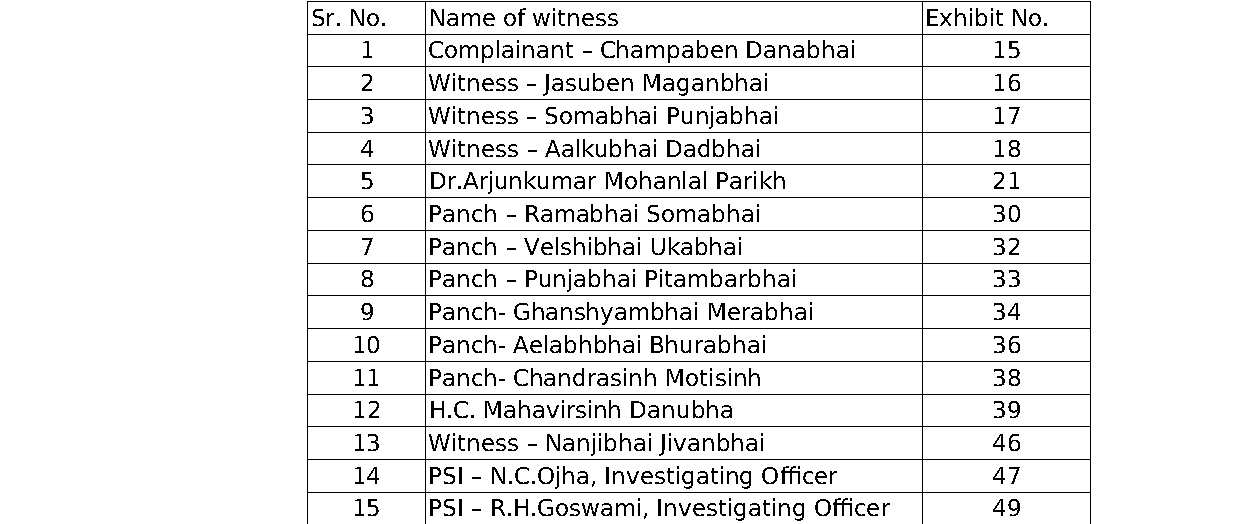
3.6. To bring home the charge levelled against the accused, the prosecution led the following oral as well as documentary evid
AI
The acquittal of accused in a murder case was upheld as the prosecution failed to prove guilt beyond reasonable doubt, highlighting the importance of credible evidence in criminal proceedings.

The appellate court must respect the presumption of innocence and the trial court's findings unless there is a clear error or misreading of evidence.
The prosecution must prove guilt beyond a reasonable doubt; acquittal should not be disturbed unless clear error or perversity is shown.

The appellate court upheld the acquittal, emphasizing the prosecution's failure to establish guilt beyond reasonable doubt due to contradictions in witness testimonies and lack of direct evidence.
The appellate court must uphold acquittals unless the trial court's decision is perverse or lacks evidentiary support, reinforcing the presumption of innocence.

In appeals against acquittal, appellate courts interfere only if trial court findings perverse or sole possible view convicts; here prosecution failed due to medical inconsistencies, unproved firearm....
The appellate court upheld the acquittal of the accused due to significant contradictions in the victim's testimony and absence of supporting medical evidence, reinforcing the presumption of innocenc....
An appellate court must respect the presumption of innocence and can only overturn an acquittal if the trial court's reasoning is perverse or unsupported by the evidence.

The appellate court upheld the trial court's acquittal due to insufficient evidence, emphasizing the presumption of innocence and the principle that two reasonable views should not disturb the trial ....



An indispensable Tool for Legal Professionals, Endorsed by Various High Court and Judicial Officers
Please visit our Training & Support
Center or Contact Us for assistance

Scan Me!
India’s Legal research and Law Firm App, Download now!


For Daily Legal Updates, Join us on :



 Back to top


