
 Back
Back





THE GAUHATI HIGH COURT, (HIGH COURT OF ASSAM, NAGALAND, MIZORAM AND ARUNACHAL PRADESH)
ROBIN PHUKAN, J.
Safina Khatun, W/o. Md. Yunush Ali @ Eunusur Rahman And Ors. – Petitioners
Versus
Moinur Ali, S/o. Lt. Fulsha Seikh And Ors. – Respondents
CRP No.137 of 2019
Decided On : 23-04-2025
| Table of Content |
|---|
| 1. procedural history and factual context underpinning the execution of a decree. (Para 2 , 3 , 4) |
| 2. parties' contentions regarding the executability of a decree and allegations of fraud. (Para 5 , 6 , 7 , 8) |
| 3. scope of section 47 cpc: executing court cannot re-examine or go behind the decree. (Para 10 , 11 , 12) |
| 4. prohibition against re-litigating findings that attained finality via previous trial and appellate court orders. (Para 13 , 14 , 15) |
| 5. setting aside improper orders and mandate to proceed with execution without further delay. (Para 18 , 19 , 20 , 21) |
JUDGMENT :
ROBIN PHUKAN, J.
Heard Mr. B.D. Deka, learned counsel for the petitioners. Also heard Mr. J. Prakash, learned counsel for the respondents.
2. In this revision petition, under Section 115 of the CPC, the petitioners have challenged the correctness or otherwise of the order dated 06.06.2019, passed by the learned Civil Judge (Senior Division) No. 3, Kamrup(M), Guwahati, in Misc. Case No. 324/2019, arising out of Title Execution Case No. 2/2009, allowing an application filed by the respondents under Section 47, read with Section 151 of the CPC.
3. It is to be noted here that vide impugned order dated 06.06.2019, the learned Civil Judge (Senior Division) No. 3, Kamrup(M), Guwahati (‘executing Court’, for short) had held that the decree passed by the learned predecessor of that Court is not enforceable, being obtained by playing fraud upon the Court.
4. The background facts, leading to filing of the present petition, are briefly stated as under:
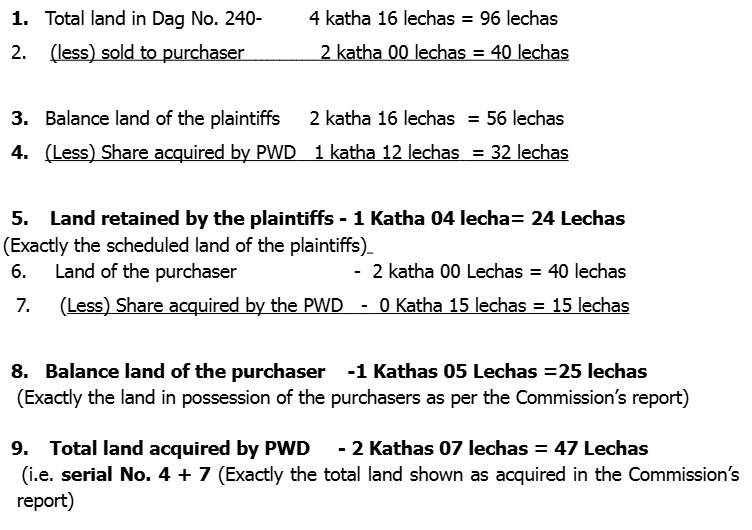
“The petitioners had filed one title suit, being Title Suit No. 324/2003, before the Court of Civil Judge (Senior Division) No. 3, Kamrup(M), Guwahati and the said suit was decreed, vide judgment and decree dated 18.09.2007. Thereafter, the respondents had filed an appeal, being First Appeal No. 24/2009 before this Court, which was dismissed, vide judgment and order dated 10.07.2018. Thereafter, the plaintiffs/petitioners herein filed Title Execution Case No. 02/2009, for execution of the decree and then, the respondents/judgment debtors challenged execution of the decree by filing an objection under Section 47 of the CPC on the ground that the decree had been obtained by playing fraud. But, in fact, the claim of the respondents/judgment debtors is only in respect of the land of a separate Dag i.e. Dag No. 238, while the claim of the plaintiffs/petitioners are in respect of a separate Dag No. 240, in which the respondents had not advanced any claim, and that as per jamabandi of the patta and the survey report obtained by the Court, a plot of land measuring 1 katha 4 lechas of Dag No. 240 still remained after sale by the plaintiffs/petitioners, which had been encroached upon and being illegally possessed by the defendants/respondents. But, vide impugned order dated 06.06.2019, passed by the learned executing Court allowing the objection filed under Section 47 of the CPC, this land of 1 katha 4 lechas had been allowed to remain under illegal occupation of the respondents/judgment debtors.”
5. Being aggrieved, the petitioners herein has preferred this revision petition on the following grounds:
(a) That, the learned executing Court passed the impugned order dated 06.06.2019, by exercising its jurisdiction, which is not vested upon it.
(b) That, while passing the impugned order dated 06.06.2019, the learned executing Court had exercised its jurisdiction illegally and with material irregularity.
(c) That, by holding the decree as not executable and reversing the decree passed by his predecessor, the learned executing Court went behind the decree.
(d) That, by holding that the plaintiffs/decree holders obtained the decree by playing fraud upon the Court, the learned executing Court had failed to consider the legal definition of the term fraud and thus, arrived at a wrong finding.
(e) That, the learned executing Court misread the jamabandi of the patta (Exhibit-4), the Survey Commissioner’s Report and miscalculated the areas o
AI
Point of Law : A person, including a stranger, could maintain a petition under Rule 97 of Order XXI and object and get adjudication when he sought to be dispossessed by the decree holder. The express....

The Executing Court must execute decrees as per their terms without questioning merits or introducing new factual disputes.


Executing Court cannot dismiss execution case on technical grounds.


The Executing Court's jurisdiction under Section 47 of the Code of Civil Procedure is limited to executability issues, and merit-based challenges to decrees are not permissible.
Objection to execution of decree – Running a separate miscellaneous proceeding under Section 47 of CPC is a misuse of process of court.


The court emphasized the limited grounds on which a decree is unexecutable and highlighted that the right of the Decree Holder to obtain relief is determined in accordance with the terms of the decre....



An indispensable Tool for Legal Professionals, Endorsed by Various High Court and Judicial Officers
Please visit our Training & Support
Center or Contact Us for assistance

Scan Me!
India’s Legal research and Law Firm App, Download now!


For Daily Legal Updates, Join us on :



 Back to top


