
 Back
Back





IN THE HIGH COURT OF KERALA AT ERNAKULAM
ANIL K. NARENDRAN, G. GIRISH, JJ.
Kochukunju – Appellant
Versus
Malabar Devaswom Board – Respondent
W.P.(C) No.42397 of 2022
Decided on : 08-02-2024
(A) Madras Hindu Religious and Charitable Endowments Act, 1951 - Sections 20, 39 and 45 - Writ petition seeking mandamus against Malabar Devaswom Board for disciplinary action against trustees and recovery of funds - Court emphasized the fiduciary duties of trustees and the necessity for safeguarding temple funds. (Paras 1, 9, 10, 12, 21, 25)
(B) Fiduciary Duty - The court reiterated that trustees must act in the best interest of the trust and avoid conflicts of interest, ensuring proper management of temple properties. (Paras 9, 10, 12)
Facts of the case:
The petitioners alleged mismanagement and loss of funds by trustees of Sree Valliyoorkavu Devaswom, seeking remedial action and recovery of losses incurred during the annual temple festival.
Findings of Court:
The court directed the Malabar Devaswom Board to ensure funds are deposited in Nationalised Banks and to take action against any violations of statutory requirements.
Issues: The main issues included the management of temple funds and the accountability of trustees for misappropriation.
Ratio Decidendi: The court held that trustees must adhere to statutory guidelines in managing temple funds and that any violations should be addressed with appropriate action.
Result: Writ petition disposed of with directions.
JUDGMENT :
Anil K. Narendran, J.
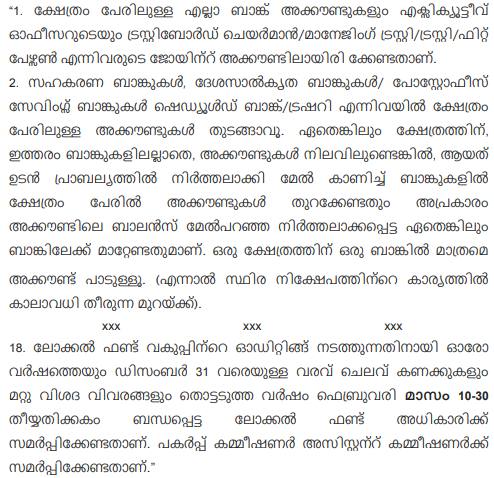
The petitioners are the devotees of Sree Valliyoorkavu Devi, the main deity of Sree Valliyoorkavu Devi Temple in Wayanad District, which is a controlled institution under the 1st respondent Malabar Devaswom Board - Sl.No.33 in List A in Appendix I in notification No.HR 3/5691/93 dated 15.02.1994 issued by the Commissioner of erstwhile the Hindu Religious and Charitable Endowments (Administration) Department, Government of Kerala. The petitioners have filed this writ petition under Article 226 of the Constitution of India, seeking a writ of mandamus commanding respondents 1 and 2, namely, Malabar Devaswom Board and its Commissioner, to take appropriate disciplinary and remedial action as envisaged under Sections 20, 39 and 45 of the Madras Hindu Religious and Charitable Endowments Act, 1951 against respondents 4 to 6, after a full-fledged enquiry, keeping away the 4th respondent hereditary trustee and the 5th respondent non-hereditary trustee from the office, re-compensating the loss sustained to Sree Valliyoorkavu Devaswom from respondents 7 and 8, the Kuthaka holders in connection with the annual temple festival-2022, who have defaulted payments, and directing the 3rd respondent Executive Officer of Sree Valliyoorkavu Devaswom to withdraw all funds and deposits of the Devaswom from the Co-operative Societies/Banks/Institutions and redeposit the same in some Nationalised Banks, in order to secure the Devaswom funds.
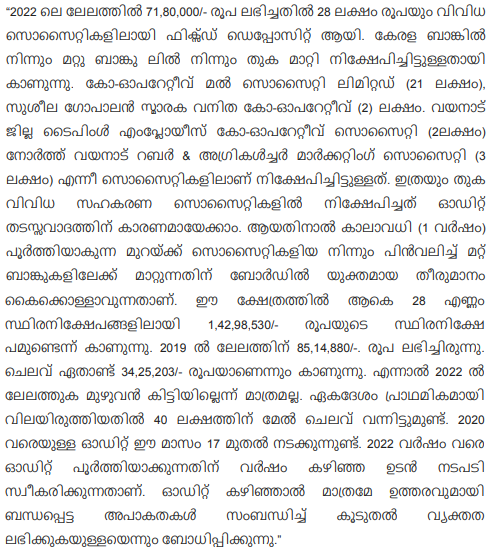
2. In the writ petition, it is alleged that due to the illegalities and irregularities committed by respondents 4 and 5, with the help of the 6th respondent, who was the then Executive Officer of Sree Valliyoorkavu Devaswom, favouring respondents 7 and 8, the Kuthaka holders in connection with the annual temple festival-2022, who have defaulted payments, there occurred a loss of more than 25 lakhs to the Devaswom, in connection with Ulsavam-2022 exhibition, trade fair and ‘chantha lelam’ and also depositing Devaswom funds in Co-operative Societies, and institutions, interested by the Trustees.
3. On 23.12.2022, when this writ petition came up for admission, this Court admitted the matter on file. The learned Standing Counsel for Malabar Devaswom Board took notice for respondents 1 and 2. This Court issued notice by speed post to respondents 3 to 8 returnable within two weeks. The learned Standing Counsel for Malabar Devaswom Board was directed to get instructions.
4. Respondents 4 and 5 have filed a counter affidavit dated 15.02.2023, producing therewith Exts.R4(a) to R4(e) documents, opposing the reliefs sought for in this writ petition. The 6th respondent has filed a counter affidavit dated 31.05.2023, producing therewith Ext.R6(a) letter dated 11.08.2022. The 8th respondent has filed a counter affidavit dated 23.06.2023. The 7th respondent has filed a counter affidavit dated 09.07.2023. The petitioner has filed a reply affidavit dated 24.09.2023. The 3rd respondent Executive Officer has filed a counter affidavit dated 11.10.2023, producing therewith Exts.R3(a) to R3(b) documents.
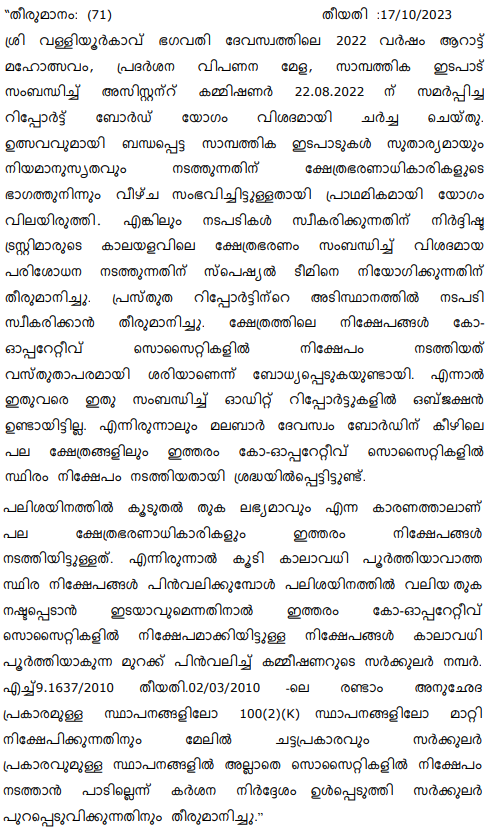
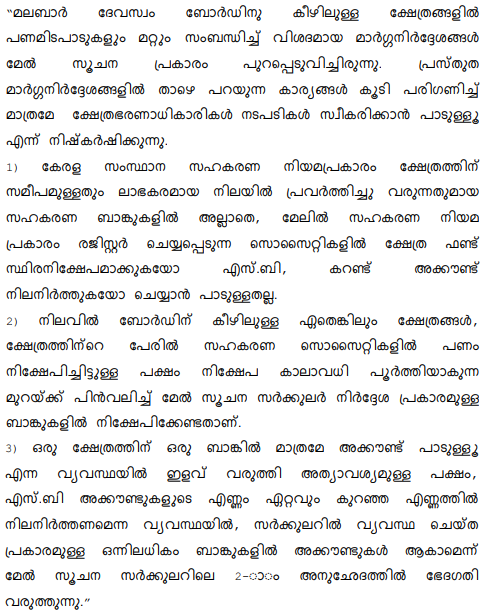
5. On 11.10.2023, when this writ petition came up for consideration, the State of Kerala, represented by the Chief Secretary to Government; the Principal Secretary to Government, Revenue (Devaswom) Department; the Secretary to Government, Department of Co-operation; the Registrar of Co-operative Societies; the Director, Kerala State Audit Department; and the Deputy Director, Local Fund Audit, Malabar Devaswom Board Audit were impleaded as additional respondents 9 to 14. The learned Standing Counsel for Malabar Devaswom Board sought time to get instructions on the action, if any, taken by the 2nd respondent Commissioner on Ext.P4 report dated 15.10.2022 of the Assistant Commissioner in which the irregularity in Sree Valliyoorkavu Devaswom maintaining fixed deposits in Co-operative Societies was specifically pointed out. The 2nd respondent Commissioner was directed to explain the circumstances in which the Devas
AI
Trustees of religious institutions must adhere to fiduciary duties and statutory guidelines to safeguard temple funds and avoid conflicts of interest.

Only the Temple Advisory Committee can conduct religious rites and collect contributions in temples managed by the Cochin Devaswom Board, as per statutory provisions.
Devaswom Boards are trustees with a legal obligation to protect and manage the properties of the Devaswoms, and failure to do so constitutes a breach of trust.
The Travancore Devaswom Board must verify credentials of officers before postings to ensure integrity and proper management of religious institutions.
The court established that the Cochin Devaswom Board must protect temple funds and properties, ensuring proper management and preventing exploitation through unauthorized online platforms.
The Cochin Devaswom Board must impose stringent penalties for misconduct by employees to uphold its fiduciary duties under the Travancore-Cochin Hindu Religious Institutions Act.
The court established that the Travancore Devaswom Board has a robust obligation to manage and protect the properties of Devaswoms, reinforcing the necessity for careful credential scrutiny of staff ....

The court ruled that a compromise decree is binding on parties involved, and a temple advisory committee cannot re-agitate settled issues regarding ritual performance and fund collection without appr....
Statutory remedies must be pursued before seeking court intervention under Article 226.
The court reinforced that the Temple Advisory Committee must fulfill statutory duties regarding financial account audits while confirming the limit of writ jurisdiction to prevent unlawful directives....



An indispensable Tool for Legal Professionals, Endorsed by Various High Court and Judicial Officers
Please visit our Training & Support
Center or Contact Us for assistance

Scan Me!
India’s Legal research and Law Firm App, Download now!


For Daily Legal Updates, Join us on :



 Back to top


