
 Back
Back





IN THE HIGH COURT OF KERALA AT ERNAKULAM
BECHU KURIAN THOMAS, J.
B.G. Krishnamurthy S/o. B.K.Gopal Rao - Appellant
Versus
Union of India - Respondent
WP(CRL.) NO. 549 OF 2023
Decided On : 21-01-2025
(A) Kerala Prisons and Correctional Services (Management) Act, 2010 - Section 79 - Constitutional validity of Rule 415(3) challenged - Denial of escort visit outside Kerala deemed discriminatory under Articles 14, 15, and 19(1)(d) - Court held that geographical restrictions are valid and do not infringe fundamental rights. (Paras 3 , 11 , 25 )
(B) Fundamental Rights of Prisoners - Prisoners retain fundamental rights, albeit limited by incarceration - The right to family interaction is essential for maintaining dignity. (Paras 11 , 12 )
Facts of the case: The petitioner, facing trial under the Unlawful Activities (Prevention) Act, challenged Rule 415(3) which restricts escort visits outside Kerala, claiming it violates his constitutional rights based on his place of birth. (Paras 1 - 3 )
Findings of Court: The court found no merit in the petition, affirming that the rule's geographical limitation is reasonable and does not discriminate based on birthplace. (Paras 25 , 26 )
Issues: Whether Rule 415(3) violates Articles 14, 15, and 19(1)(d) of the Constitution and if it is ultra vires the Act. (Paras 3 , 26 )
Ratio Decidendi: The court ruled that the restriction is based on geographical limits, not birthplace, and serves legitimate state interests in security and practicality. (Paras 20 , 25 )
Result: Writ petition dismissed.
JUDGMENT
Petitioner challenges the constitutional validity of Rule 415(3) of the Kerala Prisons and Correctional Services (Management) Rules, 2014 (for short ‘the Rules’). Petitioner also seeks the grant of an escort visit to see his mother and close relatives who reside in Chikkamangaluru, Karnataka.
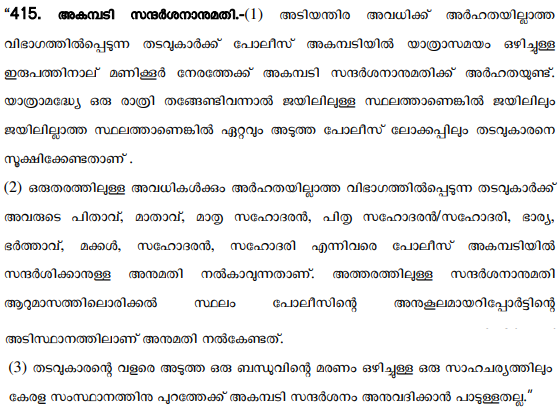
2. Petitioner is facing an indictment under the Unlawful Activities (Prevention) Act, 1967. He was arrested on 10.11.2021 and is facing trial as the 14 th accused in S.C. No.2/2021 before the Special Court for the trial of National Investigation Agency Cases, Ernakulam. He hails from Chikkamangaluru in Karnataka. Petitioner's request for permission to visit his mother and near relatives was denied by the Special Court pointing out Rule 415(3) of the Rules which restricts escort visits outside the State of Kerala except for the death of an immediate relative.
3. Petitioner pleads that the denial of escort visit under Rule 415(3) of the Rules to a place outside the State of Kerala is violative of Article 14 and 15 of the Constitution as it discriminates between ‘prisoners born outside Kerala State’ and those ‘born in Kerala’. It is also pleaded that since the discrimination is based on the place of birth, the said provision infringes the fundamental right under Article 15 and Article 19(1)(d) of the Constitution of India. Petitioner has also alleged that restricting escort visit to places within the State of Kerala except for the death of a near relative is ultra vires the Kerala Prisons and Correctional Services (Management) Act, 2010 (for short ‘the Act’) as it goes beyond the powers under section 79 of the Act.
4. A counter affidavit has been filed by the second respondent stating that petitioner is involved in 125 cases in Karnataka and 2 cases in Kerala and that he was admitted into the High Security Prison at Viyyur on 10.11.2021 where he is presently lodged. It is further pleaded that Rule 415(2) enables a prisoner who is not eligible for any other leave to be granted permission to visit immediate relatives under a police escort once in six months, but, as per Rule 415(3), such escort visits cannot be permitted to places outside the State except in the case of death of a near relative. Respondents further allege that the Rules have been made for the benefit of society including safety of the Officers and that under Section 79 of the Act, an escort visit can be granted only for a maximum period of twenty four hours.
5. Considering the nature of the issue involved, Smt. Dhanya P.Ashokan, learned Senior Counsel, was appointed as Amicus Curiae to assist the Court.
6. The petitioner, as the party in person, argued from the Central Prison, Viyyur, through video conferencing. He submitted that sub-rule (3) of Rule 415 of the Rules violate Articles 14, 15 and 19(1)(d) of the Constitution of India, apart from being ultra vires section 79 of the Act. Petitioner further contended that Rule 415(3) is discriminatory since it violates the mandate of equal protection of laws, as escort visits are being denied to persons like him, on the basis of the place of birth. After referring to section 2(xvi) of the Act, which does not limit escort visits to any area, it was submitted that the rule-making power under section 99 of the Act requires the Rules to be consistent with the statute and that the impugned sub-rule goes against the spirit of the definition of the term escort visit. Petitioner also contended that his mother is unable to travel to Kerala due to old age and hence denying permission to visit his mother, is causing serious prejudice. In the alternative, petitioner also submitted that he be at least shifted to the Central Prison Kannur, which is closer to his native place.
7. After referring to the decisions in Francis Coralie Mullin v. Administrator, Union Territory of Delhi and Others , [(1981) 1 SCC 608] and Sunil Batra (II) v. Delhi Admi
Geographical restrictions on prisoner escort visits do not violate fundamental rights and are justified by practical considerations.

Denial of conjugal relationship for a specific purpose may amount to denial of the fundamental right guaranteed under Article 21, but it should not be construed as a fundamental right for having conj....


Parole conditions restricting a convict from visiting an ailing family member are liable to be set aside if the underlying law and order concerns can be managed through police monitoring, as such res....
The High Court has the discretion under Article 226 to grant temporary escort parole to a convict for the purpose of visiting ailing family members, provided such relief is reasonable and compliant w....

The constitutional validity of furlough provisions must account for individual prisoner circumstances, ensuring that previous overstays do not lead to automatic denials of furlough requests.

If a pure administrative circular/executive instruction is in conflict with certain rules and regulations, former would be bad in law.
The circular regulating foreign travel permits for court staff does not violate Articles 14 or 21 of the Constitution, as it serves a legitimate administrative purpose and does not unjustly discrimin....

The court ruled that it lacks jurisdiction to direct visa issuance in bail proceedings, emphasizing the distinction between judicial custody and executive detention under the Foreigners Act.



An indispensable Tool for Legal Professionals, Endorsed by Various High Court and Judicial Officers
Please visit our Training & Support
Center or Contact Us for assistance

Scan Me!
India’s Legal research and Law Firm App, Download now!


For Daily Legal Updates, Join us on :



 Back to top


