
 Back
Back





IN THE HIGH COURT OF KERALA AT ERNAKULAM
SATHISH NINAN, P.KRISHNA KUMAR, JJ.
Shaji Sebastian S/o Sebastian – Appellant
Versus
Julie Joseph D/o Joseph – Respondent
MAT Appeal No. 537 of 2014
Decided On : 29-01-2026
| Table of Content |
|---|
| 1. background and facts of the case (Para 1 , 2 , 3 , 4 , 5 , 6) |
| 2. arguments regarding financial claims (Para 8 , 9 , 10 , 11 , 13) |
| 3. court analysis of testimonies and evidence (Para 12 , 14 , 16 , 18) |
| 4. interpretation of desertion regarding maintenance (Para 20 , 21 , 22 , 23) |
| 5. final ruling on maintenance issues (Para 24) |
JUDGMENT :
P. KRISHNA KUMAR, J.
1. These appeals arise out of a common judgment rendered by the Family Court, Muvattupuzha. O.P. No. 573/2012 was instituted by the husband seeking dissolution of marriage, while O.P. No. 574/2012 was filed by the wife seeking return of gold ornaments and money, along with past maintenance.
2. By the impugned common judgment, the Family Court granted a decree of divorce on the ground of desertion and also allowed the wife’s claim for return of gold and money, as well as maintenance. Though the husband succeeded in obtaining a decree of divorce, he has preferred these appeals insofar as the Family Court declined to grant divorce on the additional grounds of adultery and cruelty urged by him, and also challenging the decree granting the aforesaid reliefs to the wife.
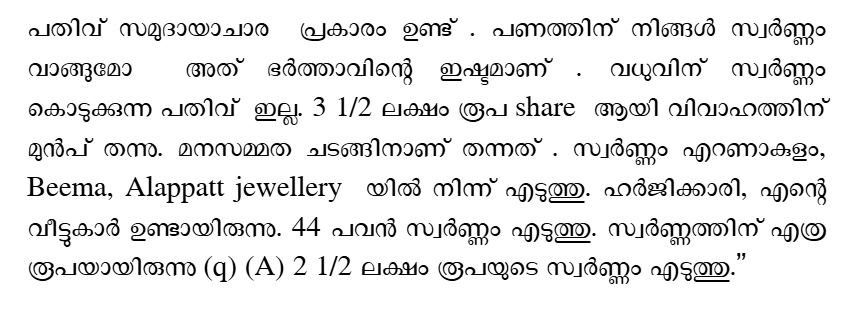
3. The brief facts necessary for the disposal of the disputes are as follows: The marriage between the appellant and the respondent was solemnised on 08.06.2003 in accordance with the religious rites and customs prevailing in the Christian community. The respondent claimed recovery of Rs. 2,00,000/- and 28 sovereigns of gold ornaments from the appellant, contending that at the time of marriage her relatives entrusted a sum of Rs. 3,50,000/- with the father of the appellant (who is the second respondent in O.P. No. 574/2012) towards her share in the parental properties. It was further contended that, using Rs. 1,50,000/- out of the said amount, 44 sovereigns of gold ornaments were purchased for the respondent. According to her, most of the ornaments, except those used for daily wear, were kept in the custody of the appellant’s father.
4. It was alleged that when the respondent became pregnant, she returned to her parental home. The appellant did not take her back after she gave birth to a child on 20.12.2005. The parties have been living separately thereafter. The respondent further alleged that the appellant has been retaining her 28 sovereigns of gold ornaments and that she is therefore entitled to recover the same along with the balance amount of Rs. 2,00,000/-.
5. Though the appellant admitted receipt of Rs. 3,50,000/-, he contended that the 44 sovereigns of gold ornaments worn by the respondent at the time of marriage were purchased by him from his own funds. He further contended that his gold ornaments are still in the possession of the respondent and that she is bound to return the same.
6. Claiming that she was unable to maintain herself and the minor child, the respondent sought past maintenance of Rs. 49,500/- for herself and Rs. 16,000/- for the child. She alleged that the appellant was employed in the Central Industrial Security Force and was earning Rs. 12,000/- per month. The appellant opposed the claim for maintenance contending that the respondent had deserted him.
7. Upon appreciation of the evidence, the Family Court allowed the respondent to recover Rs. 2,00,000/- with interest at the rate of 6% per annum and further directed the appellant and his father to return 28 sovereigns of gold ornaments or its market value. The court also awarded Rs. 25,500/- as past maintenance to the respondent and Rs. 8000/- to the minor child.
8. We have heard Sri.M.P.Ramnath, the learned counsel appearing for the appellant and Sri.N.K.Subramaniam, the learned counsel for the respondent.
9. During the course of hearing, learned counsel for the appellant submitted that, though an appeal was preferred against the order in the divorce petition to the extent it declined to grant divorce on the grounds of cruelty and adultery, the appellant is now satisfied with the decree granted on the ground of desertion. In view o


AI
Desertion under the Divorce Act implies abandonment against the wish of the other spouse; entitlement to maintenance must be assessed in light of circumstances surrounding the separation.
In matrimonial disputes, the burden of proof for the return of property lies initially with the claimant, requiring evidence of entrustment to substantiate claims.

Wife entitled to recover gold ornaments misappropriated by husband’s family, and maintenance awarded, while divorce granted due to irretrievable breakdown of marriage after prolonged separation.

Evidence of entrustment of gold ornaments by a wife to her husband is a valid basis for recovery, alongside maintenance claims.
Claims regarding marital assets and maintenance are to be substantiated by credible evidence, allowing for equitable relief based on factual findings.
Misappropriation of marital assets leads to liability for their return in matrimonial disputes.
The court affirmed that abusive behavior constitutes cruelty justifying divorce, while dismissing claims for maintenance and compensation due to lack of evidence.
The court affirmed the wife's entitlement to recover gold ornaments but found insufficient evidence for monetary claims, establishing the husband's obligation to provide maintenance unless the wife i....
Evidence is evaluated under the principle of preponderance of probability in claims for return of misappropriated items.
The court established that oral evidence can substantiate claims for return of gold ornaments in family disputes, emphasizing the husband's burden to account for entrusted property.



An indispensable Tool for Legal Professionals, Endorsed by Various High Court and Judicial Officers
Please visit our Training & Support
Center or Contact Us for assistance

Scan Me!
India’s Legal research and Law Firm App, Download now!


For Daily Legal Updates, Join us on :



 Back to top


