
 Back
Back





IN THE HIGH COURT OF JUDICATURE FOR RAJASTHAN BENCH AT JAIPUR
SAMEER JAIN, J.
Avdheshacharya son of (Late) Shri Ramodaracharya Ji – Appellant
Versus
Devesthan Commissioner, Office of the Commissioner – Respondent
S.B. Civil Writ Petition No. 16347/2016, S.B. Civil Writ Petition No. 16243/2016, S.B. Civil Writ Petition No. 16327/2016, S.B. Civil Writ Petition No. 16371/2016, S.B. Civil Writ Petition No. 16461/2016, S.B. Civil Writ Petition No. 16511/2016, S.B. Civil Writ Petition No. 8991/2017
Decided on : 22-07-2024
| Table of Content |
|---|
| 1. court's authority invoked to resolve property management issues. (Para 1 , 2) |
| 2. historical context of galta ji and its significance. (Para 3 , 4 , 5 , 6 , 7 , 8) |
| 3. appointment processes for mahants established on merit. (Para 9 , 10 , 11 , 12 , 13) |
| 4. legal recognition of ownership by galta ji trust. (Para 14 , 15 , 16 , 17) |
| 5. historical context of thikana galta ji as a public trust. (Para 19) |
| 6. arguments presented against claims of locus standi. (Para 26 , 27 , 28) |
| 7. issues of locus standi and their implications. (Para 29 , 30 , 31 , 32 , 33 , 34 , 35 , 36 , 37 , 38) |
| 8. validity of succession claims over the mahant's position. (Para 39 , 40 , 41 , 42) |
| 9. ownership of properties and their categorization. (Para 43 , 44 , 45 , 46 , 47) |
| 10. procedures for changes in trust management. (Para 48 , 49 , 50 , 51 , 52 , 53) |
| 11. allegations of mismanagement and fraud considered. (Para 54 , 55 , 56 , 57) |
| 12. importance of protecting the idol and its property. (Para 58 , 59 , 60 , 61 , 62 , 63) |
| 13. implications of mahant's authority over trust properties. (Para 64 , 65 , 66 , 67) |
| 14. role of the state as guardian and custodian. (Para 68 , 69 , 70) |
| 15. conclusion about trust management practices. (Para 71 , 72) |
| 16. endowments usage and temple maintenance. (Para 73 , 74 , 75) |
| 17. conclusions and key takeaways on the matter. (Para 76 , 77 , 78) |
| 18. highlighting fraud and mismanagement by the mahant regarding trust properties. (Para 83 , 85 , 86 , 90) |
JUDGMENT :
SAMEER JAIN, J.
| Sr. No. | Contents |
| Part A | Prefatory Remarks |
| Part B | Introduction: Origin, Significance and Historical Background of the Galta Peeth Dispute |
| Part C | Orders Impugned Dt. 28.03.2013 and 10.11.2016 |
| Part D | Submissions of the Petitioners |
| Part E | Submissions of the Respondents |
| Part F | Issues/Points of Determination |
| Part G | Discussions and Findings |
| Part H | Ancillary Remarks |
| Part I | Conclusion |
| Part J | Directions |
Part A
Prefatory Remarks
1. Since time immemorial, the history and culture of this country have been home to the quests for truth, whether it be through the material, the political or the spiritual. By virtue of the present set of petitions, this Court is called upon to exercise its adjudicatory authority, with regards to the issues emanating from the administration of Thikana Galta Ji and the ownership of its properties, which vide orders impugned dated 28.03.2013 and 10.11.2016, passed by the Assistant Commissioner, Devasthan and Commissioner, Devasthan Department (Appellate Authority) respectively, are stated to have been altered, purportedly sans the authority of law.
2. Therefore, since the scope of the controversy involved in the present batch of writ petitions is identical and overarching; with due consent of learned counsel appearing on behalf of both the sides, the petitions are jointly taken up for final disposal, by way of a common order.
Part B
Introduction: Origin, Significance and Historical Background of the Galtapeeth Dispute
3. Situated within the welcoming Aravalli hills, which traverse through the landscape of Jaipur, the site of Galta Ji, also known as Galtapeeth/Galta Gaddi/Galta Thikana, consists of a series of temples, a Gurukul/Ashram, seat of the Mahant and a picturesque natural spring emerging high on the hill, which flows downwards and fills a kund (water tank) where devotees of Galta Ji bathe.
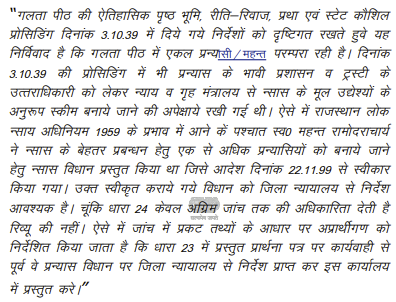
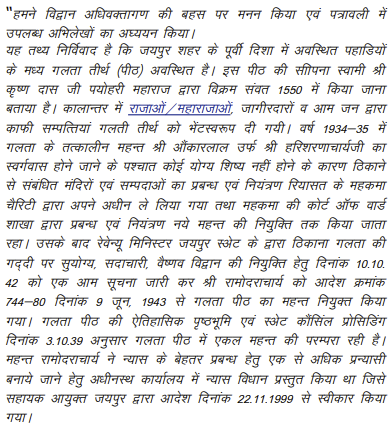
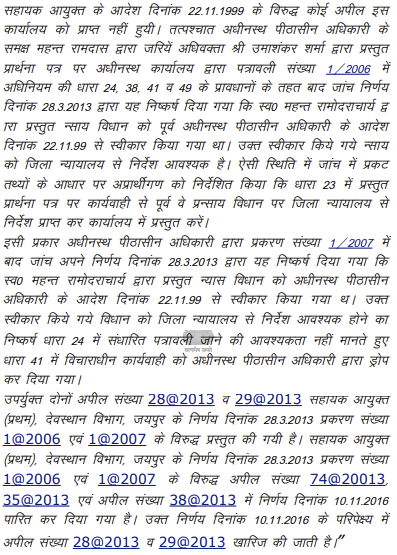
4. Galta Ji has its origin from ‘Galav’ rishi, a saint who lived at the site practicing meditation and doing penance i.e. tapasya. With the passage of time and on account of the astute worship and belief of its devotees, Galtapeeth emerged as a ‘tirth’ i.e. pilgrimage for the Hindu faith, with the underlining belief that the water at the site was holy. As a result, Galtapeeth garnered notable religious, spiritual and emotional s
AI
The appointment of Mahant is non-hereditary, governed by a systematic selection process by the State, with properties belonging to the idol, asserting the guardian role of the State.


The court clarified the authority of the Assistant Commissioner under Section 23 of the Act of 1959 and interpreted the eligibility criteria for trusteeship as per the amended constitution of the Tru....


A pujari's role does not confer ownership rights over temple property, which vests in the deity and is managed by the State.

Properties held in trust cannot be claimed as personal property of a trustee; relevant decrees regarding management are binding on all parties.

The position of Sarvarakar is not inheritable and requires legal appointment, especially under established public trust regulations.
The main legal point established in the judgment is that the plaintiff failed to prove his title over the suit property and the suit was not maintainable as per the provisions of the Chhattisgarh Pub....




An indispensable Tool for Legal Professionals, Endorsed by Various High Court and Judicial Officers
Please visit our Training & Support
Center or Contact Us for assistance

Scan Me!
India’s Legal research and Law Firm App, Download now!


For Daily Legal Updates, Join us on :



 Back to top


