
 Back
Back





IN THE HIGH COURT OF JHARKHAND AT RANCHI
SUJIT NARAYAN PRASAD, ARUN KUMAR RAI, JJ.
Kamlesh Dubey, S/o. Sri Babu Lal Dubey - Appellant
Versus
The State of Jharkhand & Ors. - Respondents
L.P.A. No. 55 of 2023
Decided On : 04-07-2024
[DISCIPLINARY ACTION] - [DEPARTMENTAL ENQUIRY] - [N/A] - [The court discussed the principles of natural justice, the standard of proof in departmental proceedings, and the limited scope of judicial review. It emphasized that the findings of the Enquiry Officer, based on the preponderance of probabilities, were sufficient to uphold the disciplinary action against the appellant. The court highlighted that strict rules of evidence do not apply in such proceedings, and the testimony of the Officer-in-Charge was pivotal in establishing the misconduct, leading to the dismissal of the appeal.]
Fact of the Case:
The appellant, a Constable in Jharkhand Police, was charged with misconduct for allegedly abusing and assaulting locals while intoxicated, leading to a law and order situation. After a departmental enquiry, he was dismissed from service. The dismissal was challenged multiple times, with the court previously quashing the dismissal due to procedural lapses and remanding the case for a fresh enquiry. Following a second enquiry, the appellant was again dismissed, prompting the current appeal.
Finding of the Court:
The court found that the Enquiry Officer's conclusions were based on sufficient evidence, particularly the testimony of the Officer-in-Charge, which corroborated the charges against the appellant. The court ruled that the disciplinary authority acted within its jurisdiction and that the principles of natural justice were upheld during the proceedings.
Issues: Whether the dismissal of the appellant from service was justified based on the evidence presented during the departmental enquiry and whether the court could interfere with the disciplinary authority's decision.
Ratio Decidendi: The court held that in departmental proceedings, the standard of proof is based on the preponderance of probabilities, and the findings of the Enquiry Officer should not be re-evaluated by the court unless there is a clear violation of natural justice or the findings are based on no evidence.
Final Decision: The appeal was dismissed, affirming the dismissal of the appellant from service as justified based on the evidence presented during the enquiry.
JUDGMENT :
Sujit Narayan Prasad, J.
1. The instant appeal, under clause 10 of the Letters Patent, is directed against the judgment/order dated 03.11.2022 passed by the learned Single Judge of this Court in W.P. (S) No. 329 of 2017 whereby and whereunder the order of the punishment of dismissal of appellant from service on conclusion of departmental enquiry as also the order passed by the appellate authority, affirming the order passed by the original authority has been refused to be interfered with by dismissing the writ petition.
Facts of the Case
2. The brief facts of the case, as per the pleading made in the writ petition is required to be enumerated which reads as under:-
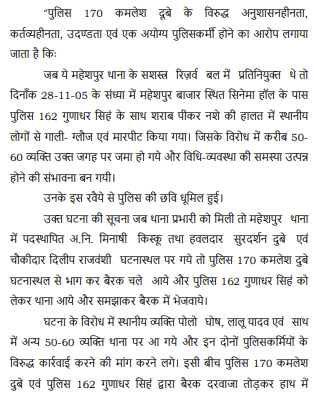
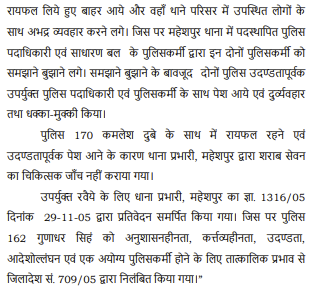
It is the case of the appellant that while he was working as Constable in Jharkhand Police and while he was posted at Maheshpur, Pakur, he was served a charge sheet contained in memo no. 856 dated 27.12.2005, alleging therein that on 28.11.2005 while he was posted in Armed Police Force at Maheshpur P.S., he along with another Police Constable was involved in abusing and assaulting locals while under influence of liquor and in protest 50-60 persons assembled and law and order situation was created.
3. It has further been alleged that when the Officer-in-charge got information, he went to the place of occurrence wherefrom the appellant fled away and came back to the Police Line and the Officer-in-charge managed to bring other constable to the Police Line and the 50-60 persons thereafter came to the Police Station and demanded action against the two policemen and in the meantime the appellant and other constable broke the door and came out armed with Rifles and misbehaved with members of public and also misbehaved with police personnel.
4. The appellant was issued memorandum of charge. He filed reply to the charges and thereafter an Enquiry was ordered against the appellant. The Enquiry Officer held the charges to be fully proved and forwarded his findings to the Disciplinary Authority.
5. The Disciplinary Authority issued second show cause to the appellant wherein it was pointed out that the appellant was not allowed to cross examine the witnesses and again the Disciplinary Authority vide its Memo No. 2709 dated 15.12.2006 directed the Enquiry Officer to provide opportunity of cross examination to the appellant.
6. Thereafter the appellant was permitted to cross examine the witnesses which was done on 21.12.2006 and the Enquiry Officer again submitted his report on same day, i.e. 21.12.2006 and the earlier finding were reiterated without appreciating the response of witnesses during cross examination and without even any reference to such cross examination.
7. The disciplinary Authority vide order dated 07.05.2007 accepted the finding of Enquiry Officer and dismissed the appellant from service.
8. The appellant filed appeal before the Appellate Authority and vide order dated 19.04.2008, appellant's appeal was dismissed and order of Disciplinary Authority was affirmed.
9. The appellant thereafter moved this Court by filing writ petition being W.P.(S) No. 3517 of 2008 before this Hon'ble Court and challenged the orders passed by Disciplinary Authority as well as Appellate Authority.
10. This Court vide order dated 30.09.2015 allowed the aforesaid writ petition and quashed the orders dated 07.05.2007 and 19.04.2008 passed by Disciplinary Authority and Appellate Authority respectively and the matter was remanded to the Superintendent of Police, Pakur to pass fresh order in accordance with law after supplying second enquiry report to the appellant and after complying with the principles of natural Justice.
11. The appellant thereafter submitted copy of aforesaid order on 25.02.2016 and requested for reinstatement and the Superintendent of Police, Pakur issued Order No. 637/16 dated 04.04.2016 and absorbed the appellant in service and vide order dated 04.04.2016 contained in Memo No. 620/R. Ka. dated 05.04.2016 provided copy of Enquiry Report dated 21.12.2006 and asked him to
In departmental proceedings, the standard of proof is based on the preponderance of probabilities, and the court will not interfere with the disciplinary authority's findings unless there is a clear ....


The court emphasized the limited scope of judicial interference in departmental enquiries and the principle that the High Court cannot act as a second court of first appeal.


The punishment imposed in a disciplinary proceeding should not shock the conscience of the court and should be proportionate to the proven charge.
The main legal point established is the limited scope of interference in departmental inquiries by the court, which can only be done in specific circumstances such as violation of principles of natur....


Judicial review in disciplinary matters is limited; courts cannot reassess evidence or interfere unless findings are arbitrary or unsupported by evidence.



An indispensable Tool for Legal Professionals, Endorsed by Various High Court and Judicial Officers
Please visit our Training & Support
Center or Contact Us for assistance

Scan Me!
India’s Legal research and Law Firm App, Download now!


For Daily Legal Updates, Join us on :



 Back to top


