
 Back
Back





IN THE HIGH COURT OF JHARKHAND AT RANCHI
HON'BLE THE ACTING CHIEF JUSTICE SHREE CHANDRASHEKHAR, HON'BLE MR. JUSTICE ARUN KUMAR RAI, J.
Indu Bhushan Singh, s/o late Ram Prasad Singh - Appellant
Versus
The State of Jharkhand and Ors. - Respondents
L.P.A No.547 of 2023
Decided On : 09-02-2024
[JUDICIAL REVIEW] - [DISCIPLINARY PROCEEDINGS] - [ARTICLES 226, 227 OF THE CONSTITUTION OF INDIA; INDIAN PENAL CODE SECTIONS 406, 409, 420, 467, 468, 471, 120-B] - [The court discussed the limited scope of judicial review in disciplinary proceedings, emphasizing that it cannot reappreciate evidence or interfere with findings unless there is no evidence or the findings are perverse. Key legal provisions include the principles of natural justice and the standard of proof in departmental inquiries, which is based on preponderance of probabilities rather than beyond reasonable doubt. The court's decision was influenced by precedents that restrict judicial intervention in disciplinary matters unless clear errors are present.]
Fact of the Case:
The appellant, an Assistant appointed in 1995, faced disciplinary action for alleged misappropriation of nearly 80 lakh rupees through missing cheque leaves. He claimed that he was not given custody of the cheque book and that a preliminary inquiry report supported his defense. Despite this, he was dismissed from service after a departmental inquiry found him guilty based on circumstantial evidence.
Finding of the Court:
The court found that the disciplinary authority's decision was based on a report that lacked sufficient evidence against the appellant. It noted that the inquiry officer's conclusions were not supported by witness testimonies and ignored critical findings from the preliminary inquiry report, which indicated that the appellant was not responsible for the missing cheque leaves.
Issues: Whether the disciplinary authority's findings were based on sufficient evidence and whether the writ court erred in not intervening in the disciplinary proceedings despite apparent inconsistencies in the inquiry report.
Ratio Decidendi: The court held that judicial review in disciplinary matters is limited to ensuring that the inquiry was conducted fairly and that findings are based on some evidence. It emphasized that mere suspicion is insufficient for a finding of guilt and that the inquiry report must be substantiated by credible evidence.
Final Decision: The court set aside the dismissal order and the appellate authority's decision, allowing the appellant's writ petition and reinstating him, as the disciplinary proceedings were found to be flawed due to lack of evidence.
JUDGMENT :
Shree Chandrashekhar, A.C.J.
The appellant has challenged the writ Court’s order dated 18th May 2023 passed in W.P(S) No.7007 of 2019 primarily on the ground that the restrictions upon the powers of the writ Court are not absolute and the writ Court can interfere with the order passed in a disciplinary proceeding on the ground of mala fide perversity, proportionality and other well-known grounds of the like nature.
2. The appellant who was appointed on the post of Assistant on 4th September 1995 was served a charge-memo dated 8th May 2013 on the allegation of misappropriation of Rs.79,92,465/- through 29 cheque leafs fraudulently taken out from the Nazarat. This is the case set up by the appellant that he was transferred from Nagar Untari Block to Garhwa where he tendered his joining on 21st January 2012 and worked as Nazir in the Nazarat. He was handed over charge of general cash register but other registers including the cheque book register were not given to him. On 5th May 2012, he gave a written information to the Block Development Officer that several leafs from the cheque book were missing from the Nazarat and on that basis a First Information Report vide Garhwa PS Case No. 141 of 2012 was registered under sections 406, 409, 420, 467, 468, 471 and 120-B of the Indian Penal Code. In that criminal case, the appellant was taken into custody on 7th May 2012 and was put under suspension vide order dated 8th May 2012. Before the Inquiring Officer, the appellant took a similar stand that except cash register other important registers including the cheque book register were not handed over to him. To corroborate this stand, the appellant produced the report dated 1st June 2012 submitted by the Enquiry Committee constituted by the Deputy Commissioner at Garhwa. However, the Inquiring Officer submitted a report on 9th September 2014 holding that the appellant’s conduct was not beyond suspicion. The appellant controverted the adverse findings therein by submitting his reply to the second show-cause notice dated 12th March 2015. However, the disciplinary authority passed an order of dismissal from service on 2nd July 2018 and the appellate authority dismissed his appeal by an order dated 21st October 2019.
3. Before the writ Court, the appellant laid a challenge to the inquiry report and continuation of the domestic inquiry on the ground that the allegations against him both in the domestic inquiry and the criminal proceedings were the same and similar and therefore the domestic inquiry was required to be postponed till a final decision in the criminal case. The inquiry report dated 9th September 2014 was criticized on the ground that it was cryptic and reflected non-application of mind on the part of the Inquiring Officer and the same was based on conjectures and surmises.
4. The writ Court after referring to the judgments in “Union of India v. P. Gunasekaran” (2015) 2 SCC 610, “State of Bihar & Ors. v. Phulpari Kumari” (2020) 2 SCC 130, “Pravin Kumar v. Union of India & Ors.” (2020) 9 SCC 471, “SBI v. Ajai Kumar Srivastava” (2021) 2 SCC 612, and “UCO Bank v. Krishna Kumar Bhardwaj” (2022) 5 SCC 695 formed an opinion not to interfere with the punishment order. While dismissing the writ petition, the writ Court recorded the following reasons for not interfering with the punishment order passed against the appellant:
“8. Be that as it may, having gone through rival submissions of the parties and on perusal of the records, it appears that the petitioner has been found guilty of charges and the charges have been duly proved in the regular departmental proceeding. The order of Disciplinary authority has been affirmed by the appellate authority. This Court sitting under Article 226 of the Constitution of India, restrains itself from reappreciating the evidences, which has already been appreciated in the enquiry by the disciplinary authority and, thereafter, providing full opportunity, punishment order has been passed. The Cour
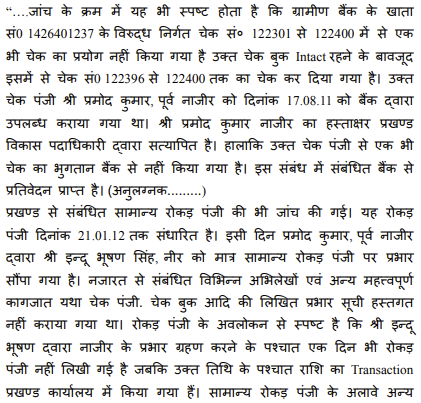
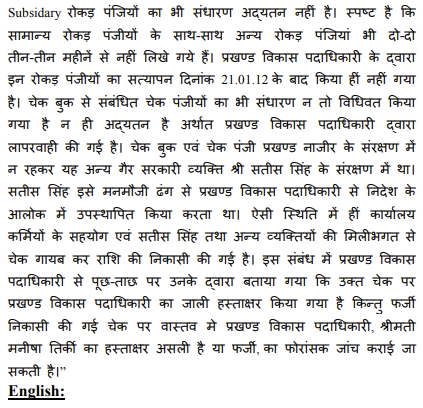

Under Article 226/227 of the Constitution of India, the High Court shall not re-appreciate the evidence, interfere with the conclusions in the enquiry, in case the same has been conducted in accordan....


The court does not act as a Court of appeal in departmental proceedings and considers the conduct of the appellant before and after the punishment order.


Judicial review of disciplinary actions is limited; courts cannot reappraise evidence or substitute their judgment unless findings are arbitrary or unsupported by evidence.

The punishment imposed in a disciplinary proceeding should not shock the conscience of the court and should be proportionate to the proven charge.
Fairness in disciplinary proceedings requires adherence to natural justice, and actions unsupported by adequate evidence are not sustainable.



An indispensable Tool for Legal Professionals, Endorsed by Various High Court and Judicial Officers
Please visit our Training & Support
Center or Contact Us for assistance

Scan Me!
India’s Legal research and Law Firm App, Download now!


For Daily Legal Updates, Join us on :



 Back to top


