
 Back
Back





IN THE HIGH COURT OF JUDICATURE AT MADRAS
Marathal (Died) – Appellant
Versus
Kanniammal (Died) – Respondent
Second Appeal No.339 of 2019 and C.M.P.No.5014 of 2019
Decided On : 26-07-2024
JUDGMENT
The present Second Appeal arises out of the judgment and decree, dated 30.06.2011, passed by the Court of the Principal Subordinate Judge at Tiruppur in A.S.No.14 of 2009 in reversing the judgment and decree of the Court of the District Munsif–cum–Judicial Magistrate at Palladam in O.S.No.235 of 2006 dated 29.01.2009. The 1st appellant before me is the plaintiff in the suit in O.S.No.235 of 2006.
2. For the sake of convenience, the parties will be referred to as per their rank in the suit.
3. One Vellapa Gounder married one Palaniammal. From the wedlock, three daughters and one son were born. The daughters are Kanniyammal, Chinnammal, Marathal and the son is one Marappan. The plaintiff/Marathal is the youngest of three sisters. For easy understanding, the genealogy chart is extracted hereunder :
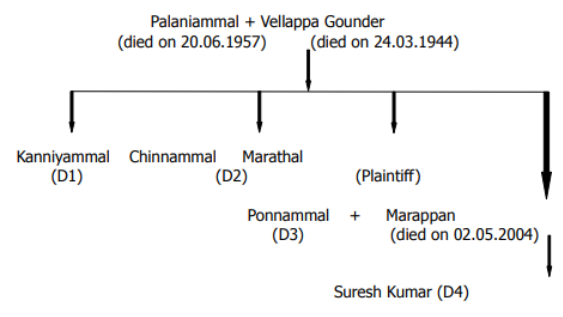
4. Palaniammal purchased Item I of the suit schedule mentioned property on 12.05.1946. Item II of the suit schedule mentioned property was purchased by her on 31.07.1947. Both the purchases were made after the death of her husband/Vellappa Gounder on 24.03.1944. There is no dispute that she was the absolute owner of the property.
5. Accepting the relationship between the parties, the plaintiff claimed that as she is the 3rd daughter of Palaniammal and Vellappa Gounder, she is entitled to 1/4th share in the property. She would state that defendant Nos.1 and 2 are entitled to 1/4th shares each and defendant Nos.3 and 4 together should take 1/4th shares. She pleaded that she convened a Panchayat on 20.07.2006 calling upon the defendants to equitably divide the property and to hand over her share. As they did not do so, she presented a suit for partition.
6. On being served with the summons, defendant Nos.1 and 2 filed a written statement in common and defendant Nos.3 and 4 filed a written statement in common.
7. The case of defendant Nos.1 and 2 supports the case of defendant Nos.3 and 4. They accepted their relationship with the plaintiff but their simple plea was that on 10.08.1956, Palaniammal executed an unregistered "WILL" bequeathing the property in favour of her only son/Marappan. They would also plead that on the death of Palaniammal on 20.06.1957, Marappan took possession of the property and he had been in enjoyment of the same ever since till his death on 02.05.2004.
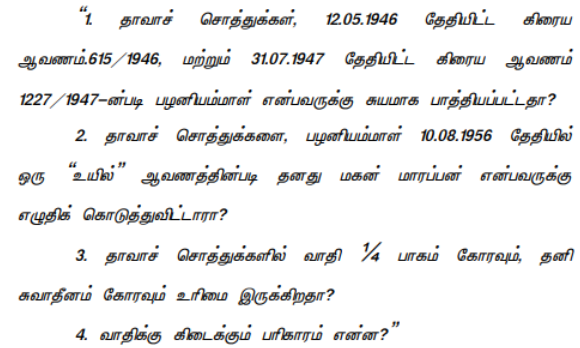
8. On the basis of these pleadings, the learned trial Judge framed the following issues :
9. On the side of the plaintiff, she examined herself as P.W.1 and one Palani Gounder as P.W.2. She marked Ex.A1 to Ex.A3. On the side of the defendants, the 3rd defendant/Ponnammal examined herself as D.W.1 and the 4th defendant/M.Sureshkumar as D.W.2. The attesting witness of the "WILL" of Palaniammal was the eldest daughter/Kanniammal and in that capacity, she was examined as D.W.3. The 2nd defendant/Chinnammal was examined as D.W.4 and one Uppiliappan was examined as D.W.5. On the side of the defendants, Ex.B1 to Ex.B8 were marked. Ex.B1 and Ex.B2 are the original sale deeds under which Palaniammal purchased the properties on 27.04.1946 and 31.07.1947. The revenue records were marked as Ex.B3 and Ex.B4, and the original of the "WILL" of Palaniammal was produced as Ex.B5 by D.W.1. The other records are the death and legal heirship certificates of Marappan, and Ex.B8 are revenue records reflecting mutation from the name of Marappan to the name of defendant Nos.2 and 3.
10. The learned Trial Judge, on the basis of his appreciation of oral and documentary evidence, came to the conclusion that the "WILL" of Palaniammal had not been proved by D.W.3, and therefore, he held that the partition suit would have to be decreed as prayed for.
11. On appeal, on the basis of the very same evidence, the learned appellate Judge took a diametrically opposite view, and was satisfied that the "WILL" had been proved. He further held that the "WILL", being more than 30 years old as of the date of the production before the Court, is entitled to the benefit of Section 90 of the Indian Evidence Act
AI
The presumption of execution and attestation of a 'WILL' over 30 years old can be drawn under Section 90 of the Indian Evidence Act if produced from proper custody.

The presumption under Section 90 of the Indian Evidence Act does not apply to Wills, necessitating proof of execution and attestation by the propounder.


Point of Law - Section 16 (c) of the Act of 1963 provides that specific performance of a contract cannot be enforced in favour of a person who fails to prove that he has performed or has always been ....

A will must be proven in accordance with statutory requirements; the presumption for documents over 30 years old does not apply to wills under Indian law.

(1) Presumption contemplated under Section 90 of Indian Evidence Act in respect of documents more than 30 years old does not apply to a Will.(2) Second Appeal – Scope of interference in a Second Appe....
A Will must be proved in accordance with Sections 63(c) and 68 of the Succession Act, and Section 90 of the Evidence Act does not apply to Wills.


Point of Law : Legal position by explaining the rule of per incuriam, relevancy and binding precedent of ratio decidendi laid down in an earlier judgment of co-equal Bench or a larger Bench.

Exhibiting Wills relies on witness testimony as dictated by Sections 63 and 68 of the Indian Evidence Act; Section 90's applicability is denied for Wills requiring attestation.



An indispensable Tool for Legal Professionals, Endorsed by Various High Court and Judicial Officers
Please visit our Training & Support
Center or Contact Us for assistance

Scan Me!
India’s Legal research and Law Firm App, Download now!


For Daily Legal Updates, Join us on :



 Back to top


