
 Back
Back





BEFORE THE MADURAI BENCH OF MADRAS HIGH COURT
V.SIVAGNANAM, J.
Kailasam Ammal (died) - Appellant
Versus
A.K.C.Balasubramanian (died) - Respondent
S.A.No.2127 of 2002
Decided on : 29-01-2025
| Table of Content |
|---|
| 1. plaintiffs argue against appeal (Para 11 , 12) |
| 2. court reviews evidence (Para 14) |
| 3. court's reasoning on ownership (Para 23) |
| 4. second appeal dismissed (Para 24) |
JUDGMENT :
The Second Appeal has been filed against the Judgment and Decree passed in A.S.No.537 of 1999 dated 25.01.2002 on the file of the Principal Subordinate Judge, Trichy reversing the Judgment and Decree passed in O.S.No.5 of 1994 dated 27.02.1998 on the file of the District Munsif, Musiri.
2. For the sake of convenience, the parties are referred to as per their ranking in the Trial Court.
3. The plaintiffs in O.S.No.5 of 1994 on the file of the District Munsif, Musiri are the appellants herein.
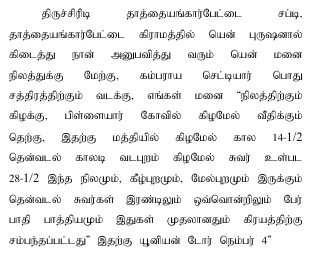
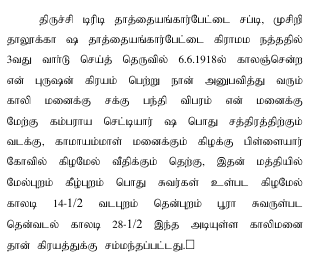
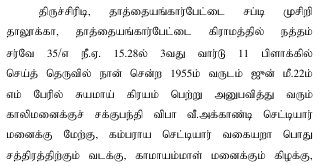
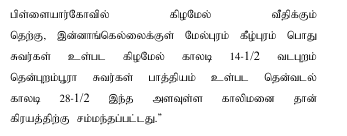
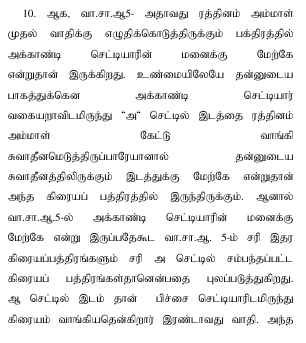
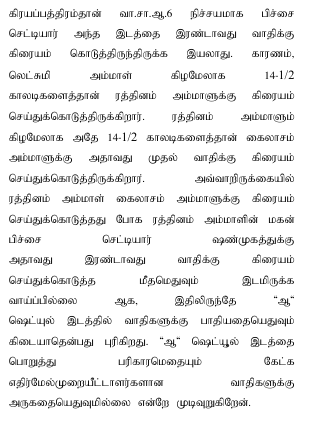
4. The case of the plaintiffs is that the portion marked as BCEF in plaint plan (marked as Ex P-1) is suit 'B' schedule property. The portion marked as EFGH in plaint plan A-1 is suit 'A' schedule property. Originally, ABEFCD portion in the plaint belonged to Vaiyapuri Chettiar. The wife of Vaiyapuri Chettiar inherited the property and sold suit 'B' schedule property to one Mookan Chettiar through Ex.A3 dated 06.06.1918. Thereafter, the wife of said Mookan Chettiar sold the said property to one Rathinammal through Ex.A4 dated 22.06.1955. Thereafter, the said Rathinammal sold the said property to 1st plaintiff through Ex.A5 dated 11.05.1968. When the said property was under the possession and enjoyment of the 1st plaintiff, the defendants asked the 1st plaintiff to sell said property to them, however, she refused. Enraged by this, the defendants highhandedly encroached and put up construction in the 'B' schedule property. The construction put up by the defendants is shown as 'C' schedule in the plaint. The 'A' schedule property was bought by the 2nd plaintiff, who is none else than the son of the 1st plaintiff from one Pichai Chettiar S/o Rathinammal through Ex.A6 dated 02.09.1993. As the defendants have created documents and claimed that the property purchased by the 1st plaintiff is 'A' schedule and not 'B' schedule and further they claimed ownership over 'B' schedule through Ex.B1, the suit was constrained to be filed to declare that the 1st plaintiff is the sole, absolute and exclusive owner of the suit 'B' Schedule property and to deliver possession of the 'B' schedule property to the first plaintiff and to grant a mandatory injunction in favour of the plaintiffs directing the defendants to remove the construction in 'C' schedule property.
5. The defendants filed a written statement and contested suit. It is denied that the subject matter of conveyance under 22.06.1955 sale deed was a schedule property. It is false to state that Rathinam Ammal vendee under sale deed was put into possession of 'B' schedule property and in pursuance of said sale deed, she has been in enjoyment of 'B' schedule property openly, peacefully, continuously and uninterruptedly for more than that the statutory period of limitation and thus, she had perfected title by adverse possession also in respect of 'B' schedule property. As mentioned supra, the subject matter of conveyance under sale deed dated 22-6-1955 was only a schedule property and Lakshmi Ammal was in enjoyment of A schedule property only. The averments in para 11 of the plaint are totally false. The first plaintiff purchased under sale deed dated 11-5-1968 from prior owner Rathinam Ammal only 'A' schedule property and since 'A' schedule property was situated adjacent west of Akkandi Chettiar manai, it has been rightly described in said sale deed as west of Akkandi Chettiar manai. The first plaintiff has purchased under sale deed only 'A' schedule property and she has been in possession and enjoyment of 'A' schedule property only and she has perfected title to A schedule property only by adverse possession also. The averments to the contra in para 11 of plaint are totally false. Even in the partition deed dated 09-07-1993, it is held that in 2nd defendant's family owner of 'A' schedule property is derived to Arumugham
Ownership must be established through valid documentation and evidence of possession; failure to do so results in dismissal of claims.

The central legal point established in the judgment is the shift of burden to the defendants to prove lack of possession and title when the plaintiffs have established continuous possession and title....

Claimants must provide valid title documents and evidence of ownership in property disputes; reliance on non-title documents like patta is insufficient.
The First Appellate Court correctly reversed the trial court's decree due to insufficient evidence from the plaintiffs to establish title over the suit property.

The central legal point established in the judgment is the importance of valid documentation and unchallenged possession in establishing ownership rights, as well as the requirement for legal challen....
Ownership rights cannot exceed what is originally conveyed in property transactions, substantiating claims requires clear and convincing evidence.

The burden of proof on the plaintiffs to establish the disputed properties as joint family properties and the application of settled principles of law in determining the entitlement to the properties....



An indispensable Tool for Legal Professionals, Endorsed by Various High Court and Judicial Officers
Please visit our Training & Support
Center or Contact Us for assistance

Scan Me!
India’s Legal research and Law Firm App, Download now!


For Daily Legal Updates, Join us on :



 Back to top


