
 Back
Back





IN THE HIGH COURT OF JUDICATURE AT MADRAS
J. SATHYA NARAYANA PRASAD, J.
K. Kalamani - Appellant
Versus
State of Tamil Nadu - Respondent
W.P. No. 27781 of 2023
Decided On : 31-01-2025
ORDER :
1. This writ petition has been challenging the impugned order passed by the second respondent vide proceedings Order No.S.4(1)/30584/2021 dated 10.04.2023 and further directing the respondents to grant a minimum time scale of pay of Rs.18,500/- per mensum applying equal pay for equal work under
2. The case of the petitioners is that they were all appointed as Daily Rated Casual Labourers between 2008 and 2013 and the service particulars of the respective petitioners are annexed to the typed set of papers. They are all rendering services under Nominal Muster Roll (NMR) and have continued as such as on date.
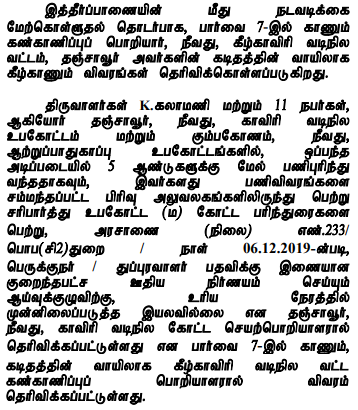
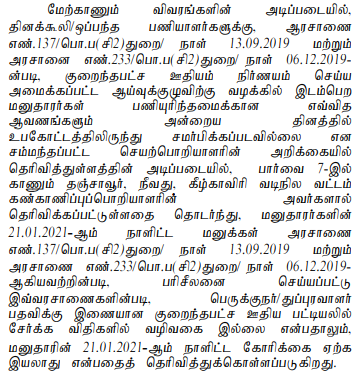
3. The Government by a Policy Decision came up with a proposal that in view of their continuous, uninterrupted services which is required in the Irrigation Management under the Water Resources Organization (WRO), issued an order in G.O.Ms.No.233, Public Works Department dated 06.12.2019, arriving at a total of about 3407 such daily rated casual labourers who are working on a temporary basis to be granted and extended with basic pay at the minimum of the pay scale applicable to the post of sweeper/scavenger with Dearness Allowance thereupon applicable from time to time directed that instead of bringing them under regular time scale of pay or for permanent absorption.
4. While being so, a Screening Committee was also constituted for the purpose of verification of these types of NMRs. The Screening Committee which was directed to identify the eligible casual labourers arrived at 3407 NMRs.
5. In an earlier round of litigation, as many as 20 persons approached the Madurai Bench of Madras High Court in W.P.(MD)No.8092 of 2020 to permit the petitioners to continue as NMRs' till their permanent absorption among other prayers. This Court after making certain observations dispose of the writ petition by giving few directions:
56. In view of the aforesaid discussions and the factual matrix of this case, this Court is inclined to pass the following orders in this writ petition:
(1) That out of the 20 petitioners, except Petitioner Nos.2, 15 and 19, others are not entitled to seek for any relief, as they have claimed in this writ petition. Therefore, insofar as the other 17 petitioners, the prayer sought for by the petitioners is rejected.
(2) In respect of the petitioner Nos.2, 15 and 19, based on the certificate issued by the very PWD Executive Engineers concerned certifying that, they have been engaged directly as NMR employees for more than five years and ten years respectively, their candidature can be considered by the respondents PWD for the continuous engagement.
(3) In future, as has been declared in the G.O.137 Public Works Department dated 13.09.2019, no NMR employees shall be engaged in the Public Works Department, except at the campus, sites indicated in Item No. (i) of Paragraph 6 of G.O.137. However, for any emergency or contingency, if the Government decides to engage any new NMR employees only for the specific purpose or for a limited period, even such engagement shall be strictly made only from among the candidates, whose names are sponsored by the concerned Employment Exchange and at no circumstances, direct engagement shall be made by way of pick and choose method by the PWD officials.
(4) The Government shall come forward to issue necessary Government orders prescribing the age, educational qualifications and physical fitness for the purpose of engagement and method of engagement of NMR employees in future.
(5) In this context, the G.O., may indicate or prescribe the educational qualifications of only or the maximum of up to Higher Secondary, ie., +2 and as far as possible, such engagement shall only be made from among the candidates, who have the educational qualification only upto +2 and the highly qualified people, who are having profess
The court affirmed that denying equal pay to similarly situated casual labourers violates constitutional rights, emphasizing the need for timely administrative action.

The court ruled that the failure to include petitioners in the Screening Committee due to administrative delay violated their rights to equal pay under Article 39(d) of the Constitution.
Equal pay for equal work under Article 39(d) of the Constitution mandates that similarly situated employees must receive the same remuneration, and arbitrary denial violates principles of natural jus....


Recognition of entitlements for long-serving casual workers under employment laws, emphasizing fair treatment and prevention of exploitation by the State.

The court affirmed that casual workers are entitled to the minimum of the pay scale for their roles based on the principle of 'equal pay for equal work', as established in relevant Supreme Court ruli....
Temporary employees performing essential functions are entitled to regularization and minimum pay, emphasizing the responsibility of employers to ensure fair treatment and compliance with legal stand....

Temporary employees performing identical duties to regular workers are entitled to minimum time scale of pay under the principle of Equal Pay for Equal Work.

Equal pay for equal work mandates 1/30th minimum wages for long-term casual labours performing regular duties, prohibiting discrimination among similarly situated employees.
The principle of equal pay for equal work mandates that employees performing similar duties must receive the same remuneration, regardless of their employment status.



An indispensable Tool for Legal Professionals, Endorsed by Various High Court and Judicial Officers
Please visit our Training & Support
Center or Contact Us for assistance

Scan Me!
India’s Legal research and Law Firm App, Download now!


For Daily Legal Updates, Join us on :



 Back to top


