Back
Back





2025 Supreme(Mad) 4453
IN THE HIGH COURT OF JUDICATURE AT MADRAS
G.Jayachandran, J.
G.Parthiban - Appellant
Versus
M.Govindasamy and ors. - Respondents
Appeal Suit No.515 of 2022
Decided On : 09-07-2025
Advocate Appeared:
For the Appellant : Mr.V.Raghavachari, Senior Counsel for Mr.T.R.Rajaraman
For the Respondent: Ms. Chenthoori Pugazendhi for Mr.K.Balu
A claim for partition must be substantiated by evidence of ancestral property status or blending with joint family property, which was not proven in this case.
Headnote:(A) Hindu Succession Act - Section 8 - This Appeal Suit is against the dismissal of a partition suit, where the appellant claimed ancestral properties were not properly partitioned. The court found that properties were not ancestral and dismissed the suit as unsubstantiated. (Paras 1, 18, 34)
(B) Joint Family Property - The court emphasized the requirement of evidence showing ancient roots or blending of properties to establish ancestral character; failure to prove such connections led to dismissal. (Paras 26, 30-31)
(C) Evidence - The trial court properly considered both documentary and oral evidence in determining property ownership, finding significant discrepancies in claims regarding property status. (Paras 20, 28, 34)
Facts of the case:
The appellant sought a partition, claiming ancestral status for properties held by the respondents, disputed by the respondents on grounds of individual ownership and settlement deeds executed in their favor.
Findings of Court:
The trial court found no evidence supporting joint family property status for the claimed parcels; it ruled in favor of the defendants and dismissed the suit.
Issues: The court addressed whether the properties could be classified as ancestral based on evidence of joint ownership and blending of property.
Ratio Decidendi: The court upheld that properties gained an independent character when not proven to be part of a joint family nucleus and confirmed settled ownership of the defendants as valid.
Result: Appeal dismissed.
| Table of Content |
|---|
| 1. initial facts of the partition suit and parties involved. (Para 1 , 2 , 3 , 4 , 5 , 6 , 7 , 8 , 9 , 10 , 11 , 12 , 13) |
| 2. arguments and evidence presented by the parties. (Para 18 , 19 , 20 , 21 , 22 , 23) |
| 3. court's observations on evidence and property character. (Para 24 , 26 , 27 , 28 , 29 , 30 , 31 , 32) |
| 4. ratio decidendi regarding blending of property. (Para 33) |
| 5. final decision and conclusion. (Para 35 , 36) |
JUDGMENT :
G.Jayachandran, J.
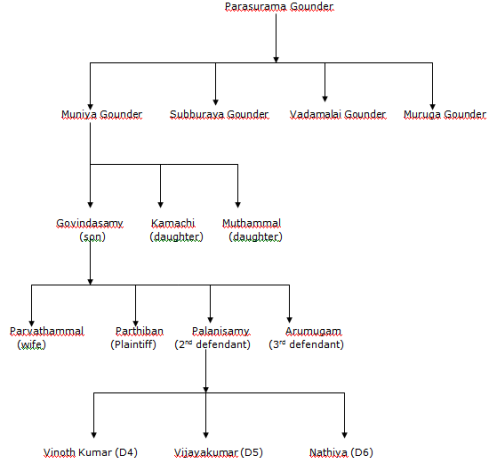
This Appeal Suit is against the dismissal of the partition suit filed by Mr.G.Parthiban, against his father Govindasamy and two brothers namely Palanisamy and Arumugam.
2. The aggrieved plaintiff is the appellant herein.
3. The case of the Appellant/Plaintiff:
The suit properties 33 in numbers are either the ancestral properties or the properties purchased in the name of the defendants 1, 2 and 4 from the ancestral nucleus put into hotchpot of the joint family properties. The suit properties are in joint enjoyment of the plaintiff along with defendants 1 to 3. While so, for past three years, the plaintiff oral request to divide the properties and give his 1/4th share, but not heeded by the defendants. Hence, the suit for partition and delivery of separate possession.
4. In support of his claim, the appellant/plaintiff had relied upon his oral evidence and the following documents:
(1) Patta issued in the name of his grand father Muniya Gounder, S/o Parasurama Gounder for suit properties described in items 1 to 7 (Ex.A-1).
(2) Patta issued in the name of Seenu Gounder (alias Muniya Gounder), S/o Parasurama Gounder for suit properties described in items 8 to 11 (Ex.A-2)
(3) Patta issued in the name of his father Govindasamy (first defendant), S/o Muniya Gounder for suit properties items 31 to 33(Ex.A-3).
(4) Patta issued in the name of his father Govindasamy (first defendant), S/o Muniya Gounder for suit properties items 12 to 18(Ex A-4).
(5) Sale deed dated 21.06.1993 in favour of Palanisamy (2nd defendant) for suit property items 20 to 22(Ex.A-5)
(6) Sale deed dated 12.10.1998 in favour of Palanisamy (2nd defendant) for suit property item 23. (Ex.A-6)
(7) Sale deed dated 29.01.1999 in favour of Palanisamy (2nd defendant) for suit property items 24 and 25 (Ex.A-7).
(8) Sale deed dated 09.07.2003 in favour of Minor Vinodkumar (4th defendant), Son of Palanisamy (2nd defendant) for suit property items 26 to 30(Ex.A-8).
(9) Settlement deed dated 31.08.2015 executed by Govindasamy (the first defendant) in favour of Vijayakumar (5th defendant) for suit property items 12, 13, 15 to 19.(Ex A-9). In this settlement deed, item No.21, bearing S.No.315/2 measuring 0.02 cents, out of 0.06 cents also included but patta for this survey number is not in the name of Govindasamy. Item 21 is one of the property in Ex.A-5 sale deed in favour of Palanisamy (2nd defendant) sold by Chinnasamy and his son Nataarajan.
(10) Settlement deed dated 29.03.2016 executed by Govindasamy ( first defendant) in favour of Nathiya ( 6th defendant) for suit property items 8 to 11(Ex A-10).
5. In Ex.A-9, Govindasamy had described the properties items 12 to 19 (except item 14)settled to the 5th defendant as his self acquired property purchased from his income as a Teacher on various dates . In Ex.A-10, he had described the properties, items 8 to 11 as properties inherited from his ancestors. (Pithurajiaya).
6.During the cross examination of PW-1, the first defendant had marked Ex.B-1 to Ex.B-12. These 12 documents are:
Ex.B-1 to Ex.B-6 and Ex.B-8 are the sale deeds in the name of Munia Gounder for the purchase of suit items 1 to 6.
Ex.B-7 is a pronote executed by the 2nd defendant in favour of A.S.Subramaniam for borrowing Rs.23,000/-. In this pronote, the plaintiff is one of the attesting witness.
Ex.B-11 is the sale deed in favour of the first defendant in respect of properties in S.No.90/1 measuring 296 ¼ sq ft and 1387 ½ sqft with specific boundaries. First defendant had settled 1387 ½ sq t to the plaintiff under Ex.B-9 and 296 ¼