
 Back
Back





BEFORE THE MADURAI BENCH OF MADRAS HIGH COURT
G.R.SWAMINATHAN, J.
P.Naveen Kumar - Petitioner
Vs.
The District Collector, District Collector Office, Karur District - Respondent
WP(MD)No.10496 of 2024
Decided On : 17-05-2024
| Table of Content |
|---|
| 1. the petitioner seeks permission for a traditional religious practice. (Para 2) |
| 2. arguments raised regarding fundamental rights and governmental restrictions. (Para 3 , 4) |
| 3. court's analysis of fundamental rights under article 25(1). (Para 5 , 6 , 7) |
| 4. definition and scope of religious practices and their constitutional protections. (Para 8 , 9 , 10 , 11) |
| 5. legal interpretations of public order, morality, and health in religious contexts. (Para 12 , 13 , 14) |
| 6. contemporary cases involving religious practices and judicial intervention. (Para 15 , 16 , 17) |
| 7. recognition of fundamental rights in religious contexts including privacy. (Para 18 , 19) |
| 8. spiritual orientation as part of individual autonomy and constitutional rights. (Para 20 , 21 , 22) |
| 9. interplay between religious practices and constitutional protections against discrimination. (Para 23 , 24) |
| 10. judicial review and the principle of natural justice in prior orders regarding religious practices. (Para 25 , 26 , 27) |
| 11. orders passed in absence of necessary parties are null and void under natural justice principles. (Para 28 , 29 , 30) |
| 12. court's direction on religious practices with respect to fundamental rights. (Para 31 , 32) |
| 13. clarification of single bench and division bench authority in constitutional matters. (Para 33 , 34 , 35) |
| 14. judicial intervention is necessary only in violation of constitutional principles. (Para 36 , 37) |
| 15. statutory permissions irrelevant for customary religious events. (Para 38 , 39) |
| 16. final ruling allows the petitioner to perform the religious practice free of state interference. (Para 40) |
ORDER :
G.R. SWAMINATHAN, J.
1. Heard both sides.
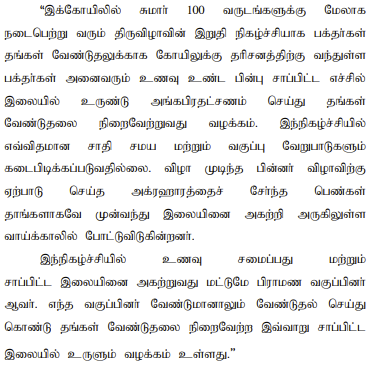
2. The writ petitioner is a resident of Karur District. He is a devotee of Sri Sadasiva Brahmendral, one of the most well known saints of Tamil Nadu. His final resting place is at Nerur Village. His Jeeva Samadhi Day is marked by performance of “Annadhanam”(Sacred offering of food) and other religious rituals. One of the main events used to be the rolling over (Angapradakshinam) the banana leaves in which other devotees had partaken their food. The petitioner has taken vow to perform the said religious service this year. The Jeeva Samadhi Day falls on 18th of May. The petitioner formally wrote to the authorities seeking permission since the performance of the ritual which is 120 years old was stopped in the year 2015. The representation dated 22.04.2024 did not elicit any response. Hence, the present writ petition came to be filed.
3. The learned counsel appearing for the petitioner contended that the issue involves the petitioner's fundamental rights guaranteed under the Constitution of India. He called upon this Court to grant relief as prayed for. The petitioner's stand was fully endorsed by the learned counsel appearing for the fourth respondent which organises the function.
4. The learned Additional Government Pleader appearing for the District Administration and the learned Government Advocate (crl.side) appearing for the police authorities submitted that their hands are tied in view of the order dated 28.04.2015 made in WP(MD)No.7068 of 2015.
5. I carefully considered the rival contentions and went through the materials on record. Two issues arise for consideration. One is the scope and ambit of the petitioner's right. The other is whether the order cited as an impediment by the respondents is nullity in law.
6. Part III of the Constitution of India enumerates the fundamental rights. Article 25(1) of the Constitution declares that all persons are equally entitled to freedom of conscience and the right to freely profess and practise religion. However, this right is not absolute. It is subject to public order, morality and health and the other provisions of Part III. Clause 2 of Article 25 clarifies that nothing in that article shall affect the operation of any existing law or prevent the State from making any law regulating or restricting any economic, financial, political or other secu
AI
The fundamental right to freely practice religion under Article 25(1) is protected, and any prohibitory orders lacking natural justice are null and void.

Religious practices are subject to constitutional morality and must not infringe on human dignity or public health, reaffirming the binding nature of higher court judgments.

A single judge cannot declare a Division Bench judgment null; judicial discipline mandates adherence to higher court rulings, ensuring consistency in legal interpretations.

Stray incidents do not justify blanket executive ban on religious festival celebrations in temple under Articles 25, 26; rights prevail subject to reasonable restrictions with proximate nexus to publ....


The impugned order was passed without jurisdiction and in violation of the principles of natural justice, and it infringed upon the Petitioner's fundamental rights under Article 19(1), Articles 25 an....

The court ruled that the Udayasthamana Pooja's status as a religious practice must be established in civil court, and the Managing Committee's decisions regarding rituals are not subject to judicial ....
The court affirmed that access to public temples cannot be restricted based on caste or community, emphasizing the fundamental right to worship under Article 25 of the Constitution.



An indispensable Tool for Legal Professionals, Endorsed by Various High Court and Judicial Officers
Please visit our Training & Support
Center or Contact Us for assistance

Scan Me!
India’s Legal research and Law Firm App, Download now!


For Daily Legal Updates, Join us on :



 Back to top


