
 Back
Back





BEFORE THE MADURAI BENCH OF MADRAS HIGH COURT
S.SRIMATHY, J.
Palanichamy - Appellant
Versus
Muthu - Respondent
S.A.(MD).No.17 of 2024 and C.M.P.(MD)Nos.478 and 480 of 2024
Decided on : 19-06-2024
| Table of Content |
|---|
| 1. overview of property dispute between brothers. (Para 1 , 2 , 3) |
| 2. defendant's claim based on ancestral property rights. (Para 4 , 5) |
| 3. identification of substantial questions of law. (Para 6) |
| 4. analysis of coparcenary rights post-antiquity. (Para 7 , 8) |
| 5. examination of family arrangements and wills. (Para 9 , 10 , 11 , 12 , 13 , 14) |
| 6. suit barred by limitation based on lack of action. (Para 15) |
| 7. ruling in favor of the defendant and dismissal of the appeal. (Para 16 , 17) |
JUDGMENT :
S. SRIMATHY, J.
1. The Second Appeal in S.A.(MD)No.17 of 2024 is filed against the Judgment and Decree, dated 14.09.2023 in A.S.No.41 of 2020 on the file of the II Additional District Court, Thoothukudi, reversing the Judgment and Decree, dated 18.12.2019 passed in O.S.No.41 of 2015, on the file of the Sub Court, Kovilpatti.
2. The defendant in the suit is the appellant herein and the plaintiff in the suit is the respondent herein. For the sake of convenience, the rank of the parties shall be referred as plaintiff and defendant as stated in suit.
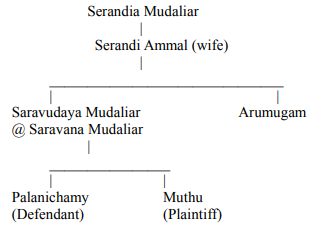
3. The suit in O.S.No.41 of 2015 was filed to declare that the property belongs to the plaintiff and consequently, to vacate the defendant within a particular period to be fixed by the Court. The plaintiff and the defendant are brothers. The brief facts as stated by the plaintiff is that the mud wall and thatched house in the suit property in Natham S.No.593/2, Door No.20 belongs to the father of the plaintiff and defendant namely Saravana Mudaliar. Originally, the suit property and the eastern portion Door No.19 was comprised with Door No.20 and the said house was bequeathed to the plaintiff through Will dated 13.12.1978 and the said Saravana Mudaliar died on 08.12.1985, thereafter, the Will came into effect. Since the plaintiff was in Government job and was staying elsewhere, further the defendant, being plaintiff’s brother, was not having any house to reside, the defendant had sought permission to reside in the house and the permission was granted. The defendant was residing in the suit property only as the brother of the plaintiff and the plaintiff directed the defendant to pay all taxes only on behalf of the plaintiff. But only in the year 2010, the plaintiff came to know that the defendant is paying property taxes in the name of the defendant and not in the name of the plaintiff. After questioning the same the plaintiff tried to change the name in the property tax records. Hence, the defendant Palanichamy had filed suit in O.S.No.50 of 2010 on the file of District Munsif Court, Vilathikulam, by arraying the Municipal Commissioner, District Collector, Tahsildar and the plaintiff Muthu as parties. The said suit was allowed in favour of the defendant Palanichamy. Hence, the plaintiff Muthu had filed A.S.No.12 of 2015 and the same is pending. Since the plaintiff had granted permissive possession to the defendant, but the defendant by paying taxes in his name had created documents in his name, the plaintiff had issued Lawyer Notice dated 10.03.2015 cancelling the permission to reside in the suit property. The defendant had received the same and through reply notice dated 18.03.2015 had falsely stated that during the life time of Saravana Mudaliar the suit property was given to the defendant through oral partition. Since the said statement is false, the plaintiff had filed the suit to declare that the suit property belongs to the plaintiff and consequently, to direct the defendant to vacate the suit property and hand over the same to the plaintiff. The said suit in O.S.No.41 of 2015 was dismissed, Aggrieved over the same, the plaintiff had filed the appeal in A.S.No.41 of 2020 and the same was allowed. Aggrieved over the same, the defendant in the suit had preferred the present second appeal in S.A.(MD)No.17 of 2024.
4. The case of the defendant Palanichamy is that the suit property along with its contiguous portions on its east and other properties originally belong to his paternal grandfath
AI
The court affirmed that coparcenary properties cannot be unilaterally willed, preserving the equal rights of all coparceners under Hindu law.
The court affirmed that the plaintiff, as a coparcener by birth, is entitled to a ½ share in ancestral properties under the Hindu Succession Act, 1956, and ruled against the validity of transactions ....

Court ruled that ancestral property retains its character despite prior partition and upheld the validity of a Will despite exclusion of a natural heir.
The main legal point established in the judgment is the determination of ancestral properties available for partition and the validity of gift settlement deeds.
The properties in question were determined to be ancestral, granting coparcenary rights to the daughter under the Hindu Succession (Amendment) Act, 2005.

The main legal point established in the judgment is the entitlement of the Plaintiffs to a 1/4th share in the joint family ancestral properties and the invalidity of the registered Will Deed.

The ancestral nature of property was affirmed, and a Will executed by a deceased patriarch in favor of an illegitimate child was recognized as valid for 1/3rd share, pending partition.

The court established that ancestral property retains its coparcenary character despite partition, affirming the rights of legitimate heirs under Hindu law.



An indispensable Tool for Legal Professionals, Endorsed by Various High Court and Judicial Officers
Please visit our Training & Support
Center or Contact Us for assistance

Scan Me!
India’s Legal research and Law Firm App, Download now!


For Daily Legal Updates, Join us on :



 Back to top


