
 Back
Back





THE HIGH COURT OF JUDICATURE AT MADRAS
P.B.BALAJI, J.
Ravikumar – Appellant
Versus
N.R. Pachamuthu - Respondent
A.S. No.391 of 2023 and CMP. Nos. 13732 & 13733 of 2023
Decided On : 13-02-2026
| Table of Content |
|---|
| 1. background of the partition dispute (Para 1 , 3) |
| 2. arguments on partition deed validity and minor's rights (Para 4 , 5 , 6 , 7) |
| 3. court's examination of limitations and fairness of the partition (Para 8 , 9 , 10) |
| 4. legal standing of partition based on execution and prior conduct (Para 11 , 12) |
| 5. final findings and dismissal of the appeal (Para 13) |
| 6. final conclusion of the judgment (Para 14) |
JUDGMENT :
P.B.BALAJI, J.
The plaintiffs, aggrieved by dismissal of O.S. No.231 of 2019, on the file of the 1st Additional District Court, Namakkal, are the appellants.
2. I have heard Mr.S.Kalyanaraman, for Ms.G.Ramya, learned counsel for the appellants and Mr.C.Jagadish, learned counsel for the respondents.
3. PLEADINGS:-
(a) Plaint in brief:-
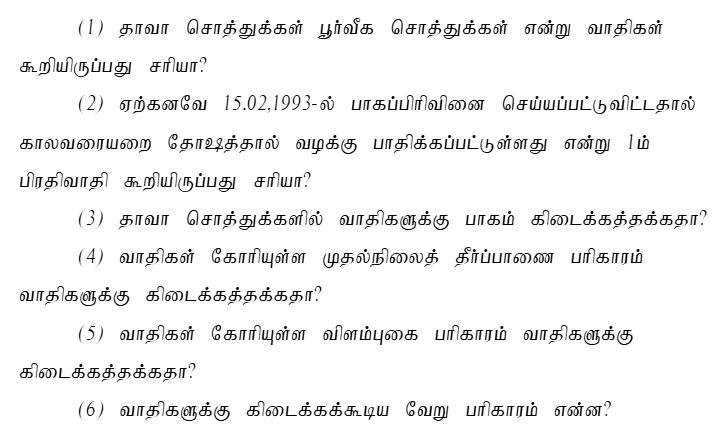
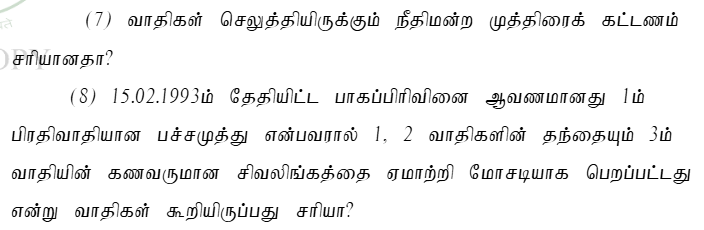
The Plaintiffs 1 and 2 are brothers and the third plaintiff is their mother. The father of the plaintiffs 1 and 2 and the husband of the third plaintiff, late Sivalingam and the first defendant have entered into a partition on 15.02.1993. The said partition deed was never acted upon. The plaintiffs 1 and 2 were minors on the date of execution of the said partition deed. They are not bound by the said partition deed, which has come to their knowledge only now. The said partition deed cannot infringe upon the rights of the plaintiffs 1 and 2. On the date of the partition deed, both the plaintiffs 1 and 2 were already born and they were proper and necessary parties to the partition deed. Their father Sivalingam, was educated and he took up employment and was not therefore, having the time to look into the agricultural operations. Taking advantage of the same, the first defendant has misled the said Sivalingam into executing the partition deed by taking fertile lands into his shares and allotting dry lands to the said Sivalingam. Sivalingam was under the impression that his elder brother, the first defendant would not cheat him and believed him blindly and signed the partition deed without even reading its contents. Therefore, he never questioned the partition deed during his lifetime. The third plaintiff is a retired Government Servant and when the plaintiffs attempted to cultivate the lands, the defendants have resisted the same, citing the registered partition deed. The defendants have also refused to release water for irrigating purposes from the Well. The Panchayat held to settle the disputes, where also the defendants refused to come forward for any amicable settlement. The plaintiffs therefore issued a lawyer’s notice on 20.12.2018 and thereafter, since there was no response from the defendants, the plaintiffs are constrained to file the suit challenging the partition deed, dated 15.02.1993 and consequently, seek partition and separate possession.
(b) Written Statement in brief:-
The plaintiffs have no right in the suit property. It is the burden of the plaintiffs to establish that the properties are the ancestral properties and hence, the plaintiffs 1 and 2 are coparceners by birth. The father and husband of the plaintiffs is not an illiterate person. He is well educated and was also employed. The averments that the said Sivalingam believed the first defendant and blindly signed the document is stoutly denied. The said Sivalingam was fully aware of the contents of the partition deed and he executed it only after understanding the implications of the division. After the said partition, the said Sivalingam never demanded for re-partition as claimed by the plaintiffs. There was no Panchayat as claimed by the plaintiffs. In fact, after the partition, Sivalingam had even leased out the lands which were allotted to his share to various persons and therefore, the partition deed was acted upon and it is false to contend that the partition was never acted upon. The division was effected taking into consideration the lay of the properties as well as their fertility alone and the partition was in a fair and equitable manner. The plaintiffs are not entitled to challenge the partition deed belated
AI
The court upheld the validity of the partition deed, ruling the plaintiffs' belated challenge was barred by limitation and emphasizing that prior acceptance of the deed by their father precluded the ....

A party is estopped from making claims contrary to prior admissions in legal notices, and a partition deed signed by the plaintiff is binding, rendering any claims of joint ownership barred by limita....
In a partition suit, registered documents act as constructive notice, initiating the limitation period. Prolonged exclusive possession of ancestral property by a co-owner establishes ouster. Addition....
Properties claimed as self-acquired were determined to be ancestral; the appeal for partition was dismissed due to lack of joint possession evidence and non-joinder of necessary parties, also barred ....
The rights of daughters as coparceners are upheld, but registered partitions enacted before the relevant amendments cannot be contested unless fraud is proven.

The main legal point established in the judgment is that allegations of fraud, coercion, and undue influence require strict proof of facts, and the mere existence of unequal shares does not lead to a....
The property in question ceased to be ancestral due to prior Release Deeds; plaintiffs failed to prove their claim for partition and their action was barred by limitation.
A partition deed's validity cannot be challenged after the limitation period, especially when the party had prior knowledge; claims of fraud must also adhere to the same statutory timelines.

Plaint rejection under Order VII Rule 11 upheld where averments admit knowledge of challenged partition deed since 2002, rendering 2021 suit barred by 3-year limitation under Article 59, without need....
Oral transfers of property are invalid without formal documentation; joint heirs maintain equal ownership rights upon intestate succession.



An indispensable Tool for Legal Professionals, Endorsed by Various High Court and Judicial Officers
Please visit our Training & Support
Center or Contact Us for assistance

Scan Me!
India’s Legal research and Law Firm App, Download now!


For Daily Legal Updates, Join us on :



 Back to top


