
 Back
Back





IN THE HIGH COURT OF JUDICATURE AT MADRAS
D.BHARATHA CHAKRAVARTHY, J.
The Management of Pennar Industries Limited – Appellant
Versus
United Labour Federation, Rep. by its Secretary – Respondent
W.P. No. 12808 of 2024, W.M.P. No. 13982 of 2024
Decided On : 12-01-2026
| Table of Content |
|---|
| 1. acknowledgment of union demands and dispute referrals. (Para 1 , 2 , 3) |
| 2. arguments regarding management's acceptance of settlements. (Para 4 , 5 , 6 , 7 , 8 , 9 , 10) |
| 3. the binding nature of consented agreements. (Para 11 , 12) |
| 4. the petition's dismissal and encouragement for mediation. (Para 13 , 14) |
ORDER :
1. Writ Petition is filed challenging the award of the Industrial Tribunal Tamil Nadu, Chennai, dated 21.02.2024 in O.P.No.4 of 2019.
2. Upon hearing the learned counsel for the petitioner and perusing the affidavit filed in support of the writ petition and material records of the case, it can be seen that claiming on behalf of the Workmen under the petitioner- management, the respondent-trade union raised the charter of demands majority. The demands wherein respect of each and every aspects of the wage, structure, allowance, etc. The dispute was referred for adjudication by the appropriate Government vide G.O.(D).No.284, dated 22.06.2015 and the questions to be adjudicated are mentioned therein and extracted in the impugned award of the Tribunal in paragraph No.1:
AWARD
The Government of Tamil Nadu has by way of G.O. (D)No.284 dated 22.06.2015 referred the present dispute for adjudication and the following issues were referred to adjudication.
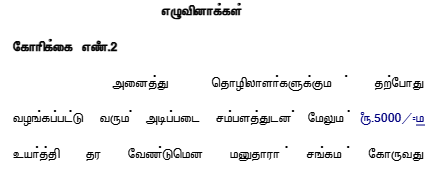
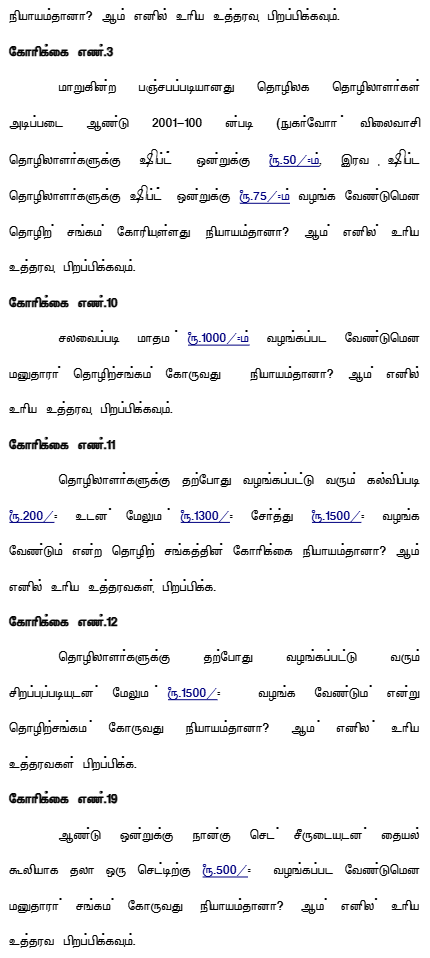
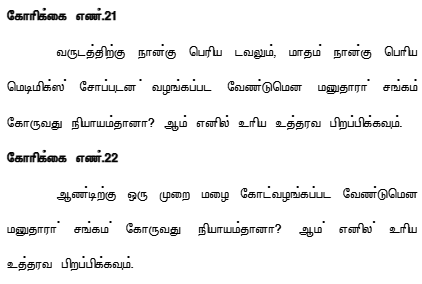
3. Under the said circumstances, the Workmen filed a claim statement in support of the claim and the same was resisted by filing a counter affidavit by the management. While so, a memo was filed on behalf of the Workman and it is essential to extract the entire Memorandum that is filed by the Workman:
“MEMO FILED ON BEHALF OF THE PETITIONER UNION
1. The petitioner respectfully submitted that the petitioner union raised an industrial dispute against the management on 16.05.2014 before the Assistant Commissioner of Labour (Conciliation-1) and subsequently failure report issued on 04.12.2014. The respondent management entered into 18(1) Settlement with the Pennar Industries Employees Union on 20.05.2015. Subsequently the respondent management has made two settlements with the Pennar Industries Employees Union in the year of 2018-2021 and 2021-2024.
2. It is further submitted that initially there were 71 workers in the petitioner union. Out of 71 workers 15 workers are working in the respondent management now, 21 workers conducting the dispute against their Transfer orders, 4 workers have been dismissed by the respondent management, and 26 workers have joined with the Pennar Industries Employees Union in the year of 2015. 15 workers who belong to the petitioner union have not accepted the said settlements. Now the workers are ready to accept the settlement due to the poverty and economic commitments. As the majority of the workers have accepted the aforesaid settlements and the rest of the 15 workers are also decided to accept the said settlements. The above said 15 workers doing the same work as the other workers but they are receiving very less salary than the others. Therefore, the 15 workers who are working in the respondent management are entitled to get the benefits of the said settlement.”
4. As per the award, opportunities were granted for the management to file their objections. However, the impugned award records, that is submitted orally by the learned counsel appearing on behalf of the management that, they have no objection for passing an award in terms of the settlement, however, they have objections with reference to the averments made in the memo. The Tribunal, after taking note of the stand of the management, passed an award in terms of the agreement between the parties, after examining, whether the award was fair and proper. The Tribunal concluded that, since the award is accepted by a majority of Workmen and both sides were willing to go by the settlement, the reference was answered by holding that the demands of the Union are answered in terms of the settlements dated 20.05.2015, 24.08.2018 and 24.08.2022 entered into under Section 18(1) of the Industrial
AI
Consent awards under the Industrial Disputes Act, once given by management, cannot be retracted unless valid objections were filed at the time of consent.

The central legal point established is that the Labour Court must prima facie satisfy itself on the fairness and justness of settlements under Section 11 of the Industrial Disputes Act, by examining ....
The court affirmed existing employee benefits under the Industrial Disputes Act, maintaining retirement age at 60 and rejecting unjustified pension scheme modifications by management.
The court held that prior settlements are binding on unions, and claims for wage benefits cannot be raised if previously resolved, emphasizing the importance of adherence to agreements.

The Tribunal must conduct a thorough evidentiary analysis to justify decisions concerning wage revisions and additional allowances under the Industrial Disputes Act, ensuring all material evidence is....

The main legal point established in the judgment is that settlements entered into in Industrial Disputes are valid and legal, even though provisions similar to Order XXIII Rule 3 CPC do not exist in ....
The main legal point established in the judgment is the validity and binding nature of settlements in industrial disputes, even if not confirmed by both parties, under Section 18(1) of the ID Act.

The court upheld the Industrial Tribunal's award for wage revision, emphasizing the need for fair compensation while considering the financial capacity of the management.
The main legal point established in the judgment is that workmen cannot retain the benefit if they want to prosecute claim petitions instituted by them with the Labour Court, and a balancing and prag....

Industrial settlements are binding package deals promoting peace; fraud requires specific proof and timely protest; employee status continues post suspension notice assuring protection until valid vo....



An indispensable Tool for Legal Professionals, Endorsed by Various High Court and Judicial Officers
Please visit our Training & Support
Center or Contact Us for assistance

Scan Me!
India’s Legal research and Law Firm App, Download now!


For Daily Legal Updates, Join us on :



 Back to top


