
 Back
Back





IN THE HIGH COURT OF JUDICATURE AT MADRAS
A.D. MARIA CLETE, J.
The Management, Sodecia India Private Limited - Appellant
Versus
The Presiding Officer, Industrial Tribunal, Tamil Nadu - Respondents
W.P.No. 1015 of 2020 and W.M.P.Nos. 1220, 1221 & 24367 of 2020 and 18333 of 2022
Decided on : 25-04-2025
(A) Industrial Disputes Act, 1947 - Section 18(1) - Writ petition challenging the Award dated 20.12.2019 passed by the Industrial Tribunal - Tribunal granted certain demands of the Trade Union while rejecting others - Management contended that the Tribunal failed to consider financial capacity and erroneously fixed wages without adequate evidence - Court found that the Tribunal's decision was reasonable and upheld the award. (Paras 6, 30)
(B) Wage Revision - The principle of 'industry-cum-region' must be applied in wage determination, ensuring comparisons are made with similar enterprises - The Tribunal's findings were based on a comprehensive evaluation of evidence, including financial records. (Paras 19, 26)
Facts of the case:
The Petitioner Management challenged the Tribunal's award granting Rs.8,100/- per month to employees from 11.09.2015, while rejecting other demands. The Management argued that the Tribunal did not adequately consider its financial losses and made arbitrary comparisons with other industries. (Paras 6, 19)
Findings of Court:
The Tribunal's award was upheld as it did not suffer from any infirmity, and the wage increase was deemed reasonable to ensure workers' livelihood. (Paras 30)
Issues: The main issues included whether the Tribunal properly considered the Management's financial capacity and the justification for the wage increase. (Paras 19, 30)
Ratio Decidendi: The court ruled that the Tribunal's decision was justified, emphasizing the importance of considering the financial capacity of the Management while also ensuring fair wages for workers. (Paras 26, 30)
Result: Writ petition dismissed.
JUDGMENT :
A.D. MARIA CLETE, J.
Heard.
2. After the matter was reserved for orders on 10.03.2025, the Court Officer compiled the case bundle, which included an office note recording the names of counsel who had advanced arguments and the list of citations relied upon, and the same was duly circulated to the residence. Following the dictation and verification of the draft, and upon the matter being ready for pronouncement, an oral representation was made by Mr. Anand Krishnan, learned counsel, on 26.03.2025, stating that he had not been heard. At no point prior to and even after 26.03.2025 did the learned counsel address any formal communication to the Registry or bring the opposite party for the purpose of mentioning. Even after the oral mention on 26.03.2025, no prompt steps were taken by the counsel to have the matter formally mentioned. It was only on 04.04.2025 that a written request was submitted to the Registry, following which the matter was listed on 16.04.2025 under the caption “for being mentioned.”
3. During that listing, learned counsel advanced submissions stating that the trial Court had failed to examine the balance sheets filed by the Management, which, according to him, demonstrated consistent financial losses. He contended that the Labour Court had instead relied on a comparison with similar industries to arbitrarily fix a sum of Rs.8,100/- as wages, without supporting evidence. Referring to paragraph 10 of the award, it was submitted that had the financial records been properly scrutinised, the Court would have concluded that the company was incurring losses, and in such a case, drawing comparisons with other industries would be unwarranted. It was further submitted that the Labour Court erroneously recorded the continued operation of Unit II at Vanagaram, whereas the said unit had been closed long prior, and that this incorrect factual premise invalidated the rationale for any upward wage revision.
4. In conclusion, learned counsel submitted that if the Court were to consider remanding the matter—as suggested by the respondent—then liberty may be granted to the Management to adduce evidence before the Labour Court. However, if the Court were disinclined to remand and intended to decide the matter on merits, then it was urged that the findings in paragraph 10 of the award be treated as indicative of perversity, warranting interference.
5. On a comprehensive evaluation, it is seen that the submissions now made are reiterations of arguments already advanced prior to the matter being reserved. Accordingly, this Court has proceeded to deliver judgment based on the arguments heard, while also giving due regard to the written submissions placed before the Labour Court and the grounds urged therein.
6. The present writ petition has been filed by the Petitioner Management challenging the Award dated 20.12.2019 passed by the 1st Respondent Industrial Tribunal in I.D.No.35 of 2015. By the said award, the Tribunal concluded that certain demands raised by the 2nd Respondent Trade Union were not justified, while granting relief in respect of some other demands. The operative portion of the impugned award reads as follows:
“In the result, the demand Nos. 1(b), 2(a), 3 and 4 are justified to that extent that all the employees in Unit-2 are entitled to get Rs.8,100/- per month with effect from the date of reference 11.09.2015 and other demand Nos. 1(a) and 2(b), 5, 6(a), 6(b), 6(c), 7,8,12 to 16. 20, 22 and 24 are not justified.”
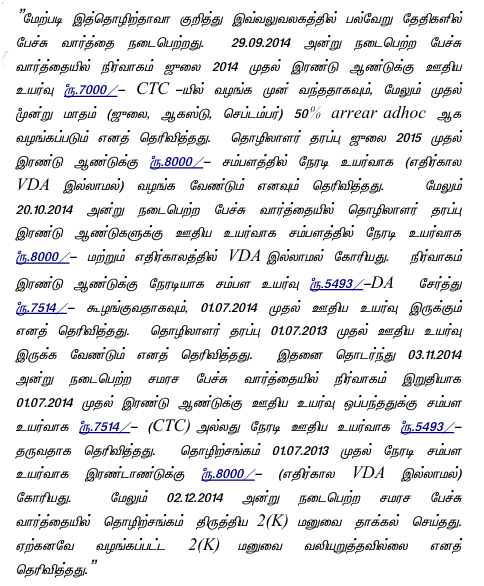
7. The writ petition was admitted on 21.01.2020. In the application for interim stay filed in WMP No.1221 of 2020, an interim stay was granted after considering the judgment of the Hon’ble Supreme Court in Shivraj Fine Arts Litho Works v. State Industrial Court, Nagpur & Ors., reported in 1978 (2) SCC 601 . Subsequently, by a further order dated 17.03.2021, the interim stay was extended until 24.03.2021. Meanwhile, the 2nd Respondent entered appearance and filed a vacate stay application dated 14.12.2020, s
The court upheld the Industrial Tribunal's award for wage revision, emphasizing the need for fair compensation while considering the financial capacity of the management.

The Tribunal must conduct a thorough evidentiary analysis to justify decisions concerning wage revisions and additional allowances under the Industrial Disputes Act, ensuring all material evidence is....

The court affirmed existing employee benefits under the Industrial Disputes Act, maintaining retirement age at 60 and rejecting unjustified pension scheme modifications by management.

Wage adjudication must balance the employer's financial capacity and fair compensation for workmen, ensuring accurate evidence of financial claims is presented.

Pay revision – To determine comparability of units applying industry-cum-region test, financial capacity of employer would be a strong factor.
Consent awards under the Industrial Disputes Act, once given by management, cannot be retracted unless valid objections were filed at the time of consent.
The court held that prior settlements are binding on unions, and claims for wage benefits cannot be raised if previously resolved, emphasizing the importance of adherence to agreements.


The court upheld the Industrial Tribunal's award of a 12% pay increase based on justifiable economic considerations, denying the petitioner's claims of illegality in reference and maintaining the Tri....

Workmen are not entitled to wages during an illegal strike; minimum wage must reflect parity with similar undertakings while considering existing agreements.



An indispensable Tool for Legal Professionals, Endorsed by Various High Court and Judicial Officers
Please visit our Training & Support
Center or Contact Us for assistance

Scan Me!
India’s Legal research and Law Firm App, Download now!


For Daily Legal Updates, Join us on :



 Back to top


