
 Back
Back





IN THE HIGH COURT OF JUDICATURE AT MADRAS
S. Sounthar, J.
Banumathy - Appellant
Versus
R. Lakshmi Kutty (Died) - Respondent
A.S.No.410 of 2007 and M.P.Nos.1, 2, 3 and 4 of 2010 and C.M.P.No.5050 of 2023
Decided On : 06-01-2026
| Table of Content |
|---|
| 1. partition lawsuit details and relationships among parties. (Para 2 , 4 , 5) |
| 2. disputed legitimacy of plaintiffs based on marriage status. (Para 10 , 11 , 12) |
| 3. implications of void marriage on inheritance rights. (Para 14 , 16 , 20) |
| 4. final ruling on the share distribution of plaintiffs. (Para 21 , 22 , 24) |
JUDGMENT :
S. Sounthar, J.
The unsuccessful defendants 7 and 9 are the appellants herein.
2. The 1st respondent, his deceased mother-R.Lakshmi Kutty and respondents 2 and 3 have filed a suit for partition against the appellants and other respondents. Pending suit, R.Lakshmi Kutty died and the respondents 1 to 3 were recorded as her legal representatives. The suit was decreed by the Trial Court by granting 10/36 share in favour of the 1st respondent/2nd plaintiff, 1/36 share in favour of 3rd respondent. The suit was dismissed in respect of 2nd respondent. Aggrieved by the said judgment and decree, the appellants have come before this Court.
3. For the sake of convenience, the parties are referred to as per their rank in the suit.
4. As per the plaint averment, the deceased 1st plaintiff-R.Lakshmi Kutty was the second wife of deceased 1st defendant-Narayanan Nambiar. The plaintiffs 2 to 4 are his sons and daughter. The 3rd plaintiff was born to 1st plaintiff through her 1st husband. The plaintiffs 2 and 4 were born to her through 1st defendant. The 2nd defendant is the 1st wife of deceased 1st defendant. The defendants 3 to 6 are daughters of defendants 1 and 2. It is also not in dispute that the defendants 1 and 2 also had pre-deceased sons Velayutham and Chandran. The defendants 7 to 10 are wife and children of said Velayutham. The defendants 11 to 14 are wife and children of said Chandran.
5. It was the case of the plaintiffs that the 1st plaintiff-R.Lakshmi Kutty got married to 1st defendant in the year 1950 as his second wife. After marriage, the 1st plaintiff joined 1st defendant and lived in matrimonial house in Namakkal. During October-1951, the 1st plaintiff got employment as Maternity Assistant in Municipal Hospital in Rasipuram. During weekends and holidays, the 1st plaintiff would go over to Namakkal and reside with defendants 1 and 2. The 1st plaintiff handed over her entire savings and salary to her husband-1st defendant. The 2nd plaintiff acquired B.Sc., degree and also passed Higher Grade in English and Tamil Typewriting. At the instance of 1st defendant, he discontinued his studies and helped him in running a hotel business at D.No.155, Thillai Puram Main Road, Namakkal. The 2nd plaintiff also runs a Job typing center in a small portion in the hotel premises and thus, contributed to the wealth of the family. From the joint earnings of plaintiffs 1 and 2 and 1st defendant, several properties were acquired for the benefit of the joint family consisting of plaintiffs 1 and 2, defendants 1 and 2 and deceased Velayutham and Chandran. The documents were taken in the name of 2nd Plaintiff, Velayutham, Chandran and 2nd defendant. Since the 1st defendant made representation that building in D.No.154, Thillaipuram Main Road, Namakkal could be treated as exclusive property of 2nd plaintiff, he executed a Release Deed in favour of the Velayutham and Chandran in respect of property in Item No.7 (suit ‘B’ schedule). A portion of the said property was also sold to 2nd plaintiff. After death of Velayutham and Chandran, the 1st defendant and 2nd defendant filed a collusive suit against the other defendants for partition and obtained a collusive decree and the same would not bind the plaintiffs. Since Suit 'A' schedule and 'C' schedule properties were purchased out of joint contribution made by the plaintiffs 1 and 2, the suit was laid for partition.
6. The appellants/defendants 7 and 9 filed a written statement denying the factum of marriage between 1st plaintiff and 1st defendant. They also contended that the plaintiffs 1 and 2 were not members of their joint family. It was also stated that the properties purchase
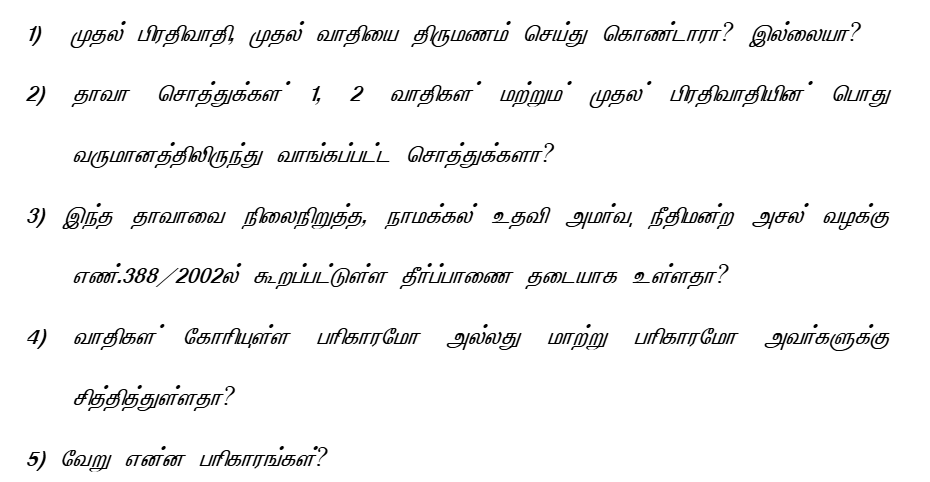
Children born to a void marriage are entitled to property shares under the Hindu Marriage Act, despite the marriage's invalidity.

Children from a void marriage are entitled to inheritance of ancestral properties under Section 16 of the Hindu Marriage Act, securing legitimacy despite marriage validity issues.

The main legal point established in the judgment is that a child born out of a void marriage is not entitled to claim partition of the joint family properties during the lifetime of the parent but ma....

Daughters have equal rights as coparceners in ancestral property under the Hindu Succession Act as amended in 2005, affecting share distribution in partition cases.


The court reaffirmed that daughters have equal rights as sons in ancestral properties, emphasizing the applicability of Section 6 of the Hindu Succession Act.
Registered partition deeds take precedence over claims of oral partition, limiting the rights of heirs under the amended Hindu Succession Act to those alive or affected at the time of partition.

Daughters have equal rights and shares in ancestral joint family properties under Section 6 of the Hindu Succession Act, 1956, as amended by the Hindu Succession (Amendment) Act, 2005.



An indispensable Tool for Legal Professionals, Endorsed by Various High Court and Judicial Officers
Please visit our Training & Support
Center or Contact Us for assistance

Scan Me!
India’s Legal research and Law Firm App, Download now!


For Daily Legal Updates, Join us on :



 Back to top


