
 Back
Back





IN THE HIGH COURT OF ORISSA AT CUTTACK
SASHIKANTA MISHRA, J.
Sushila Dash and Others – Appellants
Versus
Debendra Kumar Nanda and Another – Respondents
R.S.A. No. 181 of 2023
Decided On : 05-12-2025
| Table of Content |
|---|
| 1. definition of suit properties and background. (Para 3 , 5 , 6) |
| 2. trial court's issues framed for determination. (Para 9 , 11) |
| 3. consideration of substantial questions of law. (Para 12 , 18) |
| 4. arguments from defendant's counsel on legal issues. (Para 15 , 16) |
| 5. final analysis and dismissal of the appeal. (Para 20 , 22) |
JUDGMENT :
SASHIKANTA MISHRA, J.
1. This is an appeal by the plaintiffs against a confirming judgment. The judgment dated 31.1.2023 followed by decree passed by the learned Second Addl. District Judge, Puri in RFA No.3/59 of 2019-17 is impugned, whereby the said appeal preferred by the plaintiffs against the judgment dtd.31.7.2017 followed by decree passed by the learned Addl. Senior Civil Judge, Puri in C.S. No.123/330 of 2015-13 was dismissed.
2. For convenience, the parties are referred to as per their respective status before the trial Court to avoid confusion.
3. The suit property is described in two schedules of the plaint being Schedule-B and B-1. Schedule-B is as follows:
Mouza - Hiranpada, Satyabadi, Dist Puri, Khata No. 143 (one hundred four three) Chhaka No. 206 (two hundred six), Chaka Plot No. 970 (nine hundred seventy), Area -Ac. 3.96 (three acres ninty six dec.) Chakka No. 105/320 (one hundred five by three hundred twenty), Chaka Plot No 817/1136 (Eight hundred seventeen by one thousand one hundred thirty six), area Ac. 0.06 (six dec.). Total Ac. 4.02 (four acres and two decs.) Mouza Damadorpur Sasan, Dist - Puri, P.S - Puri Sadar, Plot No. 302, Khata No. 431 area Ac. 0.20 decimal.
Schedule-B-1 is as follows:
1. Mouza Jhadeswari Sahi, P.S Puri Town, Dist-Puri, Khata No.54 (Fifty four), Plot No-28 (Twenty eight), Gharabari area Ac. 0.006 (six decs.) and Plot No - 29 (Twenty nine), Area Ac. 0.058, Total Area Ac 0.064.
2. Mouza-Daitapada Sahi, P.S- Puri Town, Dist - Puri, Plot No. 1379 (One thousand three hundred seventy nine), Municipal Jamanbandi No. 52 (Fifty two), Area – Ac. 011 ‰ decs. (Eleven and half dec) & Municipal Jamanbandi No.62 (sixty two) Area –Ac. 002 ‰ decs. (two and half dec.) Total-Ac. 014 (fourteen dec.).
3. Mouza Daitapada Sahi, Khata No. 271 (two hundred seventy one), Plot No. 1400 (One thousand four hundred), area-Ac. 0.023 (twenty three dec.)
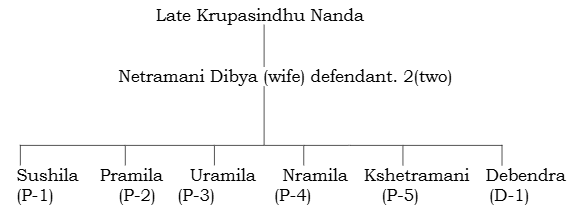
4. As per plaint Schedule-A, the following genealogy reflects the relationship between the parties:
5. The case of the plaintiffs, briefly stated, is as follows:
One Radhanath Nanda being the common ancestor had two sons namely, Krupasindhu Nanda and Madhusudan Nanda. The plaintiffs and defendants are the successors of Krupasindhu Nanda. The suit properties are partly ancestral and partly parental properties of the plaintiffs and defendant No.1. After the death of Krupasindhu Nanda, there was a partition of the ancestral properties on 01.6.1966 through a registered deed between Madhusudan Nanda on one hand and Defendant Nos.1 and 2 on the other, representing the branch of Krupasindhu Nanda. Lot Nos.1 and 3 of Schedule-B-1 properties were allotted to Defendant Nos.1 and 2. The plaintiffs being his daughters also have equal share in it. The agricultural lands in Mouza-Hiranpada (Schedule-B) were purchased out of sale proceeds received after disposal of 8 acres of land of Krupasindhu Nanda in Mouza-Singhakuda in the year 1970. Thus, said lands are also the joint family property of the plaintiffs and Defendant Nos.1 and 2. However, Defendant No.1, by projecting himself as the sole successor of Krupasindhu Nanda and by manipulation and practice of fraud, influenced the settlement authorities to get the lands recorded exclusively in his name. Furthermore, taking advantage of the old age of Defendant No.2, he also got a fraudulent Will executed by her in his favour. He thereafter sold the entire properties of Hiranpada mouza (Schedule-B) to Defendant No.3 vide sale deed dtd.11.4.2012 without consent and knowledge of the plaintiffs and without legal necessity. He then constructed a house on the paternal land without the consent of the plainti
AI
The finalized partition under the Hindu Succession (Amendment) Act, 2005 cannot be reopened unless exceptions apply; claims barred by limitation and lack of necessary parties.

Joint ownership claims persist until partition; rights in a partition suit are not bound by limitation, and the burden to prove legal necessity for property transfer lies with the transferee.
The court recognizes the entitlement of female heirs to a share in ancestral property based on notional partition, counteracting historical biases that deprived them of their rightful claims.

Properties claimed as self-acquired were determined to be ancestral; the appeal for partition was dismissed due to lack of joint possession evidence and non-joinder of necessary parties, also barred ....

In a partition suit, registered documents act as constructive notice, initiating the limitation period. Prolonged exclusive possession of ancestral property by a co-owner establishes ouster. Addition....


Previous family partition and lack of joint family status preclude the plaintiff from claiming coparcenary rights under Hindu law amendments.


The presumption of joint family property necessitates proof of individual ownership; without such proof, a child has a right to claim share in ancestral property.



An indispensable Tool for Legal Professionals, Endorsed by Various High Court and Judicial Officers
Please visit our Training & Support
Center or Contact Us for assistance

Scan Me!
India’s Legal research and Law Firm App, Download now!


For Daily Legal Updates, Join us on :



 Back to top


