
 Back
Back





IN THE HIGH COURT OF ALLAHABAD
HON'BLE KSHITIJ SHAILENDRA, J.
Smt. Laxminiya – Appellant
Versus
Deena Nath – Respondent
Second Appeal No. 80 Of 1985
Decided On : 30-07-2024
PROPERTY LAW - DISPUTE OVER LAND POSSESSION - Hindu Widow’s Remarriage Act, 1856; Uttar Pradesh Zamindari Abolition & Land Reforms Act, 1950 - The court discussed the implications of the Hindu Widow’s Remarriage Act, 1856, particularly Section 2, which states that a widow loses her rights in her deceased husband's property upon remarriage. The court also referenced the Uttar Pradesh Zamindari Abolition & Land Reforms Act, 1950, in relation to the succession of property. The interpretations of these acts influenced the court's decision to conclude that the plaintiff could not establish ownership or possession over the disputed land, leading to the dismissal of the suit.
Fact of the Case:
The plaintiff, Deena Nath, claimed ownership of a disputed land portion based on a family partition from 1881 and alleged interference by the defendants. The defendants contended that the plaintiff's claim was invalid due to the remarriage of Bhagirathia, the widow of Algu, which they argued divested her of rights to the property.
Finding of the Court:
The court found that Bhagirathia lost her rights to the property upon her remarriage to Mahadeo in 1919, as per the Hindu Widow’s Remarriage Act, 1856. The court concluded that the plaintiff failed to prove his claim of possession and ownership over the disputed land.
Issues: The main issues revolved around the rights of Bhagirathia after her remarriage and the implications for the plaintiff's claim to the property, including whether the plaintiff could establish ownership and possession despite the defendants' claims.
Ratio Decidendi: The court held that the plaintiff could not succeed in his claim for injunction as he failed to establish his title or possession over the property. The court emphasized that a plaintiff must prove their case independently and cannot rely on the weaknesses of the defendant's case.
Final Decision: The second appeal was allowed, and the judgment of the First Appellate Court was set aside, resulting in the dismissal of the original suit.
JUDGMENT :
Hon'ble Kshitij Shailendra, J.
1. Heard Shri H.N. Singh, learned Senior Counsel assisted by Shri Raghvendra Shankar Srivastava for the appellant and Shri Tripathi B.G. Bhai, learned counsel for the contesting respondents.
2. The instant second appeal has been filed by the defendants-appellants of Original Suit No. 132 of 1979 challenging the judgment and decree dated 11.10.1984, whereby the learned Special Judge, Ghazipur has set aside the trial court’s judgment dismissing the suit and has, consequently, granted a decree in favour of the plaintiff-respondent permanently restraining the defendants-appellants from causing interference in the possession of the plaintiff over the disputed portion of the land.
3. During the course of hearing, the Court found that narration of facts contained in the judgments of the trial court and the first Appellate Court, when compared to the original pleadings, was found lacking and, therefore, the Court is narrating the relevant facts after perusing the original record.
4. Since shares of the respective parties, their entitlement and divestment is the issue directly involved in the present case, it is necessary to draw a family tree of one Thanu, as pleaded in first paragraph of the plaint. It depicts as follows:
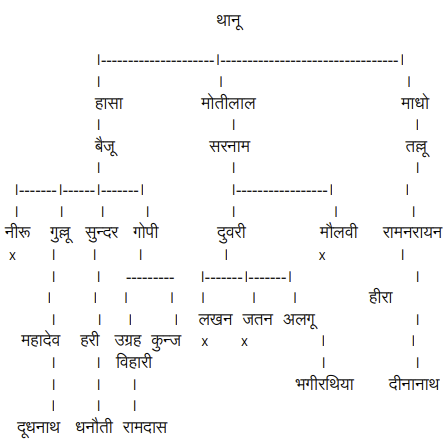
PLAINT CASE
5. As per the plaintiff Deena Nath, a partition took place amongst the aforesaid family members in or about year 1881, according to which, parties started residing as per the shares separately allotted to them. Plot No. 213, area 6 biswa, 16 dhurs, was the joint property of Baiju, Sarnaam and Tallu, recorded as such in the settlement year 1981-82. The property, on account of its location and proximity, was jointly used by all the three branches. Bhagirathia wife of Algu, after the death of Algu, resided in the house in the capacity of his widow and the plaintiff’s father took possession over the share succeeded by Bhagirathia in the disputed property, which was surrounded by a boundary wall after the death of Bhagirathia. Consolidation operations began in the village and the land covered by gatas No. 213/2 and 213/3, having been declared as Abadi, was chaked out from the consolidation operations under the order dated 12.02.1962 and it was allotted a new number 114. In paragraph No. 6 of the plaint, it was stated that Bhagirathia had started living with plaintiff’s father and, hence, the plaintiff’s father came in possession over her estate, which was succeeded by the plaintiff as owner thereof. The cause of action for filing suit was alleged on account of interference caused by defendants, i.e. Hari, Doodh Nath, Smt. Dhanauti and Ram Daras shown in the family tree, over the disputed portion described by alphabets mentioned in the prayer clause co-relating the same to the plaint map and, consequently, a decree for injunction was claimed. The plaintiff’s claim, as such, was based upon the plea that Bhagirathia started living with plaintiff’s father Hira and, hence, the plaintiff’s father and, after his death, the plaintiff became owner of the disputed land to the divestment of all the defendants.
CONTEST BY DEFENDANTS
6. A joint written statement was filed by all the defendants stating that Bhagirathia, after the death of Algu, performed second marriage with Mahadeo and out of the said wedlock, one son namely, Doodh Nath (defendant No. 2) and a daughter namely, Phulmaniya were born. Phulmaniya was married to one Aditya and had two sons, namely, Indradeo and Ram Chander. The year of marriage between Bhagirathia and Mahadeo was pleaded through amendment as 1919. The plea of partition set up by the plaintiff was admitted with further statement that certain Neem tree was purchased by Bhagirathia for a sum of Rs.32/- on 20.02.1946 in an auction held pursuant to execution proceedings. It was further pleaded that Bhagirathia was never dispossessed by the plaintiff’s side and continued to enjoy adverse possession over the estate left by her first deceased husband Algu, and settled
AI
A widow loses her rights in her deceased husband's property upon remarriage, and a plaintiff must independently establish ownership and possession to succeed in a claim for injunction.

The remarriage of a widow does not disqualify her from inheriting her deceased husband's property under the Hindu Succession Act, 1956.

Adverse possession - Right of widow after remarriage - Daughter of widow being nearer heir would succeed right and title to the property of widow - Nald plea stating that the plaintiff is in possessi....


Widow's remarriage does not strip her of inheritance rights, and married daughters have equal entitlement to family property under the amended Hindu Succession Act.

The plaintiff, as the daughter of Bhagmat, retains her inheritance rights over property despite her mother's remarriage, confirming the applicability of old Hindu law over Scheduled Tribes.

Succession to the property inherited by a widow as life-estate holder opens on her death and is governed by the provisions of Section 8 of the Hindu Succession Act, 1956, irrespective of the date of ....

The main legal point established in the judgment is the determination of the status of the parties and their entitlement to shares in the ancestral property based on the evidence presented and the ap....

The remarriage of a widow does not divest her of property inherited from her deceased husband under the Hindu Succession Act, 1956, as the Act provides for absolute ownership.

Female Hindu succession – For establishing full ownership on undivided joint family estate under Section 14(1) of Succession Act Hindu female must not only be possessed of property but she must have ....



An indispensable Tool for Legal Professionals, Endorsed by Various High Court and Judicial Officers
Please visit our Training & Support
Center or Contact Us for assistance

Scan Me!
India’s Legal research and Law Firm App, Download now!


For Daily Legal Updates, Join us on :



 Back to top


