


 Back
Back





2024 Supreme(All) 957
IN THE HIGH COURT OF ALLAHABAD
J.J. Munir, J.
Phagoo - Appellant
Vs.
Gokaran and others - Respondent
Second Appeal No. - 1761 of 1983
Decided On : 05-06-2024
Advocate Appeared:
For the Appellant : Ashutosh Srivastava,Shreesh Srivastava,Shreyas Srivastava
For the Respondent: Shakti Dhar Dube, P.H. Vashishtha
The remarriage of a widow does not divest her of property inherited from her deceased husband under the Hindu Succession Act, 1956, as the Act provides for absolute ownership.
Headnote:(A) Hindu Succession Act, 1956 - Sections 4 and 14 - Hindu Widows' Remarriage Act, 1856 - Partition suit - Plaintiff claimed 1/3rd share in property inherited from deceased husband - Court held that widow's remarriage does not divest her of property inherited after the Act of 1956 came into force - Custom of divestment upon remarriage not applicable post-1956 - Plaintiff entitled to 1/4th share, defendants 9 and 10 to 1/4th each, and Lakhraji's share recognized. (Paras 66-70)
(B) Jurisdiction - Pecuniary jurisdiction of District Court - Appeal valuation determined by relief claimed - Court held that appeal was within jurisdiction. (Paras 26-31)
(C) Res Judicata - Dismissal of earlier partition suit in default does not bar subsequent suit for partition - Right to partition is a continuing right. (Paras 33-36)
JUDGMENT :
J.J. Munir, J.
1. This is a defendant's second appeal arising out of a preliminary decree for partition.
2. Gokaran, the sole plaintiff of Original Suit No.20 of 1972, instituted a suit for partition of four houses, shown in the schedule, with their own boundaries at the foot of the plaint, giving rise to the suit and all located in Plot No.854/29. The plaintiff demanded partition of his 1/3rd share in the four houses aforesaid, hereinafter referred to as 'the suit property', that he claimed against the defendants on the basis of a registered sale deed dated 13.12.1971, executed in his favour by Smt. Jashoda widow of Patiraj. The suit property was originally owned by one Tirath Ram son of Patiraj, who had acquired it of his own exertions. Tirath Ram died on 14.10.1967. Smt. Jashoda was his mother. She executed a registered sale deed dated 13.12.1971 of her 1/3rd share in the plaintiff's favour. The plaintiff, besides seeking a decree of partition and separate possession, prayed that a decree for the recovery of a sum of Rs.2136/- be passed against defendant Nos.1 and 2, and another for Rs.840/- against defendant Nos.6 and 7, on account of his proportionate share in the rent that the said defendants had realized from the tenants in the suit property.
3. A moreful description of the facts, leading to this appeal, would be necessary. But, before a reference to the facts, it would be apposite to refer to the following pedigree, which the Lower Appellate Court has relied upon and shows the accurate relationship of parties, who were the original owners of the suit property:
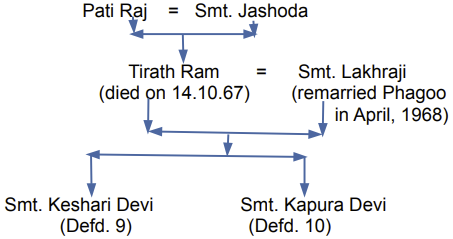
4. The plaintiff instituted the suit with a case that Tirath Ram carried on the business of a jeweller in town Khalilabad, District Basti. He constructed four houses, detailed in Schedule A at the foot of the plaint. Tirath Ram died on 14.10.1967, survived by his widow Smt. Lakhraji and two daughters, Smt. Keshari Devi and Smt. Kapura Devi, besides his mother, Smt. Jashoda Devi. Apparently, he died intestate and the four of his heirs would inherit a 1/4th share in the suit property, but for a certain decision of his widow, Smt. Lakhraji. It is the plaintiff's case that amongst the Sonars, a community from which Tirath Ram hailed, there is an ancient custom of remarriage by women after the death of their husband. There is another custom that after remarriage, the woman is divested of the estate that she inherits from her husband, which then reverts to the husband's heirs next in order of succession. Smt. Lakhraji is said to have married one Phagoo, defendant No.1 in the month of April, 1968, in accordance with the community's custom. Phagoo shifted to Smt. Lakhraji's house and settled with her, becoming what is described as 'Ghar Baitha’ Husband. Both Lakhraji and Phagoo began a life together as man and wife, in consequence of which, Lakhraji lost all her rights and title to the suit property that she inherited from Tirath Ram. As a result, the share of the other heirs, to wit, Smt. Jashoda, Tirath Ram's mother and his two daughters, Smt. Keshari Devi and Smt. Kapura Devi, defendant Nos.9 and 10 in the suit, was enlarged to a 1/3rd. Smt. Jashoda transferred her 1/3rd share in the suit property vide registered sale deed dated 13.12.1971 in the plaintiff's favour for a total sale consideration of Rs.15,000/-, said to have been paid in cash. The plaintiff thus became a co-sharer in the suit property, comprising the four houses.
5. It is averred in the plaint that in the sale deed executed by Smt. Jashoda, her share has been mentioned as 1/2 due to a clerical error. Defendant Nos.1 to 7 to the suit are men, one of them a minor at the relevant time, to whom Smt. Lakhraji transferred her entire share in the suit property, she inherited from Tirath Ram through four sale deeds, being conveyances dated 28.05.1968, 01.03.1969, 21.05.1970 and 22.04.1971. All the four houses, comprising the suit property, were constructed by the late Tirath Ram, but in the sale deed date












