
 Back
Back





IN THE HIGH COURT OF ALLAHABAD
ASHWANI KUMAR MISHRA, SHIV SHANKER PRASAD, JJ.
Lokesh and others - Appellants
Versus
State of U.P. - Respondents
Criminal Appeal No. 1371 of 2015
Decided on : 28-01-2023
Criminal - Rape and Murder - IPC Sections 376, 302, 452 - The court analyzed the reliability of the dying declaration and medical evidence, ultimately concluding that the prosecution failed to prove the charges beyond reasonable doubt.
Fact of the Case:
The case involves the brutal assault and subsequent death of a young female victim, who was allegedly raped and set on fire by the accused. The incident occurred while the victim was home alone, and the prosecution relied heavily on her dying declaration and witness testimonies.
Finding of the Court:
The court found inconsistencies in the dying declaration and medical evidence, which did not support the claims of rape. The absence of key witnesses and the presence of prior enmity between the families raised doubts about the prosecution's case.
Issues: Whether the dying declaration of the victim was reliable and whether the prosecution proved the charges of rape and murder beyond reasonable doubt.
Ratio Decidendi: The court emphasized the necessity of corroborating evidence to support a dying declaration, especially in cases involving severe injuries, and highlighted the importance of the victim's mental state at the time of the declaration.
Result: The appeal was allowed, and the conviction of the accused was set aside.
JUDGMENT :
Hon'ble Ashwani Kumar Mishra, J.
This criminal appeal is directed against the impugned judgment and order dated 11th February, 2015 passed by the Additional Sessions Judge, Court No. 3, Hathras in Session Trial No. 97 of 2013 (State of U.P. v. Lokesh and others), arising out of Case Crime 296 of 2007, whereby accused-appellants-Lokesh, Dani and Indra have been convicted and sentenced for one year rigorous imprisonment each for the offence under Section 452 I.P.C. with fine of Rs. 1,000/- each, in default thereof, to further undergo one month each additional imprisonment; life imprisonment for the offence under Section 302/34 I.P.C. with fine of Rs. 5,000/- each, in default thereof, to further undergo, three months additional imprisonment; and ten years rigorous imprisonment for offence under Section 376 I.P.C. each with fine of Rs. 5,000/-, in default thereof, to further undergo three months each additional imprisonment, with an observation that all the sentences are to run concurrently.
2. We have heard Mr. Araf Khan, learned counsel appearing for the accused-appellants and Mr. Aruendera Singh, learned A.G.A. for the State as also perused the entire materials available on record.
3. This case is a classic example of how an unscrupulous person can utilise even a misery befallen on him to avenge his enmity by falsely implicating his enemy.
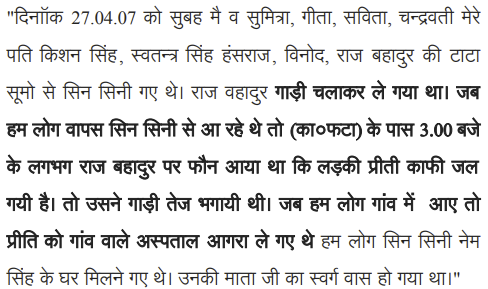
4. In the facts of this case, on the basis of a written report (Exhibit-ka/1) a First Information Report came to be lodged at Police Station M.M. Gate, Agra, as Case Crime No. Nil of 2007, under Sections 376 and 307 I.P.C. on 29th April, 2007, in respect of the incident occurred on 27.4.2007 at around 02:30 p.m., whereafter the FIR has been transferred to the Police Station-Sadabad, where the same was numbered as Case Crime No. 296 of 2007, under Sections 376, 307 and 452 I.P.C. The informant/P.W.-1 happens to be the father of the victim who had gone with his wife to his relative's place and was not present at the place of occurrence when the incident occurred. The victim/deceased aged 18 years was a 1st year law student studying in B.S.A. College, Mathura. When she was alone in her house and her grand-parents had gone towards the Jungle/forest, at around 2:30 p.m. the accused Lokesh, Dani, Indu/Indra, all sons of Surajmal and Hukum, friend of Lokesh, entered the house of the informant, grabbed the victim who was attending to the domestic chores and was intoxicated. The victim had objected to it but the four accused gagged her mouth and forcibly committed rape. With an intent to remove the evidence of crime, the accused then poured kerosene on the deceased; and set her ablaze, and fled. The victim was on the first floor of the house, rushed out screaming and somehow managed to come down the stairs whereafter neighbours tried to douse the fire. The informant was intimated about the incident and was told that they (neighbours) are bringing the victim to Agra. The informant was asked to meet them at S.N. Medical College, Agra. Persons from the village accordingly brought the victim in an injured state and her condition was critical. The victim was admitted in the emergency ward. She was struggling with life and death. On being asked, the victim informed P.W.-1/informant about the incident. On account of treatment and other exigencies, it was not possible for the informant/P.W.-1 to lodge a timely report and as the incident has to be reported to police, the informant has lodged the report at the police station. The F.I.R. was initially registered at Police Station M.M. Gate, Agra and was later transferred to Police Station-Sadabad, District Hathras, where it was registered as Case Crime No. 621-35 -Nil of 2007 under Sections 376 and 307 I.P.C.
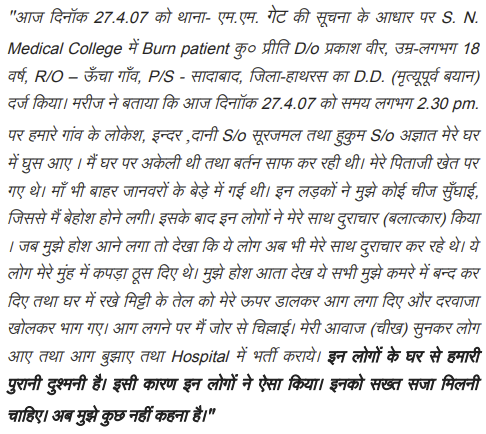
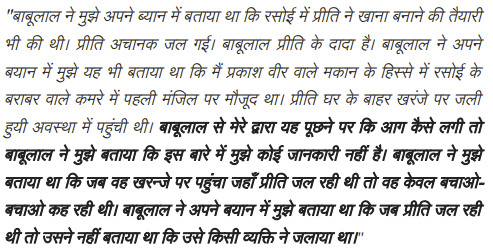
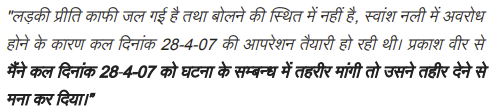
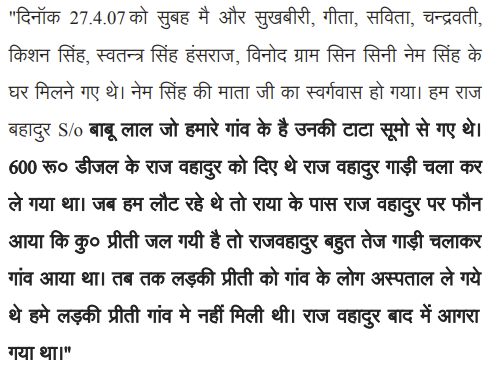
5. On the date of incident itself i.e. 27.4.2007 the dying declaration of the victim was recorded after the doctor certified that the victim, aged 18 years, is clinically fit for giving her dying declaration. The contents of the dying declaration are r
AI
A dying declaration must be corroborated by reliable evidence, particularly regarding the victim's mental state, to be admissible in court.

In cases of doubt, the proposition in favor of the accused should be accepted, and the accused should be given the benefit of the doubt.

Dying declarations can constitute sole evidence for conviction if found voluntary and truthful; the burden of proof for alibi rests solely with the appellant.

The dying declaration made by the deceased was voluntarily made and in a conscious state of mind, and it was supported by witness testimonies, medical and forensic evidence, leading to the conviction....

Dying declarations must be consistent and reliable, as they can form the sole basis for conviction only if they inspire full confidence and are free from inconsistencies.

The court established that inconsistent dying declarations can undermine the prosecution's case, necessitating a careful evaluation of their credibility.

The court ruled that a dying declaration must be credible and recorded under proper conditions; discrepancies and lack of corroborative evidence led to the acquittal of the appellant.
The court determined that inconsistent dying declarations and lack of corroborating evidence preclude conviction, emphasizing the burden on prosecution to prove guilt beyond a reasonable doubt.
A dying declaration is only valid if the victim was in a fit mental state to give it, which wasn't established; thus, conviction based solely on it is unsafe.



An indispensable Tool for Legal Professionals, Endorsed by Various High Court and Judicial Officers
Please visit our Training & Support
Center or Contact Us for assistance

Scan Me!
India’s Legal research and Law Firm App, Download now!


For Daily Legal Updates, Join us on :



 Back to top


