
 Back
Back





IN THE HIGH COURT OF JUDICATURE AT ALLAHABAD
ARVIND SINGH SANGWAN, MOHD. AZHAR HUSAIN IDRISI, JJ.
Babli And 2 Others – Appellant
Versus
State of U.P. – Respondent
Criminal Appeal No.1397 of 2020
Decided on : 24-09-2024
Indian Penal Code, 1860 - Sections 302, 498A - Dowry Prohibition Act, 1961 - Sections 3 & 4 - Conviction of appellants for murder and dowry-related offences - The trial court's reliance on the dying declaration was questioned due to lack of corroborative evidence and doubts regarding the victim's mental fitness at the time of the statement - Key witnesses declared hostile and did not support prosecution - Appeals allowed, convictions set aside. (Paras 49-50)
Facts of the case:
The appellants were convicted for the murder of Neelam and related dowry offences. The prosecution's case relied heavily on a dying declaration, which was contested by the defence as unreliable due to the victim's severe injuries and lack of corroborating evidence.
Findings of Court:
The court found that the dying declaration was not credible and that the prosecution failed to prove its case beyond reasonable doubt.
Issues: The main issues included the reliability of the dying declaration and the support of key witnesses for the prosecution's case.
Ratio Decidendi: The court emphasized that the prosecution must establish charges beyond reasonable doubt, and the absence of corroborative evidence and the doubts surrounding the dying declaration led to the acquittal of the appellants.
Result: Appeals allowed, and the appellants were acquitted.
JUDGMENT :
(Per Hon'ble Arvind Singh Sangwan,J. )
1. These appeals have been filed by the appellants challenging the judgment of conviction dated 10.01.2020, passed by learned Additional Sessions Judge, FTC, Court No.2, Bulandshahar holding the appellants Babli, Jaiprakash, Vimla, Raju and Kamal guilty of offence punishable under Sections 302/34 I.P.C., and appellants Babli, Jaiprakash, Vimla, Raju under Sections 498A of IPC and Section 3 & 4 of Dowry Prohibition Act and order of sentence of the same date sentencing appellants for life imprisonment under Section 302/34 of IPC with fine of Rs.20000/- each and in case of default in payment of fine, further to undergo six months simple imprisonment each, under Sections 498A, appellants Babli, Jaiprakash, Vimla, Raju, three years rigorous imprisonment with fine of Rs. 3000/- each and in case of default in payment of fine, further to undergo one month’s simple imprisonment, under Section 3 of Dowry Prohibition Act, appellants Babli, Jaiprakash, Vimla, Raju, three years rigorous imprisonment with fine of Rs. 3000/- each and in case of default in payment of fine, further to undergo one month’s simple imprisonment and under Section 4 of Dowry Prohibition Act, appellants Babli, Jaiprakash, Vimla, Raju, two years rigorous imprisonment with fine of Rs. 2000/- each and in case of default in payment of fine, further to undergo 20 days simple imprisonment.
2. It is worth noticing that against rejection of bail application, the accused Kamal had filed Petition(s) for Special Leave to Appeal (Crl.No(s). 9146 of 2022 in Criminal Appeal No.388 of 2020 which was disposed of on 14th December, 2022 with a direction to the High Court to dispose of the appeal expeditiously as expeditiously as possible and therefore, the arguments on all connected appeals are heard on priority basis.
3. Heard Mr. Bipin Kumar Tripathi, Mr. Sailesh Narain Pathak, Ms. Pukhraj, Ms. Richa Sharma, learned counsels for the appellants, Ms. Muskan Pandey, learned Amicus Curiae appointed by this Court on behalf of accused-appellant, Kamal, and learned A.G.A. for the State.
4. As per the prosecution, informant- Munesh submitted a complaint as Ex.Ka.1, which read as under:
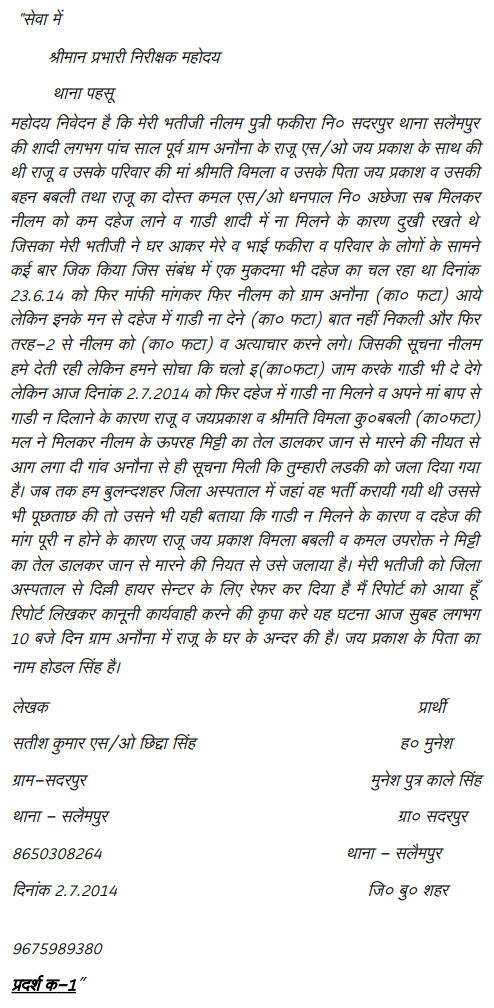
5. On the basis of complaint, chik FIR was registered as Ex.Ka.9.
6. The police started the investigation and the statement/dying declaration of the victim was recorded as Ex.Ka.2 on 03.07.2014 which read as under:
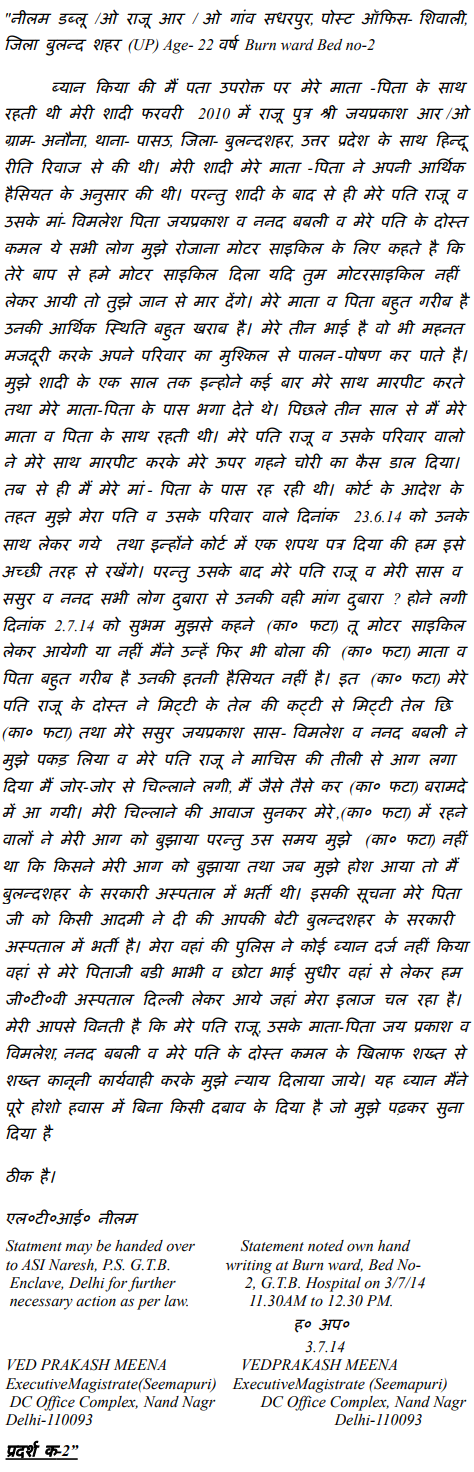
7. The victim died on 9.7.2014 and her post-mortem was conducted. During the investigation, the police prepared panchayatnama, also effected certain recoveries from the place of occurrence, arrested the accused persons, recorded the statement of the witnesses under Section 161 of Cr.P.C and thereafter, submitted the final report against five accused persons, namely, Raju, Vimlesh, Jayprakash, Babli and Kamal. The case was committed to the Court of Sessions and the charges were framed as under:
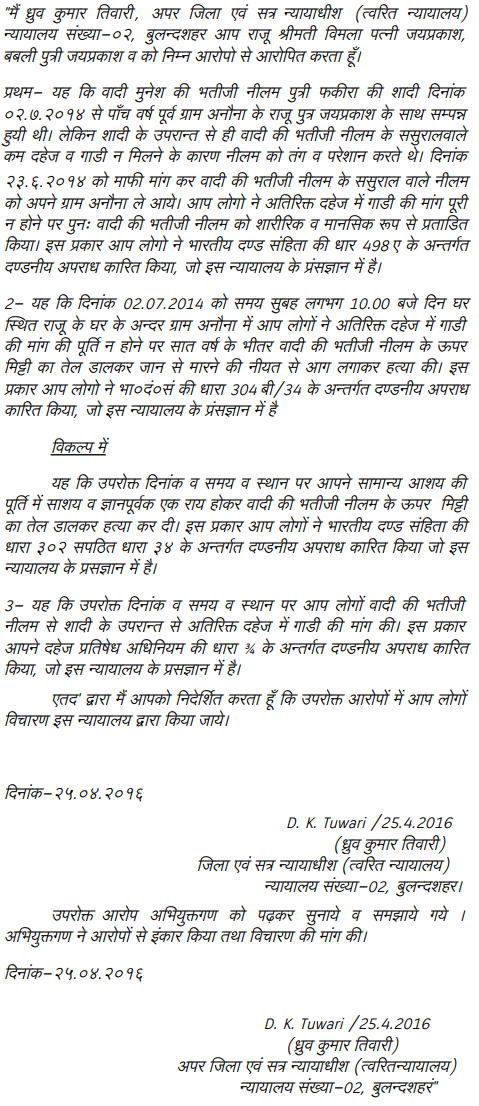
8. Identical charges were framed against accused Kamal. The accused did not plead guilty and claimed the trial.
9. In prosecution evidence, PW-1- Munesh appeared and deposed on the line of the FIR. The operative part of the examination-in-chief read as under:
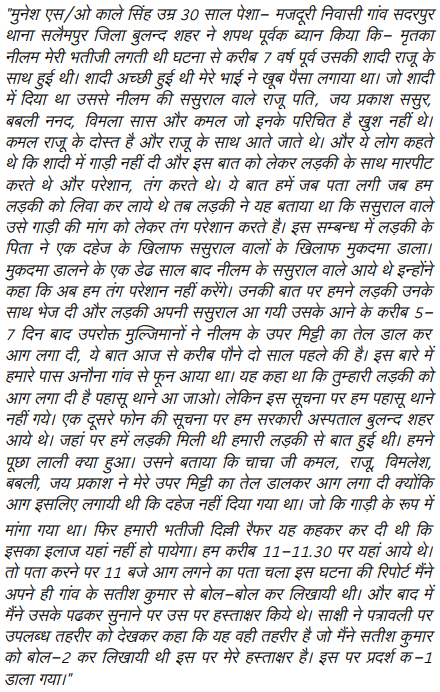
In cross-examination, this witness stated that accused Kamal is resident of different village-Accheja in District Bulandshahar. He further stated that on account of demand of dowry, the relationship of the deceased and her husband were strained and father of the deceased has got registered the police complaint regarding demand of dowry. He further stated as under :
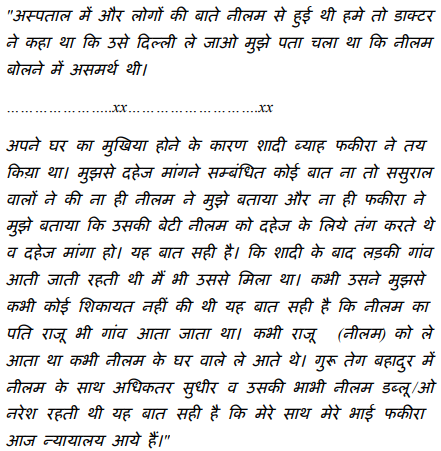
10. PW-2- Fakira- father of deceased Neelam, did not support the prosecution version and stated as under:
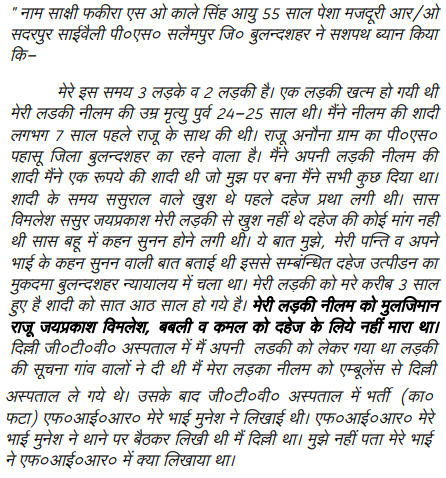
Declare hostile on the request of ADGC.”
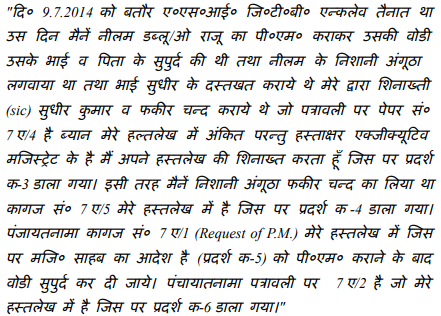
In cross-examination by ADGC, he denied that he has made a statement before C.O. regarding demand of dowry. He pleaded ignorance about the contents of the complaint filed for demand of dowry. He also denied about the dying declaration made by the deceased in the hospital. In cross-examination by accused Kamal, he
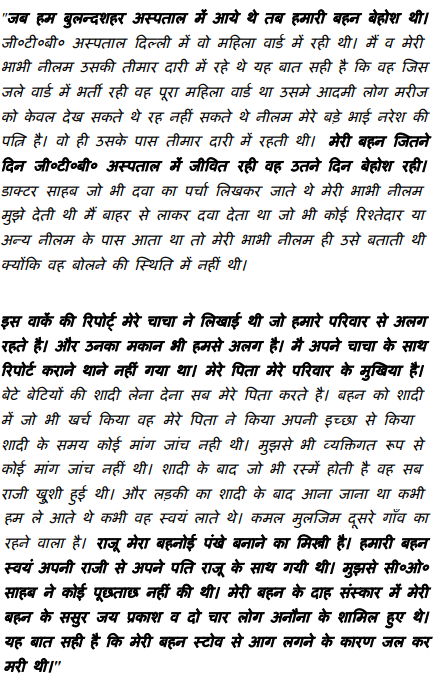
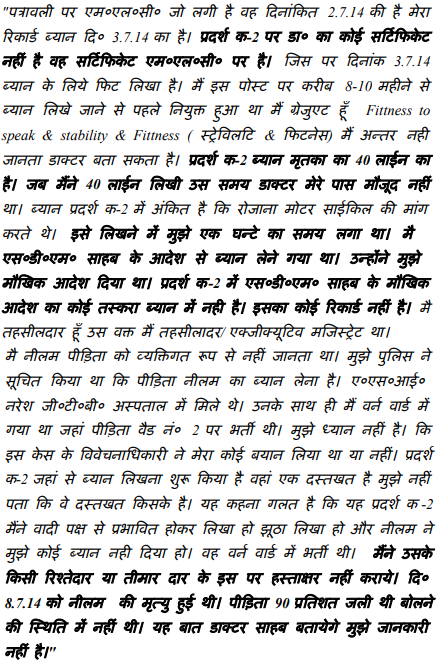
AI
The court ruled that a dying declaration must be corroborated by reliable evidence, and doubts regarding the victim's mental fitness undermine its credibility.

The Dying Declaration must be credible and corroborated; in this case, it was deemed unreliable due to contradictions and lack of supporting evidence.
The court ruled that a dying declaration must be credible and recorded under proper conditions; discrepancies and lack of corroborative evidence led to the acquittal of the appellant.

The evidentiary value of a dying declaration is undermined by doubts regarding the deceased's mental state and reliability during its recording, rendering conviction unsafe without corroborative evid....
The court emphasized the necessity of corroborating dying declarations and established that dowry-related cruelty leading to death constitutes an offence under Section 304B IPC.

Where there are more than one statement in the nature of dying declaration, one first in point of time must be preferred. Of course, if the plurality of dying declaration could be held to be trustwor....


Dying declarations must be substantiated by medical fitness certifications and corroborating witness accounts; failure to do so undermines their reliability leading to altered convictions.
The central legal point established in the judgment is the requirement to prove dowry demand for conviction under Section 498-A I.P.C. and the scrutiny of the dying declaration and medical evidence f....



An indispensable Tool for Legal Professionals, Endorsed by Various High Court and Judicial Officers
Please visit our Training & Support
Center or Contact Us for assistance

Scan Me!
India’s Legal research and Law Firm App, Download now!


For Daily Legal Updates, Join us on :



 Back to top


