
 Back
Back





IN THE HIGH COURT OF ALLAHABAD, LUCKNOW BENCH
Rajnish Kumar, J.
Sabhapati Verma - Appellant
Versus
Ved Prakash - Respondent
Second Appeal No. 2 of 2017
Decided On : 24-01-2025
| Table of Content |
|---|
| 1. substantial questions of law guiding the appeal (Para 2 , 3) |
| 2. arguments regarding the will's validity and evidence (Para 4 , 5) |
| 3. proof of the will and testimony of witnesses (Para 10 , 21) |
| 4. final judgment based on legal principles and findings (Para 12 , 39) |
| 5. legal standards for proving a will (Para 14 , 15 , 17) |
| 6. findings on the sonship and entitlement to property (Para 26 , 38) |
JUDGMENT :
Rajnish Kumar, J.
Heard Shri Mohd. Arif Khan, learned Senior Advocate assisted by Shri Mohd. Shadab Khan, Advocate holding brief of Shri Mohammad Aslam Khan, learned counsel for the appellant and Dr. R. S. Pandey, learned Senior Advocate assisted by Shri Ankit Pande, learned counsel for the respondent.
2. This second appeal has been preferred under Section 100 of CIVIL PROCEDURE CODE , 1908 (hereinafter referred to as ''C.P.C.'') against the judgment and decree dated 1.11.2013 passed in Regular Suit No. 1132 of 1988; Sabhapati Verma v. Ram Kishore (Dead) substituted by legal representative Ved Prakash by First Additional Civil Judge (Junior Division), Ambedkar Nagar and judgment and decree dated 3.10.2016 passed in Civil Appeal No. 66 of 2013; Sabhapati Verma v. Ved Prakash by Additional District Judge, Court No. 3, Ambedkar Nagar.
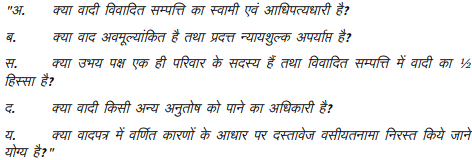
3. The appeal has been admitted on the following substantial questions of law formulated in the memo of appeal :
''A. Whether the will which was sought to be cancelled by the appellant on the ground of fraud, having not been proved by the respondent in accordance with provisions of Section 68 of the Evidence Act, the learned Courts below were justified in law in dismissing the suit?
B. Whether the learned Courts below ignoring the ample evidence on record as mentioned in the judgment passed by the Trial Court and even without discussing the same were justified in law in dismissing the suit?
C. Whether Ram Kishore who was a Gazetted Officer and the will bearing his thumb impression does not create a suspicion about the due execution of the will in favour of the respondent and the respondent having not proved the will in accordance with the provisions of Section 68 of the EVIDENCE ACT , the learned Courts below were justified in law in dismissing the suit?
D. Whether from the ample evidence on record including the sale-deed, copies of the judgments, high school certificate wherein the parentage of the appellant was mentioned as Ram Kishore, the said evidence could be ignored and the learned Courts below merely by relying upon the statement of Smt. Sursati mother of the appellant and respondent who was win over, were justified in law in dismissing the suit?
E. Whether it was not incumbent upon learned Courts below to have discussed and dealt with the oral and documentary evidence on record filed by the parties while dismissing the suit?
F. Whether substantial documentary evidence which has been placed before the Trial Court including certified copies of certain public records besides the copy of the judgment of earlier suit and the oral evidence it was not the duty of lower appellate Court sitting as a Court of first appeal to deal with all issues and the evidence lead by the parties before recording its findings and dismissing the appeal ignoring that the appeal is a valuable right and the parties have a right to be heard both on questions of law and facts?
G. Whether the judgment and decree passed by the learned Courts below is not only against the facts and circumstances of the case but also the evidence on record?''
4. Learned counsel for the plaintiff-appellant submitted that the father of the parties was trying to sell the ancestral property without consent of the plaintiff-appellant, who was a co-tenure holder, therefore, the suit for permanent injunction was filed. During pendency of the suit, a will was got executed by the defendant-respondent from the father Ram Kishore in a fraudulent manner, which is apparent from the facts that the father of the parties was an educated person but only his

AI
A will's validity requires proof of execution, with the burden resting on its propounder to eliminate any suspicious circumstances surrounding its execution.


The burden of proving the execution of a Will rests on the propounder, who must dispel any suspicious circumstances to establish its validity.

(1) Proof of execution of Will – Mere nomenclature of a person in Will as an Identifier is not sufficient to hold that Will was not attested by two witnesses.(2) High Courts should restrain itself fr....


The propounder of a Will must prove its execution and attestation in accordance with law, and any suspicious circumstances surrounding the Will must be dispelled for it to be considered valid.



An indispensable Tool for Legal Professionals, Endorsed by Various High Court and Judicial Officers
Please visit our Training & Support
Center or Contact Us for assistance

Scan Me!
India’s Legal research and Law Firm App, Download now!


For Daily Legal Updates, Join us on :



 Back to top


