
 Back
Back





IN THE HIGH COURT OF ALLAHABAD
Saurabh Lavania, J.
Ziledar – Petitioner
Versus
Deputy Director Of Consolidation Bahraich And Others – Respondents
WRIT - B No. - 113 of 2024
Decided On : 12-02-2024
JUDGMENT :
Saurabh Lavania, J.
1. Supplementary affidavit filed in the Court today is taken on record.
2. Heard Sri Ghulam Mohammad Kamil, learned counsel for the petitioner and Sri Hemant Kumar Pandey, learned counsel for the State.
3. By means of this petition, the petitioner has sought the following main reliefs:-
"i. issue a writ, order or direction in the nature of certiorari quashing the impugned order dated 27.12.2023 passed by the D.D.C. Bahraich (opposite party No. 1) in Revision No. 521/202354081500000435 (Faujdar Vs. Ziledar and others). as contained in Annexure No.1 to this writ petition.
ii. issue a writ, order or direction in the nature of certiorari quashing the impugned order dated 19.10.2022 passed by the Consolidation Officer (opposite party No.2), as contained in Annexure No.2 to this writ petition.
iii. issue a writ, order or direction in the nature of mandamus commanding the opposite party No.3 not to interfere in the peaceful possession of the petitioner over Gata No. 1765 from South East corner, situated at Village Gulra, Pargana Ikauna, Tehsil Payagpur, District Bahraich, on the basis of the impugned order dated 27.12.2023 and 19.10.2022 passed by the opposite parties No.1 and 2 (Annexure No.1 and 2 to the writ petition)."
4. Assailing the impugned orders, learned counsel appearing for the petitioner stated that the impugned orders are liable to be interfered with by this Court, as the same has been passed without considering the genuine grievance of the petitioner as also that the same is against the principles embodied under Section 19 of U.P. Consolidation of Holdings Act, 1953 (in short "Act of 1953").
5. Per contra, learned State counsel stated that the chak in issue has been allotted to the petitioner over his mool gata, as such, he is not aggrieved by the orders impugned in any manner.
6. In support of his submission, learned State counsel has placed reliance on the judgment passed by this Court in the case of Raisa Begum vs. D.D.C. and others reported in 2011 SCC OnLine All 1930 and Ram Badan vs. D.D.C. and others reported in 2019 SCC OnLine All 6344.
7. Considered the submissions advanced by the learned counsel for the parties and perused the record.
8. This case relates to allotment of chak(s), as such, before proceeding further, it would be useful to refer some judgments of this Court on the issue involved and the relevant provision of the U.P. Consolidation of Holdings Act, 1953 (in short "Act of 1953").
Section- 19(1)(e) of the Act of 1953 is as follows:-
"19. Conditions to be fulfilled by a Consolidation Scheme.-(1) A consolidation scheme shall fulfill the following conditions, namely,
(a)......
(b)......
(c)......
(d)......
(e) every tenure-holder is, as far as possible, allotted a compact area at the place where he holds the largest part of his holding :
Provided that no tenure-holder may be allotted more chaks than three, except with the approval in writing of the Deputy Director of Consolidation:
Provided further that no consolidation made shall be invalid for the reason merely that the number of chaks allotted to a tenure-holder exceeds three."
9. From reading of Section 19(1)(e) and considering the case of the parties, it is clear that consolidation Authorities can not pass arbitrary order. It is no doubt correct that during chak allotment proceedings, the allotment cannot be made in such a manner which may satisfy every tenure holder but the consolidation authorities are required follow the mandate of the Act/Rules, as explained by the judicial pronouncements.
10. In the context of this case, the following observations of the judgment passed by this Court in the case of Asbaran v. Deputy Director of Consolidation, Gonda; 1986 A.W.C. 1088, are relevant.
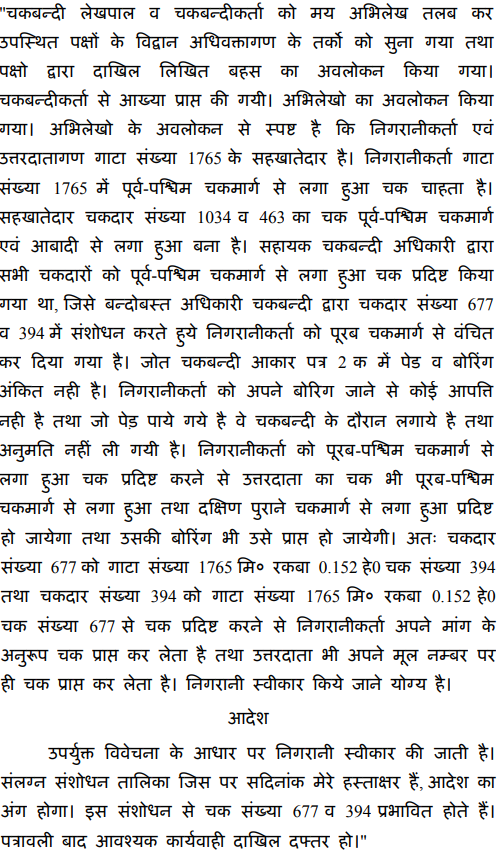
“This provision contained in Section 19(1)(f) enjoins upon the consolidation authorities to allot plot on which exists his private source of irrigation or any other improvement. Apart from it, no other provisions of Section 19 of the Act enjoins upon the c
AI
Consolidation authorities must adhere to statutory provisions when allotting chak(s) and provide justifications for deviations to ensure equitable treatment of tenure holders.
Consolidation authorities must adhere to statutory provisions when allotting chaks, ensuring tenure holders receive compact areas near their largest holdings.
Consolidation authorities must adhere to statutory provisions in allotting chaks, ensuring tenure holders receive compact areas where they hold the largest part of their holdings.

Consolidation authorities must adhere to statutory provisions and cannot act arbitrarily in allotting chaks, with judicial review permissible if principles of equity are violated.
Consolidation authorities must adhere to statutory provisions and provide justifications for deviations in chak allotment; failure to demonstrate genuine grievance leads to dismissal of the petition.
Consolidation authorities must adhere to statutory provisions in allotting chaks, ensuring tenure holders receive a compact area at their largest holding and providing reasons for any deviations.

The consolidation authorities must allot compact areas reflecting legal rights under Section 19(1)(e), ensuring valid reasons for any deviations from the standard principles of allotment.
The consolidation authorities must ensure allotments adhere to the Act's provisions, balancing tenure holders' rights and equitable allocations.
The Deputy Director of Consolidation cannot review its orders on merits, but the High Court may refrain from interference if substantial justice is achieved.



An indispensable Tool for Legal Professionals, Endorsed by Various High Court and Judicial Officers
Please visit our Training & Support
Center or Contact Us for assistance

Scan Me!
India’s Legal research and Law Firm App, Download now!


For Daily Legal Updates, Join us on :



 Back to top


