
 Back
Back





IN THE HIGH COURT OF JUDICATURE AT ALLAHABAD
Ajit Kumar, J.
Dharmendra Kumar And Another - Petitioner
Vs.
State Of U.P. And Others - Respondent
WRIT - A No. - 12051 of 2019
Decided On : 15-04-2025
| Table of Content |
|---|
| 1. petitioners are dependents of deceased employees seeking compassionate appointment. (Para 1 , 2 , 3) |
| 2. initial rejection of compassionate appointment based on delay and father's employment status. (Para 4 , 5 , 6) |
| 3. subsequent rejection based on claims of illegality in prior regularization. (Para 7 , 8 , 9 , 10 , 11) |
| 4. dispute over regularization status of petitioners' fathers and discrimination in treatment. (Para 12 , 13 , 14 , 15) |
| 5. authority's actions deemed arbitrary and not supported by previous court findings. (Para 16 , 17 , 18 , 19 , 20) |
| 6. petitioners' claims dismissed while similar cases were granted compassionate appointments. (Para 21 , 22 , 23 , 24 , 25) |
| 7. court issues mandamus for appointment and awards costs for arbitrary action. (Para 26 , 27 , 28) |
JUDGMENT :
Ajit Kumar, J.
1. Heard Ms. Jahnavi Singh, learned counsel for the petitioners and Sri P. K. Srivastava, learned Additional Chief Standing Counsel representing the State respondents.
2. Petitioners before this Court are sons of late Raja Ram and Sahib Singh respectively, who were claimed to be permanent employees working in the establishment of Public Works Department at Firozabad where they died in harness.
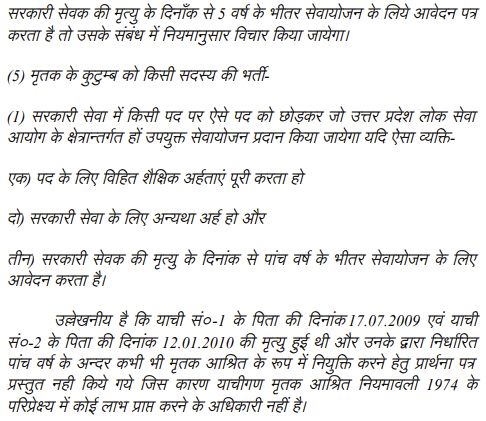
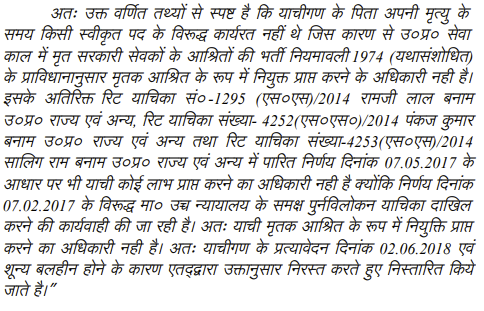
3. It is on account of these sole bread earners of the family dying in harness that petitioners moved applications before the concerned competent respondent seeking compassionate appointment. Initially nothing progressed in the matter of their applications for compassionate appointment, so they jointly approached this Court vide Writ - A No.- 9253 of 2018, which stood disposed of holding the petitioners' fathers to be confirmed employee of the respondent establishment and hence petitioners' claims were held liable to be considered for compassionate appointment and accordingly, directions were issued to the petitioners to file representation along with the certified copy of this order and the Executive Engineer, Construction Division, Firozabad was directed to take decision thereupon. The relevant extract of the order of the Court dated 25th May, 2018 is reproduced hereunder:
“With reference to the judgment of the Division Bench of this court in State of U.P. and others vs. Kuldeep Thakur reported in 2017 (35) LCD 696, it is demonstrated by the learned counsel for the petitioners that the claim for appointment on compassionate ground of the dependents of the work charge employee to whom benefit of regularization had been extended after their death, can be considered.
In the light of the fact that the regular appointment was made in pursuance of the request made by the employees concerned and on the date of their death, the claims were pending consideration, it was held by the Division Bench that on an account of unfortunate circumstance of death of an employee, his claim for regularization does not get eclipsed nor it could be said to have abandoned.
In rebuttal, learned Standing Counsel only submits that the claim of the petitioners are delayed inasmuch their fathers had died in the year 2009 and 2010. It is contended that even if, it is accepted for a moment that the claim of the petitioners were materialized after regularization of their father, the regularization order being of the year 2012, after a period of six years, it is not open for the petitioners to seek appointment on compassionate ground as they are able to meet financial crisis on account of death of their father. Considering the submissions of learned counsel for the parties and perused the record, it is more than apparent that the petitioners were repeatedly placing their claim for grant of compassionate appointment since after death of their father and till date, it has not been decided on the ground that their fathers were work charge employees, as such, the petitioners have no claim for consideration for grant of compassionate appointment.
The claim of the petitioner, thus, has not been addressed by the respondent on merits.
In view thereof, this Court does not find any for

AI
Dependents of deceased employees regularized posthumously are entitled to compassionate appointment, and authorities cannot reject claims based on arbitrary grounds or delay.


Compassionate appointments must address financial crises timely, with rules in effect at the time of application guiding decisions; administrative delays cannot negate this entitlement.

The main legal point established in the judgment is that the application for compassionate appointment should be reasonable and proximate to the time of the death of the bread earner, and the process....

Compassionate appointment is a concession and should be restricted to genuinely deserving families, with strict scrutiny of various parameters.

The regularization of service qualifies a dependent for compassionate appointment, irrespective of the father's special pay scale.

The main legal point established in the judgment is that technical objections should not prevent the grant of relief under Article 226 of the Constitution of India, and the conduct of the State as a ....


Compassionate appointments should prioritize alleviating family distress over strict adherence to procedural technicalities.



An indispensable Tool for Legal Professionals, Endorsed by Various High Court and Judicial Officers
Please visit our Training & Support
Center or Contact Us for assistance

Scan Me!
India’s Legal research and Law Firm App, Download now!


For Daily Legal Updates, Join us on :



 Back to top


