


 Back
Back





2025 Supreme(All) 3022
IN THE HIGH COURT OF ALLAHABAD
Ajit Kumar, J.
Shambhoo Nath Kushwaha – Petitioner
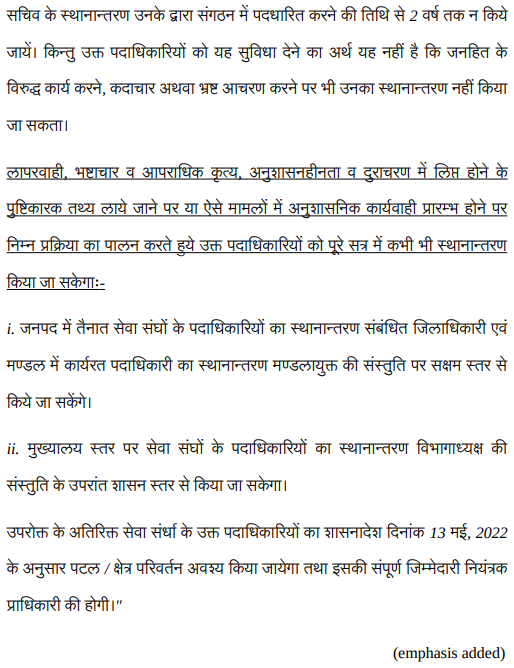
Versus
State Of UP, And 5 Others - Respondent
WRIT - A No. - 9142 of 2025
Decided On : 31-07-2025
Advocate Appeared:
For the Appellant : Siddharth Khare
For the Respondent: C.S.C.
A transfer order deemed punitive without substantiation violates administrative law, necessitating adherence to policy guidelines and a lack of malice.
Headnote:(A) Constitution of India - Article 226 - Transfer of employee - Transfer deemed punitive due to alleged misconduct related to union activities - Clause 12 of Transfer Policy dated 06.05.2025 allows transfer of union leaders under specific circumstances; transfer cannot serve as punishment - Court cited Somesh Tiwari v. Union of India regarding malice in law affecting transfer validity (Paras 4, 10, 11).
(B) Administrative powers - Administrative transfers must not be punitive unless justified with evidence of misconduct (Paras 8, 10).
Facts of the case:
Petitioner challenged a transfer order deemed punitive, claiming violation of Union leader protections under Transfer Policy and lack of prior notice regarding alleged misconduct (Paras 3, 4).
Findings of Court:
The transfer order was quashed as it was found to be punitive in nature, violating principles established in relevant case law (Paras 11, 14).
Issues: The main issue was whether the petitioner’s transfer was punitive or merely administrative and the legal requirements for such a transfer (Paras 4, 10).
Ratio Decidendi: The court asserted that transfers framed as punitive without substantiation are illegal, reiterating the need for adherence to policy regulations (Paras 10-12).
Result: Writ petition allowed; transfer order quashed.
| Table of Content |
|---|
| 1. procedural adherence and representation (Para 1 , 2) |
| 2. transfer as disciplinary action must adhere to policies (Para 3 , 4 , 6 , 8) |
| 3. judicial precedents reinforce transfer restrictions (Para 5 , 7) |
| 4. malice in law undermines administrative action (Para 9 , 10 , 11) |
| 5. discretion to transfer in administrative exigency (Para 12) |
| 6. outcome of the writ petition and future administrative authority (Para 13 , 14 , 15) |
JUDGMENT :
Ajit Kumar, J.
1. Learned Standing Counsel has obtained instruction in the matter which is taken on record, copy whereof has been supplied to learned counsel for the petitioner.
2. Heard Sri Ashok Khare, learned Senior Advocate assisted by Sri Himanshu Singh, Advocate holding brief of Sri Siddharth Khare, learned counsel for the petitioner and learned Standing Counsel.
3. By means of this petition filed under Article 226 of the Constitution of India, petitioner has assailed the order dated 13.06.2025, whereby, he has been transferred from Siddharth Nagar to Ayodhya to be stigmatic in nature and hence punitive.
4. It Is submitted that very recitals contained in the order show that petitioner has been subjected to transfer by way of disciplinary action for alleged violation or non-compliance of the directives issued by the higher authorities, which was claimed to have amounted to an alleged misconduct. Learned counsel for the petitioner submits that transfer is bad for two obvious reasons: firstly, petitioner being office bearer of the Employees' Union ought not to have been transferred in the first instance in view of the relevant Clause 12 of the Transfer Policy dated 06.05.2025 that carves out union leaders to be exceptional cases; and secondly, transfer cannot be done by way of a punitive action.
5. In support of his above second submission, learned counsel for the petitioner has placed reliance upon the judgment of the Supreme Court in the case of Somesh Tiwari vs. Union of India and Ors. AIR 2009 Supreme Court 1399
6. Learned Standing Counsel has obtained instructions in the matter and as per the instructions, petitioner has been subjected to transfer in full compliance of the provisions contained in the Clause 12 of the Transfer Policy dated 06.05.2025, according to which, if there are complaints against the office bearers and if they are found to be involved in an activity resulting in indiscipline and which affects the performance of duty and is also indication of misconduct, in such cases the office bearers can also be transferred. He has placed Clause 12 of the Transfer Policy dated 06.05.2025 before the court, which runs as under:
7. From the instructions it further transpires that some work was allotted to the petitioner under the order of a higher authority dated 19.03.2025 for the purposes to construct a dam but instead of complying with the directives issued by the higher authority, petitioner wrote back to authority that such double duties and attachment orders have already been held to be not permissible and hence he cannot be forced to discharge duties as per the directives issued. Upon this letter being written the Executive Engineer took seriously and as an exception and required the petitioner to submit his explanation to which the petitioner states that he had offered his explanation by letter dated 29.05.2025 but that remained unanswered and, instead of holding meeting and cooperating with the employees, the authorities proceeded to recommend transfer of the petitioner.
8. It is thus contended that if the petitioner was to be transferred by way of punitive action then show cause notice was a must, inasmuch as the transfer can not be made by way of action as a result of some departmental proceedings. Paragraph 19 and 20 of the judgment that has been relied upon in the case of Someshwar Tiwari (Supra) is reproduced hereinunder:
"....19. Indisputably an order of transfer is an administrative order. There cannot be any doubt whatsoever that transfer, which is ordinarily an inciden












