


 Back
Back





2024 Supreme(All) 2501
IN THE HIGH COURT OF ALLAHABAD
SAURABH SHYAM SHAMSHERY, J.
Raghuraj Singh – Appellant
versus
State Of U.P. And 6 Othrs. - Respondent
WRIT - B No. - 2855 of 2018
Decided on : 17-12-2024
For the Appellant : Abhinav Gaur,Anoop Trivedi (Senior Adv.),Vibhu Rai
For the Respondent: Alok Kumar Gupta,Brij Bhushan Paul,C.S.C.,Ghan Shyam Singh,Krishna Kant Singh,Manu Singh, Vinod Kumar Rai
Adoption deed requires evidence of consent from natural and adoptive parents and must comply with statutory provisions; failure to meet these conditions invalidates the adoption.
Headnote:(A) Uttar Pradesh Zamindari Abolition Land Reforms Act, 1950 - Hindu Adoption and Maintenance Act, 1956 - Validity of adoption - Suit filed for co-tenure rights challenged adoption deed's validity; requisites not met under Act of 1956 - Adoption not proved due to lack of evidence, leading to dismissal of writ petition. (Paras 2, 16, 18, 21)
(B) Adoption - Legal requirements - Consent of natural and adoptive parents essential; adoption deed must be proven in line with statutory mandates. (Paras 16, 21)
Facts of the case:
The appellant contested the respondents' claims from a suit established on the grounds of an alleged adoption deed, which lacked necessary evidence and statutory compliance.
Findings of Court:
The lack of original or certified copies and failure to meet statutory conditions to establish the adoption deed's validity resulted in confirmation of the lower court's rulings.
Issues: The main issues address whether the adoption was evidenced according to law and the validity of the adoption deed.
Ratio Decidendi: The court held that the absence of signatures of both natural and adoptive parents and failure to present necessary witnesses invalidates the adoption deed, aligning with established legal requirements.
Result: Writ petition dismissed.
| Table of Content |
|---|
| 1. appeal process and judicial review of land suit. (Para 1 , 6 , 7) |
| 2. co-tenure claims under land reform act. (Para 2 , 4 , 5 , 19) |
| 3. arguments on adoption deed's validity. (Para 8 , 10 , 11 , 12) |
| 4. conditions for valid adoption under law. (Para 15 , 16 , 20 , 21) |
| 5. final dismissal of the writ petition. (Para 22 , 23) |
JUDGMENT :
Saurabh Shyam Shamshery,J.
1. Heard Sri Anoop Trivedi, learned Senior Counsel assisted by Sri Vibhu Rai, learned counsel for petitioner and Sri A.P. Paul, learned counsel for contesting respondent.
2. In the present case, contesting respondents have filed a Suit No.42/2007 under Section 229 -B of Uttar Pradesh Zamindari Abolition Land Reforms Act, 1950 against the petitioner and claimed co-tenure to the extent of half shares.
3. In the said suit following 13 issues were framed.
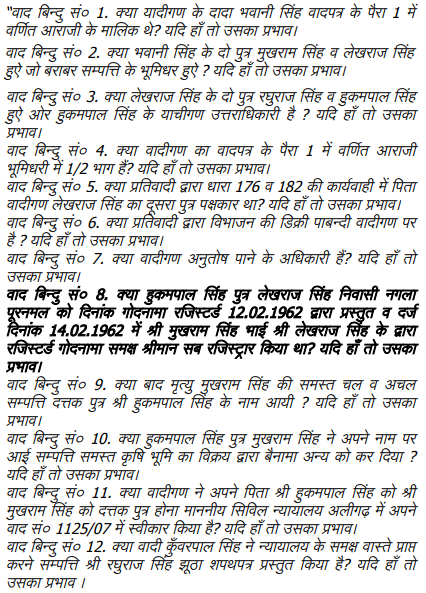
4. So far as present controversy is concerned, issue nos.8 and 13 are relevant.
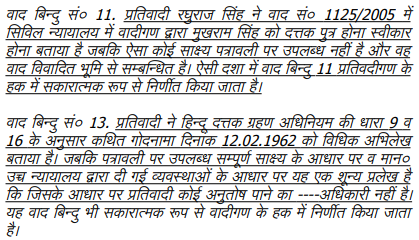
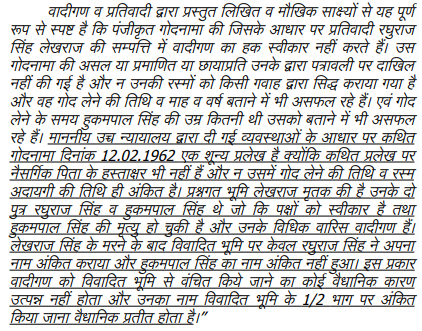
5. Learned Trial Court vide order dated 6.4.2011 decreed the suit. So far as finding in regard to issue nos.8 and 13 are concerned, relevant findings thereof are reproduced hereinafter:
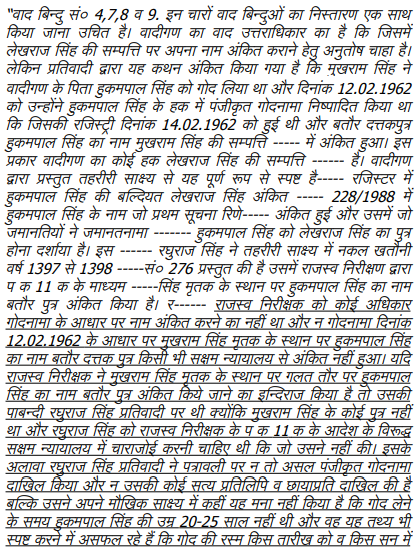
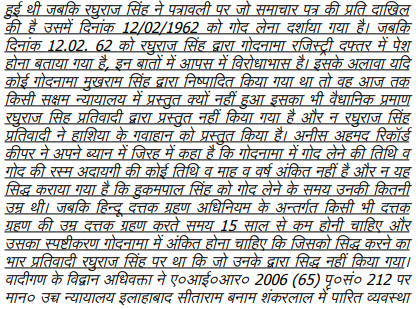
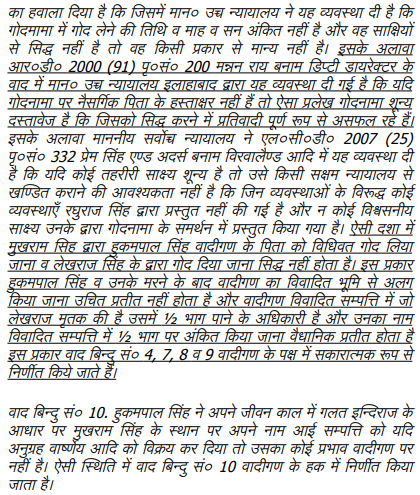
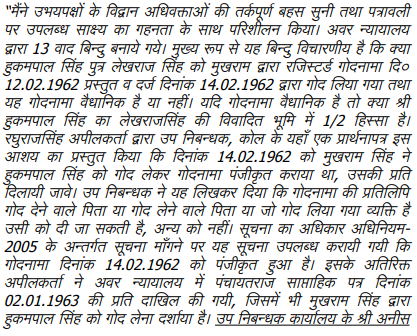
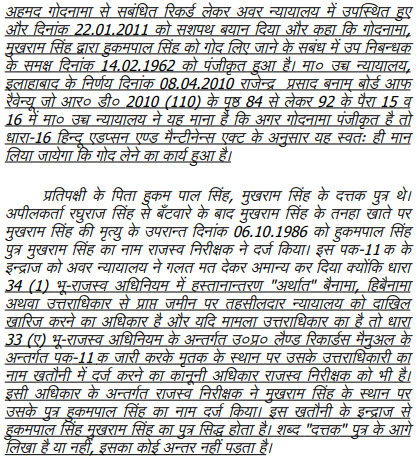
6. Petitioner being aggrieved by the above order, filed an appeal which was allowed vide order dated 11.8.2011 and the suit was dismissed. Relevant finding returned by the First Appellate Court so far as adoption is concerned is reproduced hereinafter:
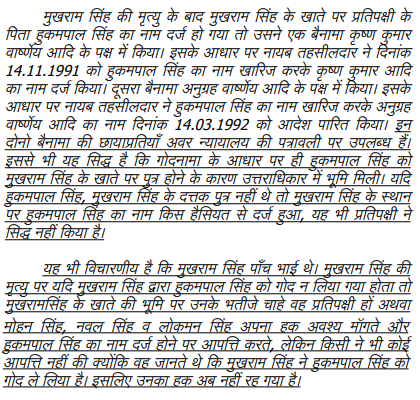
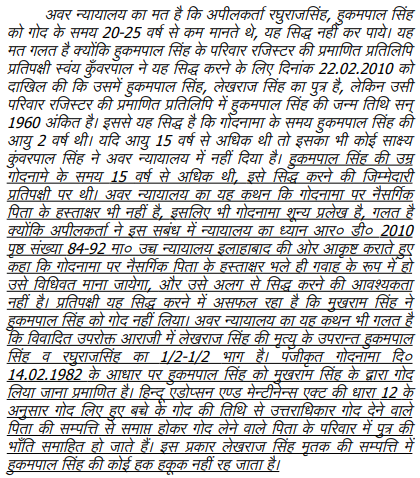
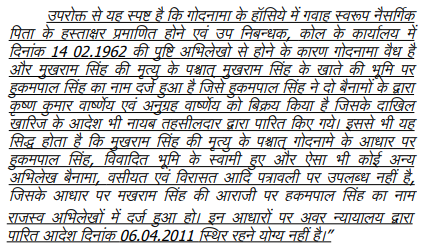
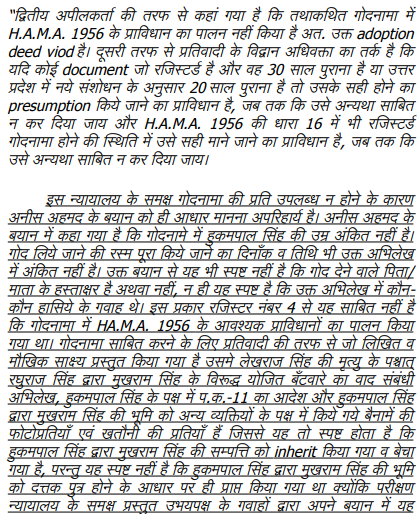
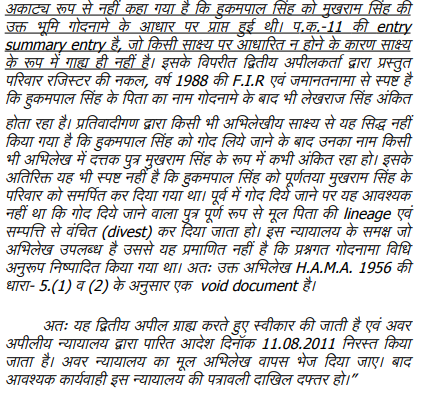
7. The plaintiff/contesting respondents being aggrieved by the aforesaid order, filed a Second Appeal before the Board of Revenue, which was allowed vide order dated 28.12.2007 and the relevant finding returned in regard to adoption deed is as follows:
8. Learned Senior Counsel appearing on behalf of petitioner submitted that the issue in regard to adoption was rightly considered by the First Appellate Court which does not require any interference by the Second Appellate Court.
9. Learned Senior Counsel referred some documents annexed along with this writ petition that plaintiff/contesting respondents has admitted existence of adoption deed.
10. Learned Senior Counsel further submitted that on the basis of adoption, sale deeds were executed which were not challenged. Contesting respondents have never made any attempt to challenge the adoption deed by way of filing separate proceedings and therefore, in aforesaid, principle of Estopple will also act against the respondents.
11. Learned Senior Counsel has referred judgments passed by Supreme Court in Mst. Deu v. Laxmi Narayan , (1998) 8 SCC 701 , that in view of Section 16 of the Act of 1956, whenever any document registered under law is produced before the Court purporting to record an adoption made and is signed by the persons mentioned therein, the Court should presume that the adoption has been made in compliance with the provisions of the said statute, unless and until it is disproved. It was further held that in view of Section 16 of the Act of 1956, it is open to the persons who challenge the registered deed of adoption to disprove the same by taking independent proceedings.
12. Per contra, learned counsel appearing on behalf of contesting respondents/plaintiff submitted that issue of adoption has to be proved in terms of relevant provisions of Hindu Adoption and Maintenance Act, 1956 (hereinafter referred to as ‘Act of 1956’) which provides that adoption be carried out in accordance with law with the consent of both the parties including their respective wife. The adoption deed was not proved in accordance with the said provisions and substantial questions of law framed by the Board of Revenue were rightly answered.
13. I have considered the above submissions and perused the records.
14. The Board of Revenue has framed substantial questions of law as to whether Hukum Pal Singh was adopted by Mukhram Singh on 12.2.1962 and the same was proved on basis of evidence or not.
15. Board of Revenue has taken note of following factors to return a finding that adoption was not proved:
(a) No original, certified or photo copy of adoption deed dated12.2.1962 is on record.
(b)












