Back
Back





2024 Supreme(All) 2577
IN THE HIGH COURT OF ALLAHABAD
Saurabh Shyam Shamshery, J.
Hukam Chand and Another – Appellants
Versus
State of U.P. and Others – Respondents
Writ (B) No. 1462 of 2022
Decided On : 27-11-2024
For the Appellant : Abhitab Kumar Tiwari
For the Respondent: Rahul Kumar Tyagi
A family settlement document does not necessarily require registration to be admissible as evidence, and a second appeal must address substantial questions of law for it to be entertained.
Headnote:(A) U.P. Z.A. & L.R. Act - Section 176 and 182 - Family settlements - Nature of documents - Appellants challenged a final decree based on a family settlement alleged to require registration; the court highlighted the implications of registered vs unregistered documents on evidence admissibility. (Paras 1, 3, 12, 19)
(B) Second Appeal - Substantial questions of law - The court reiterated that a second appeal under Section 100 CPC must address substantial questions of law; dismissals on grounds of lack of substantial question are impermissible. (Paras 17, 20, 21)
Facts of the case:
The petitioners contested a decree based on family settlement documents from 2003, asserting the lower appellate court erroneously deemed it a compromise deed requiring registration, affecting valid claims of possession and previous agreements.
Findings of Court:
The High Court set aside the order of the Board of Revenue and remitted the matter for reconsideration of substantial questions of law, emphasizing adherence to procedural norms regarding second appeals.
Issues: The main issues included the requirement of registration for a family settlement document to be admissible as evidence and whether the second appellate court addressed substantial questions of law.
Ratio Decidendi: The court ruled that the family settlement document did not necessarily require registration for its admissibility; it also confirmed that a second appeal must involve substantial questions of law to be entertained.
Result: Writ petition disposed with directions for reassessment.
| Table of Content |
|---|
| 1. multiple litigations arose from family settlement. (Para 2 , 3 , 4) |
| 2. final decrees were challenged in multiple appeals. (Para 5 , 8) |
| 3. arguments regarding registration of family settlement. (Para 10 , 11 , 12) |
| 4. discusses substantial questions of law. (Para 15 , 16) |
| 5. court's reasoning on evidence and registration requirement. (Para 17 , 18 , 19 , 20 , 21) |
| 6. writ petition disposed with directions. (Para 22) |
JUDGMENT :
Saurabh Shyam Shamshery, J.
1. Heard Sri Abhitab Kumar Tiwari, learned counsel for petitioners and Sri Rahul Kumar Tyagi, learned counsel for contesting respondents.
2. There are multiple proceedings between the parties. The first proceeding was commenced when one Rajveer Singh filed a suit under Section 176 of U.P. Z.A. & L.R. Act, which was decided and Khurras were prepared with consent of parties, purportedly on basis of a memorandum of family settlement reduced in writing on 12.04.2003 and accordingly a final decree was proposed, however, thereafter the parties remained silent for about a decade.
3. In the year 2013, when Smt. Laxmi Devi died issueless then respondent/plaintiff filed a suit under Section 176 //182 of U.P. Z.A. & L.R. Act, which commenced the second litigation between parties. It was claimed that in plaint the fact of family settlement was not disclosed. The suit was contested and finally claim of respondent No.6 was rejected and counter claim of petitioners was allowed by order dated 27.02.2019 and accordingly, a preliminary decree was prepared on 05.03.2019.
4. The aforesaid referred judgment and preliminary decree were challenged by plaintiff/respondent by way of a First Appeal before the Commissioner, Meerut.
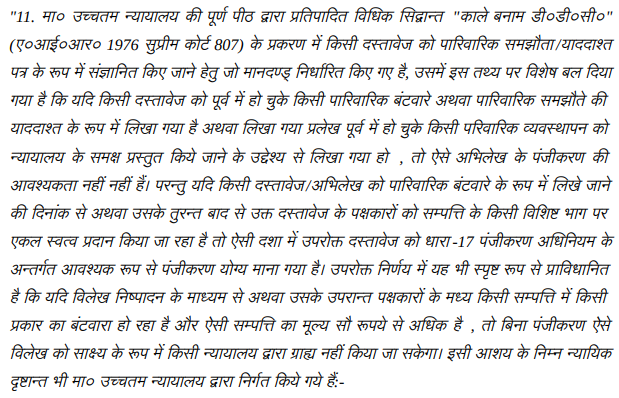
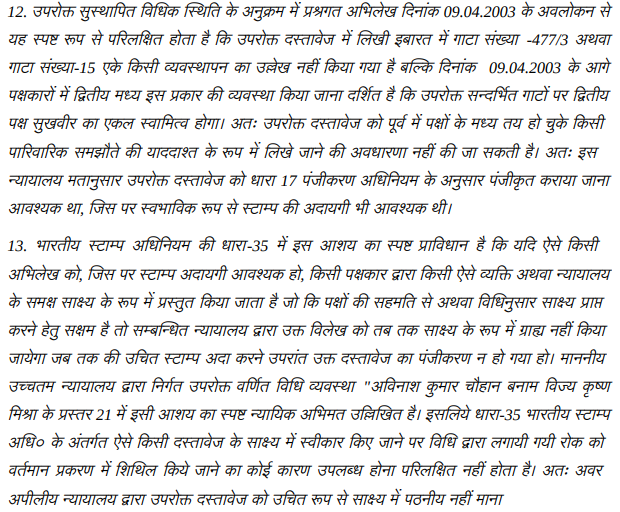
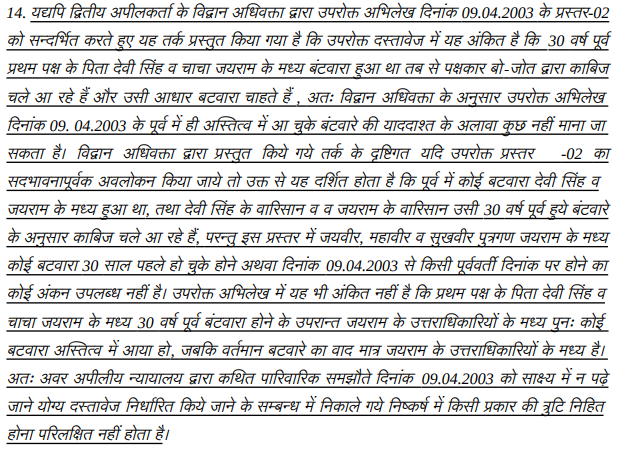
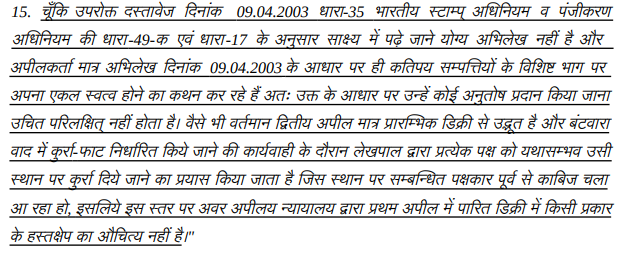
5. During pendency of the appeal, an application under Order 41 Rule 27 C.P.C. was filed but it was never allowed, still additional evidence was considered and the First Appellate Court by an order dated 20.02.2020 has set aside the judgment and preliminary decree passed by Trial Court and allowed the suit of respondent No.6. The relevant part thereof is mentioned hereinafter:-
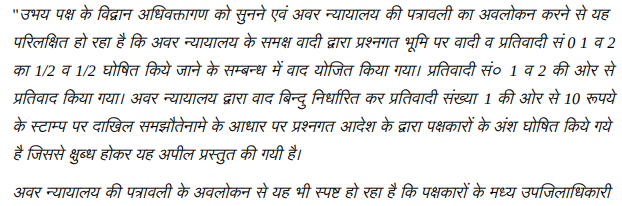
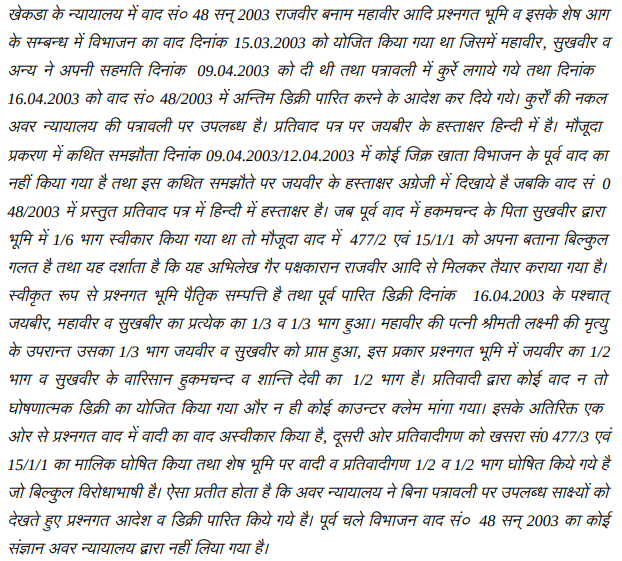
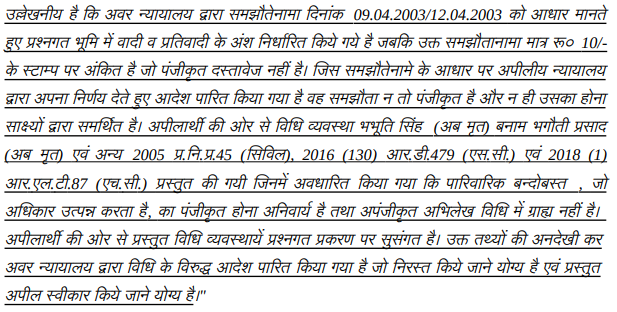
6. In the aforesaid circumstances, a Second Appeal was filed by the petitioners, wherein substantial questions of law was proposed as well as several grounds were also taken. For reference, the substantial questions of law proposed in memo of Second Appeal are reproduced hereinafter :-
"A. Whether, lower appellate court erred in law by allowing the appeal without set asiding the finding of trial court recorded on issues and without discussing about the issues framed and decided by trial court and without recording his own finding on issues.
B. Whether, lower appellate court erred in law in treating a memorandum of family settlement as compromise deed and allowing the appeal on the ground that it is not a registered documents without proper consideration of document and without reading it in whole and without recording finding that whether this document is memorandum of family settlement or family settlement of compromise deed, especially when this document is not giving any new right to the parties but it is only settlement of cultivation of lands by parties, which registration is not required.
C. Whether, lower appellate court erred in law to ignoring the fact that family settlement regarding cultivating the land was accepted by plaintiff/respondent and parties are in possession and peacefully cultivating over their land according to compromise since a long time hence claim of plaintiff/respondent is barred by principal of Estoppel.
D. Whether, lower appellate court erred in law in relying upon the documents which was first time filed in appellate court without allowing the application under Order 41 Rule 27 of C.P.C.
E. Whether, judgment and degree of lower appellate court suffers from misreading, misinterpretation and ignorance of laws and evidences."
7. The Second Appeal was heard, however, it was dismissed by an order dated 08.03.2022 at the stage of admission, taking a view that no question of law