
 Back
Back





IN THE HIGH COURT OF JUDICATURE AT ALLAHABAD
SIDDHARTHA VARMA, MADAN PAL SINGH, JJ.
Raees Ahmad @ Raesu – Appellant
Versus
State of U.P. – Respondent
Criminal Appeal No. 1597 of 2020
Decided On : 02-02-2026
| Table of Content |
|---|
| 1. factual background of the case (Para 1 , 2 , 3 , 4 , 5) |
| 2. analysis of witnesses and evidence presented during the trial (Para 6 , 7 , 8 , 9 , 10 , 11 , 12 , 13 , 14 , 15 , 16 , 17 , 18 , 19 , 20 , 21 , 22 , 23 , 24) |
| 3. arguments against the reliability of the dying declaration (Para 25 , 26 , 27 , 28 , 29) |
| 4. conclusion on the legal validity of the evidence leading to acquittal (Para 30) |
| 5. final orders of acquittal and acknowledgment of contributions (Para 31 , 32) |
JUDGMENT :
1. The present Criminal Appeal has been filed against the judgment and order dated 19.2.2020 passed by the Additional Sessions Judge, Court No. 3, Bijnor, in S.T. No. 120 of 2017 (State vs. Raees Ahmad & another) arising out of Case Crime No. 976 of 2016, under Sections 302/34, 326A/34, 342 and 201 IPC, Police Station - Najibabad, District - Bijnor.
2. The case was initiated with the lodging of a First Information Report on 5.12.2016 at 14:50 hours. The first informant, namely, Ahmad Ali @ Nanhe had in the FIR stated that his Bhanji (sister's daughter) a few days earlier had fallen in love with a neighbour's son which was not liked by Rahisa the husband of the sister Fatima. Even though the case had resulted in a settlement, the husband of the sister of the first informant was very cross with his daughter and therefore, because of this incident, the first informant had brought his niece to his house at Kashipur where she stayed for around 4 months. In the FIR, it has been stated that on 4.12.2016 at 6:00PM Rahisa the husband of the sister of the first informant came to the house of the first informant and told him that some people were coming to see his daughter in connection with her marriage at his house at Maswani and, therefore, Farheen his daughter be sent along with him. Upon this request, the first informant had taken Farheen on his motorcycle to the roadways bus stand at Kashipur and dropped her there. The next day i.e. on 5.12.2016 at around 7:00AM, he received an information from the Najibabad hospital that his niece Farheen had got acid burns and that she was found in Nanuwala village and for further treatment she had been referred to a better hospital at Bijnor. Upon getting this news, the first informant along with his brother Mubarak Ali reached the Bijnor Government Hospital and met his niece who told him that her father and one Nabi Hasan had taken her from Kasipur roadways bus stand and had made her sit in a pick up van and had proceeded for their village. On the way she had fallen asleep. Nabi Hasan the partner of the father of the niece had tried to throttle her and because of which her eyes had opened and she saw everything. Thereafter she had said she did not know as to what had happened. She had also informed that a vehicle from the Najibabad Hospital had come to take her. She had also told the first informant that she had given the telephone number of the first informant (Nanhe Mama) to the hospital authorities who had rung him up. He had, thereafter, stated in the FIR that his brother-in-law Rahees and his partner Nabi Hasan had first tried to kill his niece by throttling her and thereafter they had thrown acid on her to obliterate her identity. He had thereafter in the FIR itself stated that the niece was admitted in the hospital and he had got the FIR lodged. The case was registered as Case Crime No. 0976 of 2016 and was lodged under Section 307, 326A, 201, 342 and 34 IPC.
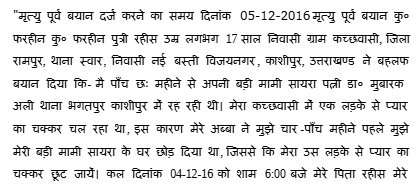
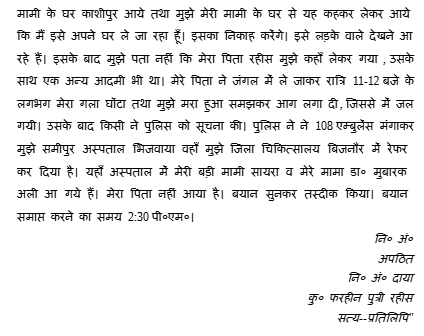
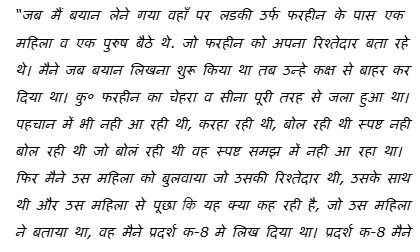
3. A dying declaration of the niece of the first informant was recorded on 5.12.2016 itself. The dying declaration which was got recorded on 5.12.2016 had stated that Farheen(victim) was staying for the past 5 to 6 months with her elder mami Sayra wife of Dr. Mubarak Ali (scribe of the first informant report) at Police Station - Bhagatpur District - Kasipur. She had stated that in her village Maswani, she had fallen in love with a boy and therefore her father had left her with her elder Mami Sayra so that she may get detached from the boy she was l

AI
A dying declaration, while admissible as evidence, must be directly articulated by the victim and free from external influence; its absence risks a conviction based on unreliable testimony.


Dying declarations can be the sole basis for conviction if credible, but inconsistencies and the circumstances of their recording can undermine their reliability.

A dying declaration must be made when the victim is in a fit mental state; mere consciousness is insufficient for reliability.
A dying declaration is only valid if the victim was in a fit mental state to give it, which wasn't established; thus, conviction based solely on it is unsafe.
The court ruled that a dying declaration must be credible and recorded under proper conditions; discrepancies and lack of corroborative evidence led to the acquittal of the appellant.

Dying declarations can be the basis for conviction if voluntary and reliable; inconsistencies can undermine their credibility, especially when the accused was not present during the incident.

Inconsistent dying declarations cannot suffice for conviction without corroborating evidence, especially when procedural guidelines for a fair trial are not met.



An indispensable Tool for Legal Professionals, Endorsed by Various High Court and Judicial Officers
Please visit our Training & Support
Center or Contact Us for assistance

Scan Me!
India’s Legal research and Law Firm App, Download now!


For Daily Legal Updates, Join us on :



 Back to top


