
 Back
Back





IN THE HIGH COURT OF JUDICATURE AT ALLAHABAD, LUCKNOW BENCH
ASHWANI KUMAR MISHRA, GAUTAM CHOWDHARY, JJ.
Shahrukh Khan And Another – Appellants
Versus
State of U.P. – Respondent
Criminal Appeal No.6151 of 2022
Decided on : 18-09-2024
(A) Indian Penal Code, 1860 - Sections 302, 498A, 304-B, 323 - Dowry Prohibition Act, 1961 - Conviction of husband and mother-in-law for murder and dowry harassment - The trial court convicted the accused based on the dying declaration of the victim, which was found unreliable due to lack of medical certification regarding her mental fitness at the time of the declaration. The court emphasized that mere consciousness does not equate to mental fitness for making a dying declaration. (Paras 12, 16, 25)
(B) Dying Declaration - Legal standards - The court reiterated that a dying declaration must be made when the victim is in a fit mental state, and the absence of such certification raises doubts about its reliability. (Paras 16, 25)
Facts of the case:
The victim was allegedly assaulted and set on fire by her husband and mother-in-law due to dowry demands. The dying declaration was the primary evidence against the accused, but the victim's mental state at the time of the declaration was questioned. (Paras 2, 4)
Findings of Court:
The court found the dying declaration unreliable and set aside the conviction, granting the accused benefit of doubt. (Paras 25, 26)
Issues: The main issues included the reliability of the dying declaration and whether the accused were given a fair chance to defend themselves regarding the contents of the declaration. (Paras 12, 25)
Ratio Decidendi: The court ruled that the prosecution failed to establish the victim's mental fitness at the time of the dying declaration, making it unsafe to rely on it for conviction. (Paras 16, 25)
Result: The appeal was allowed, and the conviction was set aside. (Paras 26)
JUDGMENT :
(Per : Hon’ble Ashwani Kumar Mishra, J.)
1. This appeal is directed against the judgment and order of conviction dated 16.07.2022 passed by learned Additional District and Session Judge, Court No. 10, Aligarh in Session Trial No. 257 of 2019 (State Vs. Shahrukh Khan and another), arising out of Case Crime No. 403 of 2018, under Sections 498A, 304-B I.P.C., in alternative under Sections 302, 323, 307 I.P.C. read with Section 3/4 of Dowry Prohibition Act, Police Station Chandaus, District Aligarh, whereby both the accused-appellants, Shahrukh Khan and Anjum, who are husband and mother-in-law of the deceased respectively, have been convicted and sentenced to life imprisonment under Section 302 I.P.C. along with a fine of Rs. 10,000/- and on failure to deposit the fine to undergo additional simple imprisonment of six months, and six months simple imprisonment along with a fine of Rs.1,000/- and on failure to deposit the fine to undergo additional simple imprisonment for one month.
2. The father of the deceased, Yaseen Khan lodged a written report on 21.12.2018, stating that his daughter Ruksar got married to the accused-Shahrukh Khan on 17.05.2018 as per Muslim traditions and customs. He had given dowry of rupees one lakh alongwith the motorcycle, gold chain and ring, etc., apart from five hundred grams silver jewellary. The daughter (deceased) was harassed for dowry by the family members. She was also ill treated and physically beaten for getting less dowry. On 21.12.2018 at about 9:00 a.m. while the informant's daughter was cooking food, the accused-Shahrukh Khan, allegedly assaulted her with an iron rod and, thereafter, her mother-in-law, sister-in-law and brother-in-law, poured kerosene on her, whereafter, the accused-Shahrukh Khan lighted the matchstick and the informant’s daughter was dragged inside. On raising of alarm by the deceased the neighbours arrived, whereafter, the fire was doused. Nazakat, S/o Fakeer Mohammad, intimated the informant about the incident, thereafter, he called police helpline number 100. On receiving of information the police took the informant’s daughter to the hospital. On the basis of aforesaid report the F.I.R. came to be lodged on 21.12.2018 at 22:25 hours in respect of the incident of the same day occurred at 9:00 a.m. The victim was apparently taken to the Community Health Clinic, Chandaus, whereafter, she was referred to the District Hospital, where the victim was taken by the police personnel. As per the medical records, the victim was got admitted at the District Hospital by the father of the victim. The victim remained admitted in the hospital and she ultimately died in the night of 04/05 of January, 2019 at 12:30 a.m.
3. Although the investigation proceeded in the matter, but neither the spot was inspected on the date of incident nor any recovery, etc., was made till the date of death of the deceased. The spot has been inspected by the Investigating Officer after 15 days. After the death of the victim the inquest was conducted at 2:00 p.m. on 05.01.2019. The postmortem has been conducted on the same day and the following condition of the victim has been mentioned in the postmortem report:
“Superficial to deep thermal burn injuries present all over body. Except some parts of legs.”
Cause of death was septicaemia and shock as a result of ante mortem thermal burn injuries.
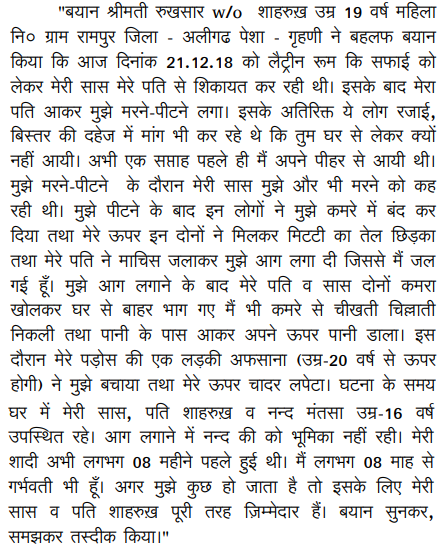
4. A dying declaration was made by the injured on 21.12.2018, as per which she was 19 years old and on the date of incident her mother-in-law had made a complaint against the victim in respect of non cleaning of toilet. The husband of the victim, thereafter, beat her. Demand of quilt, bed, etc., was also made towards dowry. The victim had gone to her paternal house and returned to her in-laws house only a week back. The mother-in-law was insisting her husband to beat her more. It is, thereafter, that the victim was locked inside the room and two accused-appellants poured kerosene on her and the husband lighted the ma
AI
A dying declaration must be made when the victim is in a fit mental state; mere consciousness is insufficient for reliability.

A dying declaration is only valid if the victim was in a fit mental state to give it, which wasn't established; thus, conviction based solely on it is unsafe.
The court ruled that a dying declaration must be credible and recorded under proper conditions; discrepancies and lack of corroborative evidence led to the acquittal of the appellant.

The admissibility and reliability of dying declarations as a sole basis for conviction, as established by various Supreme Court cases.


The court emphasized that a dying declaration must be corroborated and reliable; procedural irregularities and delays in lodging the FIR can undermine its credibility.

Dying declarations must be substantiated by medical fitness certifications and corroborating witness accounts; failure to do so undermines their reliability leading to altered convictions.

Dying declarations can serve as the sole basis for conviction if they are proven to be reliable, but lack of corroboration or inconsistencies can lead to acquittal.

A dying declaration must be trustworthy and corroborated; significant discrepancies in the statement led to acquittal due to reasonable doubt not established by prosecution.



An indispensable Tool for Legal Professionals, Endorsed by Various High Court and Judicial Officers
Please visit our Training & Support
Center or Contact Us for assistance

Scan Me!
India’s Legal research and Law Firm App, Download now!


For Daily Legal Updates, Join us on :



 Back to top


