
 Back
Back





HIGH COURT OF JUDICATURE AT ALLAHABAD LUCKNOW
INDRAJEET SHUKLA, J.
Ramesh Chandra Singh – Petitioners
Versus
The State of U.P. Through The Secy. Home and Ors. – Respondents
Writ A. No. 6218 of 2004
Decided On : 20-01-2026
| Table of Content |
|---|
| 1. petitioner's unauthorized absence from service. (Para 2 , 3 , 4 , 5 , 6 , 8 , 10 , 11) |
| 2. arguments pertaining to due process and justification of absence. (Para 12 , 13 , 15 , 16 , 17 , 18 , 19 , 20 , 21 , 22) |
| 3. court's analysis of compliance with procedural norms. (Para 14 , 32 , 39 , 41 , 46) |
| 4. legal standards for punitive action in service matters. (Para 29 , 30 , 31 , 52 , 62 , 63) |
| 5. conclusion and directions for reconsideration of punishment. (Para 64 , 65 , 66) |
JUDGMENT :
INDRAJEET SHUKLA, J.
For the convenience of exposition, this judgment is divided into the following parts:-
TABLE OF CONTENTS
| SL.No. | Heading |
|---|---|
| A. | FACTUAL MATRIX |
| B. | AVAILABILITY OF ALTERNATIVE REMEDY |
| C. | SUBMISSION ON BEHALF OF PETITIONER |
| D. | SUBMISSION ON BEHALF OF STATE RESPONDENTS |
| E. | RELEVANT RULES |
| F. | ANALYSIS AND REASONING |
| G. | CONCLUSION |
1. Heard Sri Ajai Krishna Yadav, learned counsel for the petitioner, Sri Dev Prakash Mishra, learned Additional Chief Standing Counsel representing the State respondents.
2. By means of present writ proceedings, the petitioner has set up challenge to the impugned order dated 14.04.2000 passed by 4th respondent removing the petitioner from service contained as Annexure-1 to this writ petition and impugned order of the same date forfeiting the salary of 160 days for unauthorized absence, from 14.05.1999 to 20.10.1999. The petitioner has further assailed the validity and correctness of order dated 29.09.2000 passed under appeal by 3rd respondent and the revisional order dated 22.05.2004 passed by 2nd respondent contained as Annexure-3 and 4 respectively to the writ petition.
A. FACTUAL MATRIX
3. Brief facts of present writ petition are that, the petitioner, who happened to be constable in disciplined force i.e. Provincial Arms Constabulary (PAC) was posted in 25th Battalion, Police Head Quarter, Raebareli proceeded for casual leave of 2 days on 12.05.1999 and as such he had to report the duties on 15.05.1999, but instead of reporting his duties on 15.05.1999 he became absent till 20.10.1999 i.e. almost 160 days and in this background a preliminary inquiry was directed and conducted, thereafter, regular inquiry was instituted by means of chargesheet dated 05.01.2000, primarily with the charge of unauthorized absenteeism. The relevant part of the chargesheet is extracted as under:-
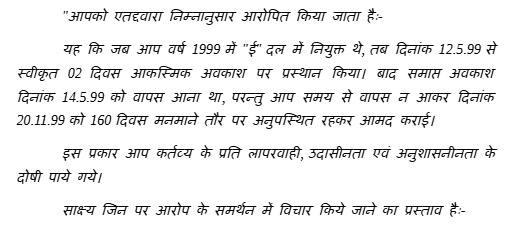
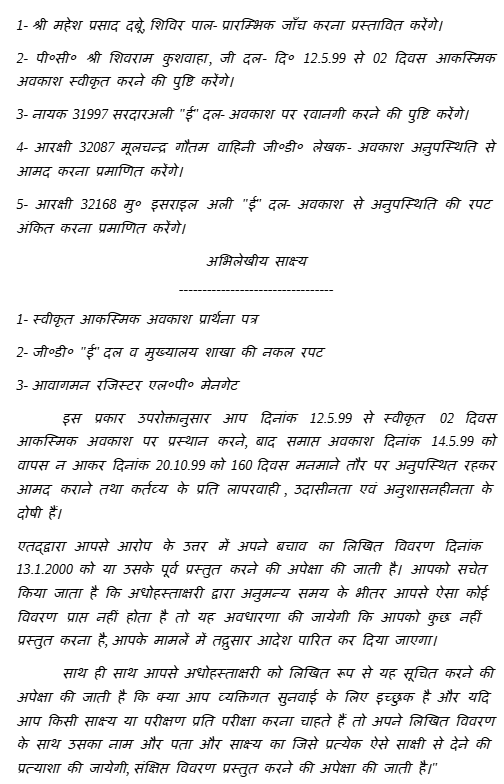
4. In the chargesheet as many as five witnesses were proposed to be orally examined and certain documentary evidence exhibiting unauthorized absence was also appended with the chargesheet.
5. After receiving the chargesheet, the petitioner submitted his reply on 17.01.2000 before inquiry officer mentioning therein that petitioner had to report on 15.05.1999 but he could not come back as such he sent an application for extension of leave. The inquiry officer in order to prove the charges of overstay/unauthorized absence examined the witnesses cited in the calendar of chargesheet and the record transpires that adequate opportunity of cross-examination of witnesses was afforded but same was not availed by the petitioner, as such the oral evidence/testimony of witnesses examined by inquiry officer remained unimpeached.
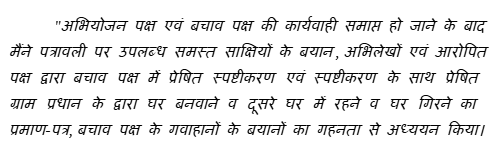
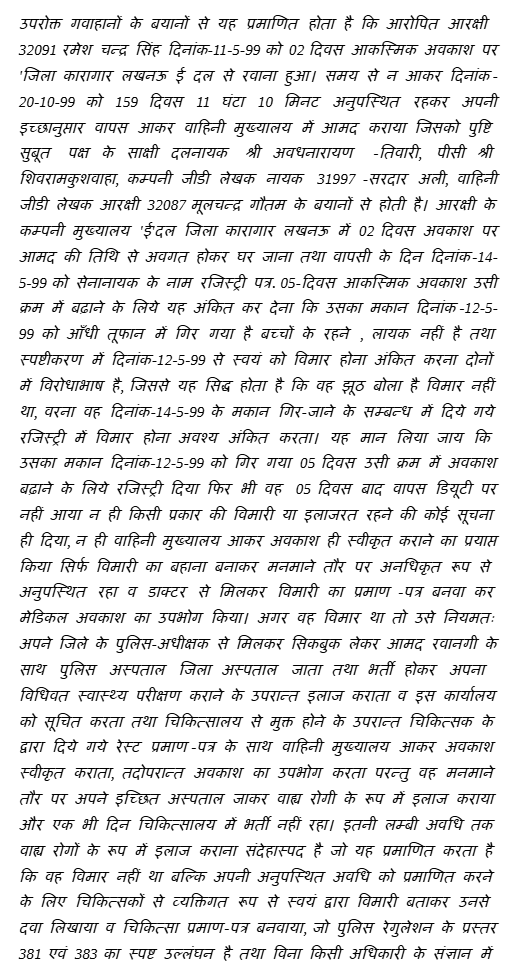
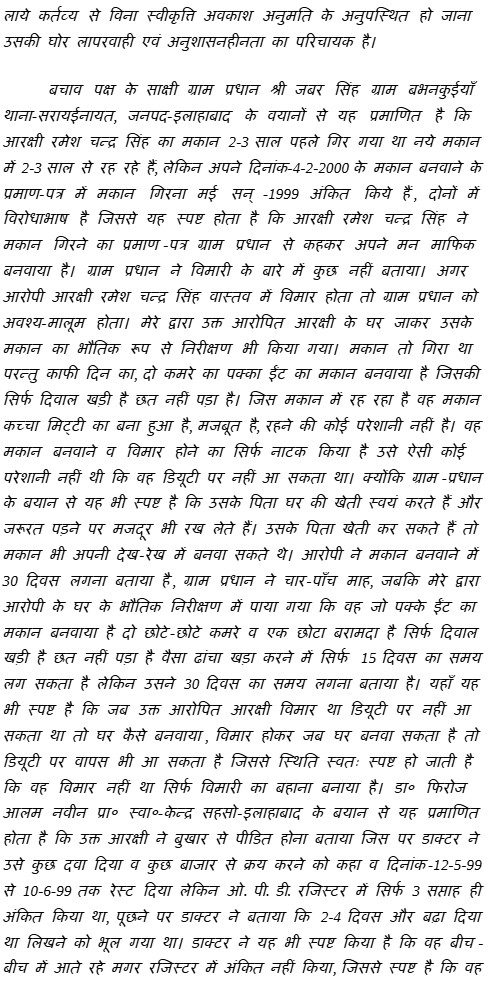
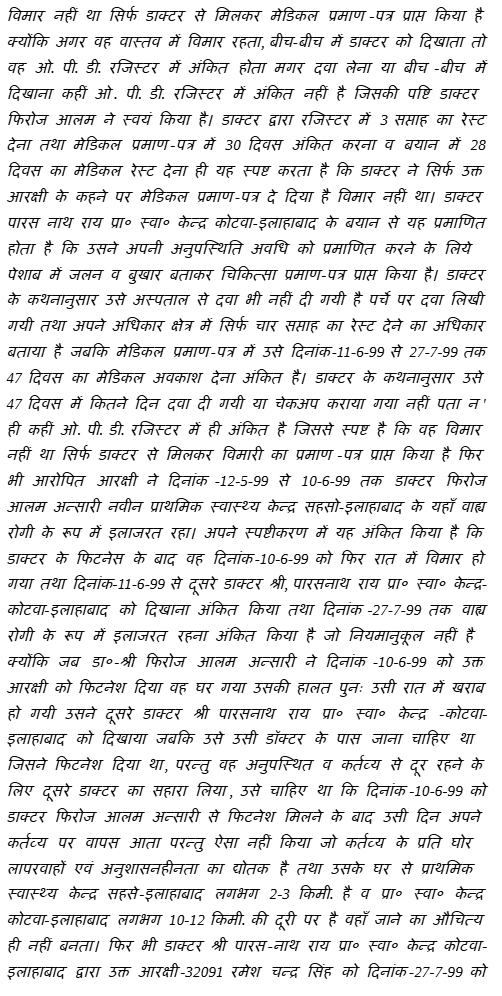
6. The petitioner, in order to prove his case examined two doctors viz Dr. Firoz Alam. Ansari, Medical Officer, New Primary Health Center, Sahson, District, Allahabad and Dr. Paras Nath Rai, Medical Officer, Primary Health Center, Kotwa, Allahabad. While taking plea of ill health, the petitioner had taken an alternate plea of collapse of his house, which was in dilapidated condition to justify his absence and as such, petitioner claimed that he was busy in construction of his house and the absence cannot be said to be willful, rather due to compelling circumstances. Just to prove aforesaid plea of collapse of house, the petitioner got examined, Jabar Singh, the then Gram Pradhan.
7. The inquiry officer examined the defence witnesses viz Jabar Singh (Pradhan of the Village), Dr. Firoz Alam. Ansari and Dr. Paras Nath Rai in extenso.
8. After meticulo
AI
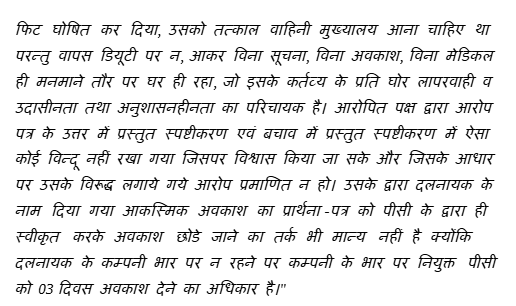
The Court emphasized that while past conduct can influence punishment, it cannot serve as the sole basis for dismissal without it being specifically charged and substantiated.


Disciplinary actions must follow due process, and absence due to illness cannot be deemed willful misconduct without proper inquiry.
Unauthorized absence from duty must be proven willful to constitute misconduct; penalties must be proportionate to the offense and consider the employee's service record.

The doctrine of proportionality must be applied in determining the proportionality of punishment in disciplinary proceedings, and the punishment must be commensurate with the fault committed.



An indispensable Tool for Legal Professionals, Endorsed by Various High Court and Judicial Officers
Please visit our Training & Support
Center or Contact Us for assistance

Scan Me!
India’s Legal research and Law Firm App, Download now!


For Daily Legal Updates, Join us on :



 Back to top


