Back
Back





2026 Supreme(All) 537
HIGH COURT OF JUDICATURE AT ALLAHABAD
VIKAS BUDHWAR, J.
Ajeet Nigam – Petitioner
Versus
Additional District Judge And Others – Respondents
Writ C. No. 26552 of 2024
Decided On : 26-05-2026
For the Petitioner: Sanjai Kumar
For the Respondents: Akshat Sinha, C.S.C., Sanyukta Singh.
The statutory limitation period for filing election petitions cannot be extended solely due to court vacations; the party seeking an extension must affirmatively prove that the court or its office was legally inaccessible for receiving such petitions on the final day of the prescribed duration.
Headnote:(A) Municipal Corporation Act - Section 62 - Election of candidate challenged - Limitation period for filing election petition is 30 days from result declaration - Whether statutory period of limitation can be extended due to court vacations - Statutory provisions for challenging an election are mandatory and do not permit the application of the Limitation Act - Section 10 of the General Clauses Act permits an act to be done on the next opening day if the court or office is closed on the last day of the prescribed period, but this requires proof that the court was legally closed for the purpose of receiving such petitions. (Paras 12, 13, 16, 29)
(B) Computational Law - Time for presentation of petitions - Merely because courts are in vacation or routine civil work is suspended does not automatically mean the office is closed for filing urgent or statutory matters - The burden lies on the litigant to demonstrate that the court was incapacitated from receiving the filing through a notification or established legal procedure. (Paras 18, 22, 30, 31)
Facts of the case:
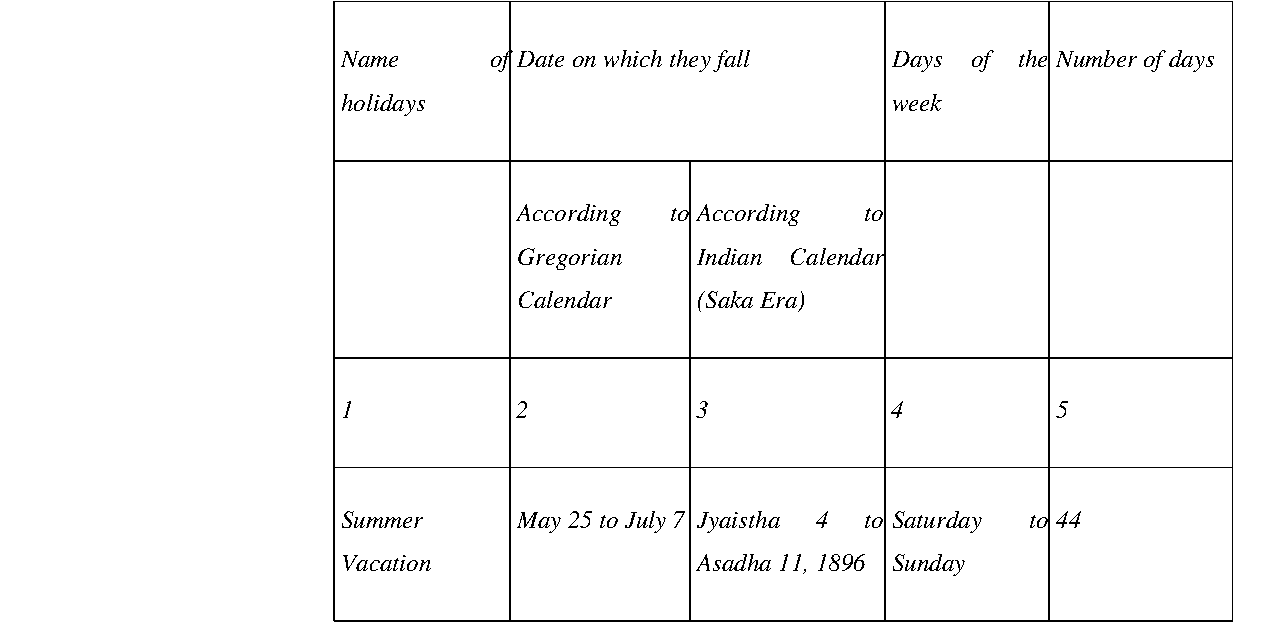
The petitioner challenged the election result of a candidate for a municipal body. The election petition was filed after the expiry of the 30-day statutory limitation period. The petitioner contended that as the period of limitation expired during the summer vacation, the petition should be considered within time under the General Clauses Act, arguing that the court was closed for civil matters during that period.
Findings of Court:
The court found that while the provisions of the General Clauses Act are applicable to the computation of time for election petitions, the petitioner failed to show that any notification or circular exists which rendered the court or its office inaccessible for filing the petition during the vacation. The mere fact that routine civil work was suspended does not satisfy the requirement of the court being closed for the purposes of statutory filing deadlines.
Issues: The central issues were whether the period of limitation for filing an election petition under the municipal law is extendable by the duration of the court's summer vacation and whether the office of the court should be deemed 'closed' for the purpose of filing during such holidays.
Ratio Decidendi: The ratio is that for the benefit of Section 10 of the General Clauses Act to apply, it must be proved that the court or office had no mechanism to receive the filing on the last day of the prescribed period. In the absence of evidence confirming the complete unavailability of the court to receive an election petition, the statutory limitation period remains rigid. Result : Petition dismissed.
| Table of Content |
|---|
| 1. summary of procedural history and factual background regarding the election petition filed under the u.p. municipal corporation act. (Para 1 , 2 , 3 , 4 , 5 , 6 , 7 , 8 , 9 , 10 , 11) |
| 2. parties' contentions on whether the period of limitation for filing an election petition can be extended by the closure of civil courts during summer vacations. (Para 12 , 13 , 14) |
| 3. applicability of section 10 of the u.p. general clauses act to computation of limitation when the court is closed on the last day of the prescribed period. (Para 15 , 16 , 17 , 18 , 19 , 20 , 21 , 22 , 23 , 24 , 25) |
| 4. analysis of binding precedents regarding the exclusion of the limitation act and the specific interpretation of court closures in election matters. (Para 26 , 27 , 28) |
| 5. conclusion that limitation period for election petitions is subject to section 10 gca; in the absence of valid proof of court closure hindrance, the petition remains time-barred. (Para 29 , 30 , 31 , 32 , 33) |
JUDGMENT :
VIKAS BUDHWAR, J.
1. Heard Sri Sanjay Kumar, learned counsel for the petitioner, Sri Sanjay Kumar Singh, learned Additional Chief Standing Counsel for respondent Nos. 1, 3, and 4, and Sri Akshat Sinha for respondent No. 2.
2. Though notices were issued to respondent Nos. 5 and 6 but as per the office report dated 23.10.2024, the notices have been delivered. Till the dictation of the orders, nobody has put in appearance on behalf of respondent Nos. 5 and 6.
3. A joint statement has been made by learned counsel for the parties that they do not propose to file any further affidavit. With the consent of the parties, the writ petition is being decided at the admission stage.
4. The case of the writ petitioner, as worded in the present petition, is that the State Election Commission had issued a notification bearing No. 206/Ra.Ni.Aa.Anu.4/Na.Ni./2023/Lucknow dated 09.04.2023 for the election of Corporators in Nagar Nigam throughout the State of U.P. The writ petitioner herein claims to have contested the election of Corporator, Ghaziabad Nagar Nigam, Ward No. 96, Nehru Nagar-III, on the symbol of camera. Respondent Nos. 2, 5, and 6 also contested the said election, which was scheduled on 11.03.2023. The petitioner was declared elected as the Corporator of Ghaziabad Nagar Nigam, Ward No. 96, Nehru Nagar-III, on 13.05.2023.
5. Being aggrieved by the declaration of the result of the Corporator, Ghaziabad Ward 96, Nehru Nagar-III, the respondent No. 2, Anil Swami son of Sri Krishna Bhargawa, instituted an Election Petition No. 20 of 2023 under Section 62 of the U.P. Municipal Corporation Act, 1959, questioning the election of the writ petitioner before the Court of District Judge, Ghaziabad. The election petition was presented on 01.07.2023. On the presentation of the election petition, the Court of District Judge, Ghaziabad, issued notices to the defendants in the said election petition.
6. Written statements came to be filed on 08.01.2024 by the petitioner- defendant. However, as many as 11 issues were framed by the Court of District Judge, Ghaziabad, on 28.03.2024, which are as under.-
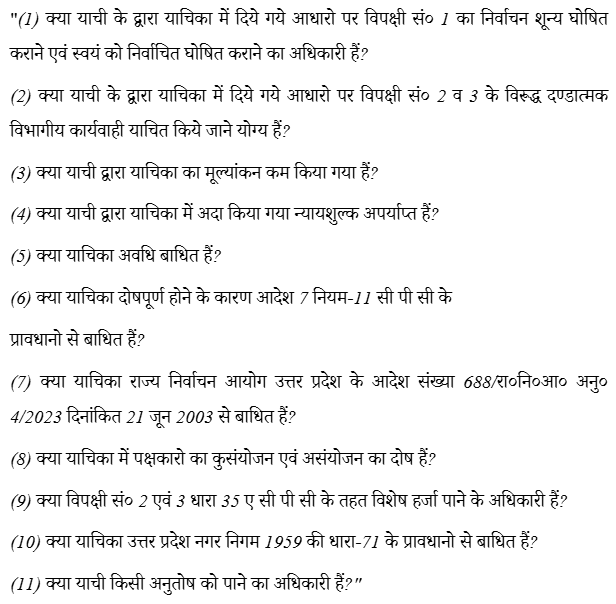
7. Vide order dated 31.05.2024 passed in Election Petition No. 20 of 2023, besides other issues, Issue No. 5 relating to the fact as to whether the election petition was time-barred or not was considered, the issue came to be decided in favor of the election petitioner and against the returned candidate (writ petitioner).
8. Questioning the order dated 31.05.2024 passed by the Court of Additional District Judge Court No. 6, Ghaziabad, in Election Petition No. 20 of 2023, to the extent of deciding Issue No. 5 against the returned candidate (writ petitioner) in favour of respondent No. 2, the present petition has been preferred.
9. This Court entertained the writ petition on 04.09.2024 while passing the following order.-
"1. Heard learned counsel for the petitioner.
2. Learned counsel for the petitioner submitted that election of Corporator was held on 11.05.2023 and the result was declared