
 Back
Back





IN THE HIGH COURT OF KERALA AT ERNAKULAM
SHOBA ANNAMMA EAPEN, J.
Aleykutty Varkey – Appellant
Versus
The Appellate Tribunal Under The Maintenance And Welfare Of Parents And Senior Citizens Act
WP(C) NO. 22485 OF 2023
Decided on : 29-01-2026
| Table of Content |
|---|
| 1. petitioner's claim for maintenance and the tribunal's orders. (Para 1 , 1 , 2) |
| 2. responses and appearances regarding the case. (Para 4 , 6) |
| 3. arguments regarding appeal maintainability under the act. (Para 7 , 8) |
| 4. court's jurisdiction regarding appeals by children. (Para 9) |
| 5. final order regarding the tribunal's jurisdiction. (Para 10) |
JUDGMENT :
SHOBA ANNAMMA EAPEN, J.
1. This writ petition is filed seeking the following prayers;
“i) call for the records leading to the issuance of the original of Exhibit P-3 and set aside it by issuing a writ of certiorari or other appropriate writ, order or direction;
ii) issue a writ of mandamus or other appropriate writ, order or direction commanding the 2nd respondent to ensure strict implementation of the directions in Exhibit P-1;”
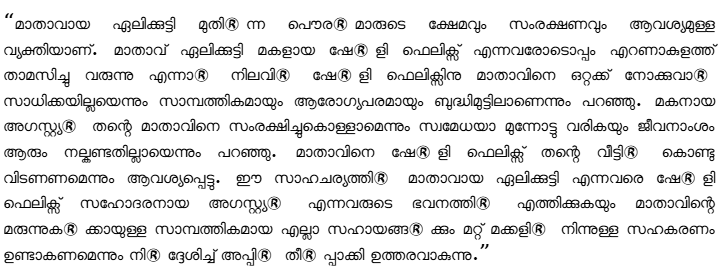
2. The petitioner, a nonagenarian, had filed a petition before the second respondent-Maintenance Tribunal, claiming maintenance from her two sons and a daughter, who are respondents 3 to 5 herein. However, no amount was claimed against the younger daughter, Smt.Sherly Felix, as she is taking care of the petitioner. The Tribunal, after considering the petition filed by the petitioner, passed Ext.P1 order, exempting the younger daughter from the payment of maintenance and directing respondents 3 and 4 to pay Rs.4,000/- each and the fifth respondent to pay Rs.2,000/- per month as maintenance. Challenging Ext.P1 order, the fifth respondent filed Ext.P2 appeal before the first respondent; and the first respondent passed Ext.P3 order, setting aside Ext.P1 order and directing the younger daughter, Smt.Sherly Felix, to bring the petitioner to the house of her elder son, the third respondent herein. According to the petitioner, Ext.P3 order was passed without considering the objection raised by her before the first respondent-appellate authority, that the appeal is not maintainable as per the provisions of the Maintenance and Welfare of Parents and Senior Citizens Act , 2007 (for short, “the Act”). Hence, she has come up before this Court, challenging Ext.P3 order.
3. The third respondent appeared in person and the fourth respondent appeared through counsel. Though notice was served on the fifth respondent, there was no appearance.
4. The third respondent submitted that he is also a senior citizen and he has no means to pay maintenance to his mother. The fourth respondent filed a counter affidavit, contending that the petitioner/mother was taken care of by him and the third respondent. It is also contended that in compliance with the interim order of this Court dated 02.04.2024, an amount of Rs.2,000/- is being paid to the petitioner without any default. To substantiate the above contention, he has produced Ext.R4(b) pay-in-slips. As regards the right of the fifth respondent to file an appeal, the fourth respondent relied on Paramjit Kumar Saroya v. The Union of India & another [AIR 2014 P&H 121] and contended that the appeal is maintainable.
5. I have heard the learned counsel for the petitioner, the learned Government Pleader, the third respondent (party-in-person) and the learned counsel for the fourth respondent.
6. The core issue to be decided in this writ petition is whether the appeal filed by the fifth respondent is maintainable before the appellate tribunal as per the provisions of the Act.
7. The learned counsel for the petitioner, relying on a judgment of the Karnataka High Court in K.Lokesh v. The Bangalore District Maintenance and Welfare of Parents and Senior Citizens Appellate Tribunal and Special Deputy Commissioner-I [NC:2024:KHC:53004-DB] and the judgment of the Madras High Court in K.Raju v. Union of India [WP No.29988 of 2019), argued that Section 16 of the Act can be invoked only by senior citizens or a parent and the right of appeal is not available to any other party.
8. The learned counsel for the fourth respondent, per contra, relying on Paramjit Kumar Saroya (supra) and the judgment of the Bombay High Court in Jagdish Pitambar Pawar

Petitioners in maintenance disputes under the Act lack appeal rights contrary to common law; tribunals must consider all objections.

Section 16 of the Maintenance and Welfare of Parents and Senior Citizens Act allows any affected party to prefer an appeal, as interpreted by the court based on the Punjab & Haryana High Court's judg....

The Maintenance and Welfare of Parents and Senior Citizens Act, 2007 allows any aggrieved party, not just senior citizens or parents, to appeal decisions, as inferred from purposive interpretation of....


The right to appeal under the Maintenance and Welfare of Parents and Senior Citizens Act, 2007 is exclusive to senior citizens and parents, excluding others like children or relatives.


Senior citizens must exhaust statutory remedies before judicial intervention under the Maintenance and Welfare of Parents and Senior Citizens Act.



An indispensable Tool for Legal Professionals, Endorsed by Various High Court and Judicial Officers
Please visit our Training & Support
Center or Contact Us for assistance

Scan Me!
India’s Legal research and Law Firm App, Download now!


For Daily Legal Updates, Join us on :



 Back to top


