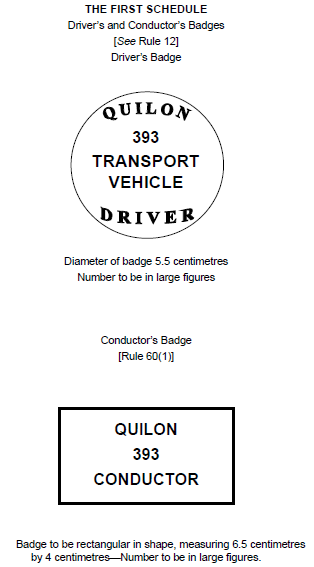
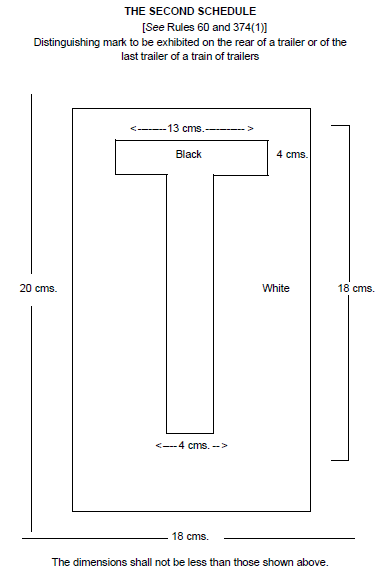
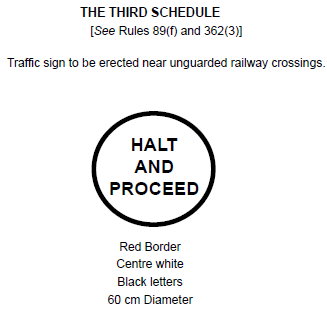
(Updated in 2025)
(As Amended by K. G. Ext. No. 3798 dt. 29/10/2025 - Amendments in Rule 91, Rule 92(1) and Rule 92(2)
S. R. O. No. 578/2024 dt. 02/07/2024 - Amendments in Rule 260A(1)
S. R. O. No. 244/2024 dt. 05/03/2024 - Amendments in Rule 260A(2)
S. R. O. No. 169/2024 dt. 19/02/2024 - Amendments in Rule 292A
S. R. O. No. 1303/2023 dt. 05/12/2023 - Amendments in Rule 406
S. R. O. No. 620/2023, dt. 31/05/2023 - Amendment in Rule 304
S. R. O. No. 20/2023, dt. 09/01/2023 - Amendment in Rule 292A
SRO 171/2022 dt. 24/02/2022,
SRO No. 916/2022 dt: 26/09/2022,
S. R. O. No. 1063/2022, Dt. 05/11/2022 -Amendment in Rule 406
S. R. O. No. 1202/2022, dt.14/12/2022 - Amendment in Rule 260A
and also all the previous amendments)
(As amended by Kerala Motor Vehicles (Amendment) Rules, 2010, 2011, 2012, 2013, 2014
Kerala Motor Vehicles (Second Amendment) Rules, 2014,
S. R. O. No. 160/2014,
S. R. O. No. 680/2014,
S.R.O. No. 703/2014,
S.R.O No. 782/2014,
S.R.O No. 38/2015,
S.R.O No. 39/2015,
S.R.O N
Read full ActS.Rule 378 Appearance and examination of parties.--
(1) The owner of the motor vehicle, the insurer and the driver may, and if so required by the Claims Tribunal shall, at or before the first hearing or within such further time as the Claims Tribunal may allow, file a written statement dealing with the claims raised in the application, and any such written statement shall form part of the records.
(2) No pleading subsequent to the written statement filed under sub-rule (1) shall be presented except by the leave of the Claims Tribunal and upon such terms as the Claims Tribunal thinks fit, but the Claims Tribunal may at any time require a written statement or additional statement from any of the parties and fix a time for presenting the same.
(3) If the owner or the insurer or the driver contests the claim, the Claims Tribunal may, and if no written statement has been filed it shall, proceed to examine the owner, the insurer and the driver upon the claim and shall reduce the substance of the examination to writing.
Legal Commentary on Kerala Motor Vehicles Rules, 1989 - Section Rule 378
Introduction
Section Rule 378 of the Kerala Motor Vehicles Rules, 1989 pertains to the appearance, examination, and procedural aspects related to parties involved in proceedings before the Transport Authorities. It establishes the framework for ensuring fair hearings, proper examination of witnesses, and the orderly conduct of cases related to motor vehicle regulation, including licensing, registration, and enforcement actions.
What does Section Rule 378 Say?
Rule 378 mandates that parties involved in proceedings before the licensing or registering authorities must be given notice and an opportunity to be heard. It prescribes the manner of appearance, examination of witnesses, and the procedure for recording statements. It also provides for the examination of the owner of the vehicle, driver, or any other person involved, and specifies that the proceedings should be conducted in a manner that ensures fairness and transparency.
Essential Ingredients
- Notice to Parties: All parties involved must be duly notified of the proceedings.
- Appearance of Parties: Parties are required to appear in person or through authorized representatives.
- Examination of Witnesses: The authority must examine witnesses on oath, record their statements, and allow cross-examination.
- Recording of Evidence: Statements and evidence must be recorded properly, with opportunities for parties to lead evidence.
- Order of Proceedings: The proceedings should be conducted in a fair, impartial manner, with adherence to principles of natural justice.
- Right to be Heard: Parties must be given adequate opportunity to present their case, objections, and defenses.
Scope of Section Rule 378
Rule 378 applies to all proceedings before the Transport Authorities under the Kerala Motor Vehicles Rules, 1989, including licensing, registration, permit issuance, renewal, and enforcement actions. It ensures procedural fairness and safeguards the rights of the licensees, vehicle owners, drivers, and other stakeholders involved in motor vehicle regulation.
Punishment for Section Rule 378
Since Rule 378 itself prescribes procedural norms, violations such as denying parties their right to be heard or conducting proceedings in a biased manner can lead to administrative or judicial review. Non-compliance can result in the quashing of orders, procedural nullity, or even disciplinary action against officials for breach of principles of natural justice. However, Rule 378 does not specify criminal or penal sanctions; rather, its breach affects the legality of the proceedings.
Legal Comments
- Fair Hearing - Rule 378 mandates that all parties must be given proper notice and opportunity to be heard, upholding principles of natural justice - [Section Rule 378]
- Notice Requirement - Proper service of notice is essential before initiating proceedings against any person or vehicle - [Section Rule 378]
- Opportunity for Cross-Examination - Witnesses must be examined on oath, and parties must be allowed cross-examination to ensure credibility and fairness - [Section Rule 378]
- Record of Proceedings - Accurate recording of statements and evidence is mandatory for transparency and future reference - [Section Rule 378]
- Appearance of Parties - Parties or their authorized representatives must be allowed to appear and participate in proceedings, ensuring their right to defend - [Section Rule 378]
- Procedural Fairness - The proceedings must be conducted without bias, prejudice, or undue delay, aligning with constitutional guarantees - [Section Rule 378]
- Validity of Orders - Orders passed without adherence to Rule 378 principles may be liable to be quashed on grounds of violation of natural justice - [Section Rule 378]
- Role of the Authority - The Transport Authority must ensure proper compliance with Rule 378 during investigations, inspections, and adjudication - [Section Rule 378]
- Impact on Enforcement Actions - Failure to follow procedural norms can invalidate penalties, penalties, or licensing decisions - [Section Rule 378]
- Legal Precedent - Courts have consistently held that violations of procedural rules like Rule 378 vitiate the proceedings, emphasizing the importance of fair process - [Case references: Saramma Scaria v. Mathai, 2002 (2) ILR 191; Lukose v. Govindan Nair, 1990 (1) KLT 378]
- Protection of Rights - The rule protects the rights of vehicle owners, drivers, and applicants by ensuring they are heard before adverse orders are passed - [Section Rule 378]
- Administrative Discipline - Breach of Rule 378 may attract disciplinary action against officials for neglect of duty or violation of rules - [Section Rule 378]
- Legal Validity of Proceedings - Proceedings not conducted in accordance with Rule 378 can be challenged in courts for procedural irregularity - [Case: Saramma Scaria, 2002]
- Procedural Consistency - The rule ensures consistency in administrative procedures across all cases under the Kerala Motor Vehicles Rules - [Section Rule 378]
- Safeguard Against Arbitrary Action - Ensures that authorities do not pass arbitrary or ex parte orders without proper examination and hearing - [Section Rule 378]
- Implication for Appeals - Orders passed in violation of Rule 378 are often subject to appeal or judicial review, emphasizing the importance of compliance - [Case: Koshy, J., 2024]
- Legal Doctrine - Upholds the doctrine of audi alteram partem, fundamental to administrative law and judicial review - [General Principles]
- Procedural Integrity - Ensures procedural integrity of enforcement and licensing actions, preventing misuse of power - [Section Rule 378]
- Requirement for Evidence - The rule emphasizes the importance of evidence-based proceedings, preventing wrongful penalties or cancellations - [Section Rule 378]
In summary, Section Rule 378 of the Kerala Motor Vehicles Rules, 1989, is a vital procedural safeguard that ensures fairness, transparency, and legality in all proceedings before the Transport Authorities. Breach of its provisions can lead to the nullification of orders and safeguards the rights of all stakeholders involved in motor vehicle regulation.
S.Rule 176 Entry of new address in the permit.--
Upon receipt of intimation under Rule 175, the Transport Authority shall, after making such enquiries as the authority deems fit and after the changed address is recorded in the certificate of registration, enter in the permit the new address and shall intimate the particulars to the Authority of any region in which the permit is valid by virtue of endorsement or extension of validity of the permit.
S.Rule 177 Alteration to Motor Vehicles.--
(1) Report regarding.-- Further to the provisions of sub-section (4) of Section 52 of the Act, the owner of a Transport vehicle shall, at the same time as the report required therein is made to the Registering Authority, forward a copy thereof to the Transport Authority by which the permit relating to the vehicle was granted.
(2) Variation or invalidation of permit.-- Upon receipt of a report under sub-rule (1), the Transport Authority by which the permit was issued, may, if the alteration is such as to contravene any of the provisions of the conditions of the permit--
(a) vary the permit accordingly; or
(b) require the permit holder to produce a substitute vehicle within such period as the authority may specify, and if the holder fails to comply with such requirement, cancel or suspend the permit.
S.Rule 178 Permit--Transfer of.--
(1) When the holder of a permit desires to transfer the permit to some other person under sub-section (1) of Section 82 of the Act he shall, together with the person to whom he desires to make the transfer, make a joint application in writing to the Transport Authority by which the permit was issued setting forth the reasons for the proposed transfer. The fee for transfer of permit shall be the same as prescribed for the grant or renewal of permits under Rule 164.
(2) On receipt of an application under sub-rule (1) the Transport Authority may require the holder of the permit and the other party to state in writing whether any premium, payment or other consideration arising out of the transfer is to pass or has passed between them and the nature and amount of any such premium, payment or other consideration.
(3) Without prejudice to any other penalty to which the parties may be liable, any transfer of a permit ordered upon an application which to Transport Authority is
S.Rule 179 Permit Conditions--variation of.--
(1) Every application for variation of conditions of permit made under sub-section (3) of Section 80 of the Act or otherwise shall be in Form "P.V.A.".
(2) Upon receipt of an application made by the holder of the permit to vary any one or more of the conditions thereof other than those referred to in sub-section (3) of Section 80 of the Act, the Transport Authority which granted the permit may allow the application or for reasons to be recorded in writing disallow the same:
Provided that if the grant of variation would authorise transport facilities materially different from those authorised by the original permit, the Transport Authority shall dispose of the application only after giving the interested persons, if any, an opportunity of being heard.
Explanation.-- For the purpose of this rule, variation of Transport facilities not exceeding 25 per cent of the Gross Vehicle weight or seating capacity in respect of goods carriages and stage carriages
S.Rule 180 Fee for variation of permit.--
The fee for the variation of permit otherwise than by change of timings and for variation of extension of endorsement of validity of a permit otherwise than by change of timings in respect of vehicles having primary permits in other States, for the unexpired period shall be the fee for the grant of permit.
S.Rule 181 Use of stage carriage on more than one route.--
If a person holds stage carriage permits for two or more routes the Regional or State Transport Authority may, in exceptional circumstances, permit him to use a vehicle in respect of which he holds a valid stage carriage permit on any of such routes, provided that the vehicle shall be used only for the provision of such transport facilities as the owner is authorised to provide in accordance with the terms of the permit which he holds.
S.Rule 182 Reserve bus (Spare bus).--
It shall be a condition of every stage carriage permit that an operator having seven or more route buses in operation (including stage carriages operating on temporary permits) shall maintain reserve buses calculated at the rate of one reserve bus for every complete unit of seven route buses:
Provided that such operator may at his discretion maintain an additional reserve bus for the residuary fraction in excess of the complete units of seven route buses:
Provided further that an operator of stage carriage having less than seven route buses in operation (including stage carriages operating on temporary permits) may in his discretion maintain one reserve bus.
Explanation.-- Reserve buses are stage carriages permitted mainly to operate substitute services in place of route buses when such route buses are not used for operating the schedule service.
S.Rule 183 Permit--cancellation on surrender.--
(1) The holder of a permit may at any time surrender it to any Transport Authority and thereupon the permit shall be deemed to have been cancelled with effect from the date of such surrender.
(2) Where the Transport authority to which the permit has been surrendered for cancellation is not the authority which issued the permit, such authority shall forthwith forward the permit to the Transport Authority which issued the permit.
S.Rule 184 Permit--delivery on expiry.--
Within fourteen days of expiry of any permit by efflux of time, the holder shall deliver the permit to the Transport Authority by which it was issued and the Transport Authority receiving such permits shall intimate the fact to the Authority or Authorities by which it was endorsed or extended if such endorsement or extension was in force on the date of the expiry of the permit.
S.Rule 185 Permit--Suspension or cancellation.--
The State or Regional Transport Authority may suspend or cancel the permit of any vehicle. When the State or Regional Transport Authority suspends or cancels a permit--
(a) the holder shall surrender the permit or the temporary permit, as the case may be, within seven days of the receipt of a demand in writing by the Transport Authority concerned or any Authority authorised by the Transport Authority;
(b) the holder of the permit shall, if so required by the Regional Transport Authority, intimate to it within 24 hours of the receipt of the order of suspension the place where the vehicle in respect of which the order is passed will be kept during the period of suspension and shall not remove the vehicle from the place so intimated without the prior sanction of the Regional Transport Authority;
(c) the Transport Authority or any authority authorised by the Transport Authority in this behalf shall record in the permit or on the temp
S.Rule 186 Recovery of sum of money in lieu of cancellation or suspension of permit under Section 86(5)-- Procedure.--
(a) The Transport Authority while passing an order of cancellation or suspension of a permit under clause (a) or clause (b) or clause (c) of sub-section (1) of Section 86 of the Act shall specify--
(i) the sum of money payable by the permit holder in case he agrees for the composition;
(ii) the date by which the permit holder should intimate acceptance of composition;
(iii) the date by which the composition fee should be remitted and the chalan produced; and
(iv) the date from which the suspension or cancellation will take effect in case the composition fee is not paid within the date specified under clause (iii).
(b) The Transport Authority shall, in determining the sum of money to be recovered in lieu of cancellation or suspension of different classes of permit have regard to the following, namely:--
(i) nature, gravity and frequency of the brea
S.Rule 187 Intimation to the concerned Transport Authority.--
(1) A Transport Authority varying, transferring, suspending or cancelling a permit or allowing another vehicle to be substituted for a vehicle covered by a permit shall intimate the particulars thereof within fifteen days of such variation, transfer, suspension, cancellation or substitution, as the case may be, to the Transport Authority which has countersigned the permit.
(2) The Transport Authority, which has countersigned the permit shall, on receipt of the intimation referred to in Sub-rule (1) above, and on receipt of application with the fee prescribed if any, from the holder of the permit, wherever necessary make appropriate entries in its own records and in the countersignature portion of the permit, but without repeating the procedural formalities already followed under Rules 174, 178 or 179 of these rules, as the case may be, by the Transport Authority which issued the permit.
S.Rule 188 Hours of work-fixing in advance.--
The State or Regional Transport Authority may require any person employing drivers of transport vehicles to make such time-table, schedule or regulation as may be necessary to fix in advance the hours of work of persons employed by him and upon approval by such Authority of any time-table, schedule or regulation, as aforesaid, it shall be the record of the hours of work fixed for the persons concerned for the purpose of sub-sections (3) and (4) of Section 91 of the Act.
S.Rule 189 Interval of rest for drivers--Specification of.--
(1) Any time spent by the driver of a vehicle on work other than driving, in connection with the vehicle, or with the load carried or to be carried on the vehicle, including any time spent on the vehicle during a journey save as a passenger in a public service vehicle, shall not be deemed to be an interval of rest for the purposes of clause (a) of sub-section (1) of Section 91 of the Act.
(2) Any time, spent by the driver of a vehicle on or near the vehicle, when it is at rest, when he is at liberty to leave the vehicle for rest and refreshment although required to remain within sight of the vehicle shall be deemed to be an interval of rest for the purposes of clause (a) of sub-section (1) of Section 91 of the Act.
S.Rule 190 Space on side of driver.--
No person shall sit nor shall any goods be placed on the right side of the driver of a transport vehicle fitted with right-hand steering control and on the left side of the driver of a transport vehicle fitted with left-hand steering control.
S.Rule 191 Prohibition of advertisement or writing on vehicles.--
35[(1) No advertising device, figure or writing shall be exhibited on any transport vehicle, save as may be specified by the State or Regional Transport Authority by general or specific order and on payment of fee of 35C[Rs.5] per 100 centimetre square for an advertisement in writing and 35D[Rs.10] per 100 centimetre square for an electronic advertisement for a period of 35E[one month] or part thereof for each vehicle:]
Provided that in respect of vehicles of the State Transport Undertaking the Government may allow such advertisements subject to the conditions that they may lay down from time to time in this regard.
35A[Provided further that the maximum period for exhibiting advertisement at a time shall be one year and can be renewed for subsequent years or part thereof.]
35B[x x x x]
35A[(2) The matter of each advertisement intended to be exhibited on the vehicle shall be
S.35F[Rule 191A Passenger Information System.--
(1) The owner or operator of any stage carriage may install a Passenger Information System inside the passenger compartment of such vehicle subject to the conditions specified below, namely:--
(i) It shall be exhibited only in a digital screen of a size not exceeding 73 cms X 43cms;
(ii) The advertisements or awareness matters relating to road safety, messages of pandemic or epidemic diseases or such other messages of public interest as may be directed by the Government from time to time, shall be exhibited at such intervals among other information;
(iii) The audio, if permissible, shall not exceed 50 decibel;
(iv) The advertisement, if any, shall be legally permissible and it shall not be of a nature creating any communal, gender or lingual animosity among the people;
(v) The commercial advertisement, if any, shall not exceed 25 seconds in a minute;
(vi) The installation of the system shall not cause to d
S.Rule 192 Prohibition of painting or marking in certain manner.--
(1) No public service vehicle shall be painted in the pattern adopted by the vehicles of the Kerala State Road Transport Corporation with the following combination of colours or with a colour which is the same as the colour with which vehicles regularly used for carrying Government mail by or under a contract with Indian Posts and Telegraphs Department are painted:--
(i) upto window--'Red' and 'Cream' on the top;
(ii) upto window top--'Green' and 'Cream' on the top;
(iii) (a) Limited Stop City Services--Upto window 'Cream' with Green border and 'Cream' on the top;
(b) Ordinary City Services--Upto window 'Cream' with Red border and 'Cream' on the top.
(2) A vehicle carrying Government mail may be painted with a specified colour and exhibited in a conspicuous place upon a plate or plain surface on the vehicle the word 'Mail' in red colour on a white ground, each letter being not less than fifteen centimet
S.Rule 193 Licensing of agents engaged in the sale of tickets for travel by public service vehicles.--
(1) Every owner of a public service vehicle to be let or plied for hire shall, intimate the Regional Transport Authority concerned, the name and address of the person appointed as the agent for the sale of tickets to, or, canvas, passengers for travel in such vehicles.
(2) No person shall act as an agent or canvasser and no owner of a public service vehicle shall so employ any person unless he has obtained an agent's licence in Form "LAPT" granted by the Regional Transport Authority concerned authorising such person carrying on of such business.
Explanation.-- For the purpose of this sub-rule, persuading any person, soliciting or attempting to persuade any person, to travel in a public service vehicle shall be deemed to be acting as an agent or canvasser in the sale of tickets or travel thereby.
(3) An agent's licence may be granted for one year, two years or three years from the date of its grant or renewal.
(4) No person under the age of 18 years
S.Rule 194 Licensing of agents engaged in the Business of collecting, forwarding and distributing goods carried by goods carriages.--
(1) Definitions.-- In this rule, unless the context otherwise requires.--
(a) "agent" means a person who carries on for another or represents another in the business of--
(i) collecting;
(ii) forwarding and distributing; or
(iii) collecting, forwarding and distributing; goods carried by any goods carriage.
(b) "agents licence" means a licence granted under sub-rule (3)
(c) "collecting agent" means a person licensed to do the business of collecting goods carried by any goods carriage;
(d) "forwarding agent" means a person licensed to do the business of forwarding and distributing goods carried by any goods carriage;
(e) "collecting and forwarding agent" means a person licensed to do the business of collecting, forwarding and distributing goods carried by any goods carriage;
(f) "licensing authority"
S.Rule 195 Supply of copies, orders or documents.--
The licensing authority shall, on application by a party, give a certified copy of any order passed under Rule 193 or 194 or of any other relevant document on payment of a fee of five rupees. The application shall be affixed with Court Fee Stamps of the value of rupees five for each such copy of the order or document.
S.Rule 196 Appeals.--
(a) Any person aggrieved by an order made under sub-rules (8), (9) or (10) of Rule 193 or under clauses (k), (i) and (m) of sub-rule (7), sub-rule (9), clause (a) of sub-rule (10) clause (a) or clause (b) of sub-rule (12), sub-rule (13), or sub-rule (15) of Rule 194 or Rule 195 may appeal within 30 days from the date of receipt of such order to the State Transport Appellate Tribunal.
(b) The memorandum of appeal shall be filed as prescribed in Rule 6 of the State Transport Appellate Tribunal Rules, 1988.
S.38A[Rule 197 Carriage of animals in goods carriages
(1) No animals shall be carried in Goods Vehicle unless,--
(a) in the case of horned or unhorned animals having body weight up to fifty kilogram minimum floor area of 0.28 square meter per head of such animal, and half of such floor space for young one of such animal is provided in the vehicle;
(b) in the case of horned or unhorned animals having body weight more than fifty kilogram but up to hundred kilogram, minimum floor area of 0.56 square meter per head of such animal and half of such floor space for young one of such animal is provided in the vehicle;
(c) in the case of unhorned animals having body weight more than hundred kilograms but up to two hundred kilograms, a minimum floor area of 0.62 square meter per head of such animal and half of such floor space for young one of such animals is provided in the vehicle;
(d) in the case of horned animals having body weight more than hundred kilograms but up to t
S.Rule 198 Infectious or contagious diseases--persons suffering from.--
(1) No driver and no conductor of a public service vehicle shall cause or allow to enter into or to be placed or carried in the vehicle any person whom he knows or has reason to believe to be suffering from any infectious or contagious disease or the corpse of any person whom he knows or has reason to believe was suffering from any such disease.
(2) Notwithstanding the provisions of sub-rule (1), the driver and the conductor may, upon application in writing by a Registered Medical Practitioner allow any such corpse or person suffering from an infectious or contagious disease to be carried in a public service vehicle provided that no other person save a person or persons in charge of the corpse or in attendance of the sick person shall be carried in the vehicle at the same time.
(3) When any such corpse or sick person has been carried in a public service vehicle the driver and the conductor shall report the fact to the owner of the vehicle and neither the owner not the
S.Rule 199 Carriage of persons or goods in public service vehicles.--
No public service vehicle operating on a permit issued under Section 66 of the Act shall carry at any time persons, luggage or goods in excess of what is specified in the permit by the Transport Authority which granted the permit.
S.Rule 200 Disposal of property left in public service vehicles.--
Every conductor of a public service vehicle or if there be no conductor, the driver thereof shall immediately after the completion of any trip or journey, as the case may be, carefully search for any property left in the vehicle and shall, as soon as may be, and in any case within twenty- four hours, if not sooner claimed by the owner, deliver such property to the nearest police station.
S.Rule 201 Taxi-meter.--
(1) When a Regional Transport Authority requires that a motor cab shall be fitted with a taxi-meter, the taxi-meter shall be of a pattern approved by the State Transport Authority and shall be fitted in conformity with any instructions that may be issued by the State Transport Authority in this regard.
(2) A permit holder required to fit a taxi-meter shall produce it fitted to the vehicle before the Inspecting Authority constituted under Chapter IV of the Act so that it may be tested and sealed, and shall produce it for examination subsequently whenever the vehicle to which it is attached is inspected or whenever for any reason it has become necessary to break the seal.
(3) No person shall drive or cause or permit to be driven any motor cab in the permit of which a condition is attached under clause (viii) of sub-section (2) of Section 74 of the Act if the taxi-meter is not fitted to the vehicle and sealed or if he knows or has reason to believe that it is not accurate
S.Rule 202 Driver of a motor cab to proceed by the shortest route.--
The driver of a motor cab shall in the absence of reasonable cause proceed to the destination named by the hirer by the shortest and quickest route.
S.Rule 203 Motor cab stand-rules for drivers.--
The drivers at motor cab stands shall observe the following:--
(a) the drivers of the first two motor cabs at the stand shall stay beside their cabs and be ready to be hired at once by any person provided that a hirer wishing to hire any particular cab on the stand may do so,
(b) all motor cabs at the stand shall move up as vacancies occur,
(c) no motor cab engaged for some future time shall remain at the stand unless the driver is willing to accept any intermediate hiring that may be offered,
(d) no disabled motor cab shall remain at the stand unless such disablement is temporary, and can be and is remedied at once, and
(e) every motor cab other than a motor cab referred to in sub-rule (d) which is at the stand shall be ready to be hired and when its turn comes the driver shall accept the first offer of hire which may be made to him irrespective of the length of the journey for which such offer is made.
S.Rule 204 Motor cab--payment of legal fare.--
(1) In the absence of an enforceable contract to the contrary, no hirer shall refuse or omit to pay the legal fare for the hire of a motor cab, nor shall he refuse to give his correct name and address to the driver in the case of dispute in connection with the fare.
S.Rule 205 Trailers.--
(1) No trailer other than the trailing half of an articulated vehicle shall be attached to public service vehicle.
(2) Nothing contained in sub-rule (1) shall be deemed to apply to a trailer on which a charcoal gas producer is mounted.
(3) No person other than the Attendant or Attendants required by rule shall be carried on a trailer:
Provided however that nothing contained in this sub-rule shall apply to a trailer which is being used for the carriage of troops or police.
(4) No trailer other than the trailing half of an articulated vehicle shall be attached to a goods carriage unless the permit of the goods carriage specifically permits the use of such trailer.
(5) Subject to the provisions of sub-rule (1) all the provisions of these rules relating to a goods carriage permit shall apply to any trailer used for the purposes of a goods carriage.
S.Rule 206 Stopping place for stage carriage.--
The State or Regional Transport Authority may, if no stopping place has been fixed for stage carriages in accordance with the provisions of any statute, fix such places for such carriages after consultation with such other authority as it may deem desirable. Such stopping places shall be indicated by means of notice boards. The driver of a stage carriage shall stop it at such stopping places when so required by any person wishing to alight or to enter but he need not stop the carriage for a person wishing to enter if the vehicle is already full. Halts for the purpose of setting down or taking up passengers shall be limited to the time reasonably necessary for such purpose. On routes along which stopping places have been fixed no driver of a stage carriage shall stop the vehicle at any place other than such stopping places except--
(a) when failure to stop the vehicle would constitute an offence punishable under these rules or under any law for the time being in force, o
S.Rule 207 Starting places and termini.--
In the case of public service vehicles (other than motor cabs) the State or Regional Transport Authority may, after consultation with such other authority as it may deem desirable, fix such places at the termini of the bus routes and in the course of the routes, as may be necessary, at which the vehicle may stop and wait for picking up or setting down passenger. Where a local authority has provided and maintains a public stand for motor vehicles with facilities for drinking water supply, lighting, latrine and waiting sheds for passengers and convenient parking places, the State or Regional Transport Authority may approve the use of that stand for the purpose of picking up or setting down passengers of public service vehicles (other than motor cabs) and thereafter every vehicle shall make use of that stand. The approval granted by a Transport Authority may be revoked by it, if the facilities provided at the stand cease to be to its satisfaction:
Provided that if bus stan
S.Rule 208 Starting points and destination to be specified.--
The State or Regional Transport Authority shall specify in the case of all stage carriage permits the exact place and point from which the daily service shall start and the exact place and point at which the service shall terminate in each trip.
S.Rule 209 Destination of Board.--
Both termini of the route on which the stage carriage is plying shall be clearly stated in English and in Malayalam and also in such other minority language as may be specified by the Regional Transport Authority issuing the permit, on boards conspicuously placed 39A[at the top on all sides of the vehicle], specifically indicating the terminus to which the stage carriage is actually proceeding in each trip.
39B[Provided that Destination board provided in buses that are registered on or after the 1st day of October, 2017 shall be in accordance AIS 052 (Rev.1)-2008 as amended from time to time.]
S.Rule 210 Painting and illumination of destination board.--
The destination board shall be painted in letters not less than five centimetres high on a clear background. It shall be clearly visible and unobstructed and shall be illuminated by a white light from half an hour after sun set to half an hour before sun rise.
S.Rule 211 Fixation of fare stages for stage carriages.--
In the case of stage carriages the State or Regional Transport Authority shall after such enquiry as it may deem desirable, fix fare stages on all routes. The maximum distance of each such stage shall not ordinarily exceed six kilometres and five hundred metres. When stages are so fixed, fare shall be collected according to stages:
Provided that this rule shall not apply to vehicles of State Transport Undertaking.
Explanation.-- When a passenger gets into or gets down from a stage carriage at a place lying in between two stages, fare shall be collected from him from the stage preceding the place from where he gets into the bus to the stage succeeding the place where he gets down.
S.Rule 212 Schedule of timings.--
(1) The State or Regional Transport Authority may from time to time--
(a) by a general order prescribe a schedule of timings for stage carriages other than those belonging to State Transport Undertakings running on specified routes, or
(b) by a special order prescribe a schedule of timings for each stage carriage other than that belonging to State Transport Undertaking.
(2) The changes ordered by the Transport Authority in the timings of a service shall not be considered as variation of permit under sub-section (3) of Section 80 of the Act.
(3) The State Transport Authority or the Regional Transport authority may, by resolution, delegate to its Secretary the powers conferred on it under this rule subject to any conditions that it may prescribe:
Provided that the State or Regional Transport Authority shall not however vary the timings of a service without giving to the interested permit holders an opportunity to rep
S.Rule 213 Vehicles to run in accordance with schedule.--
When a schedule of timings has been prescribed under Rule 212 every stage carriage on such route shall run in accordance with it, except--
(a) when prevented by accident or other unavoidable cause, or
(b) when otherwise authorised in writing by the Authority granting the permit or the State Transport Authority.
S.Rule 214 Interchangeability of timings of stage carriage.--
When a permit holder has more than one vehicle plying exclusively on the same route, he may, notwithstanding that a schedule of timings has been fixed for each vehicle, use temporarily, and in any case for not more than ten days at any one time any one of the other vehicles to maintain all or any of the timings fixed for a particular vehicle on the route:
Provided that--
(a) intimation thereof is sent to the Authority which granted the permit and to the Authority, if any, which has endorsed or extended the permit, within seven days of such use, and
(b) the schedule of timings granted to the other vehicles of the permit holder on the route are not affected.
S.Rule 215 Failure to perform service--Report to be made.--
If at any time a stage carriage is prevented from running in accordance with the schedule prescribed or, where no schedule is prescribed, is prevented from performing the service for which a permit has been granted, the holder of the permit shall forthwith report the fact and reason therefor to the Authority which granted the permit and the Authority, if any, which has countersigned the permit:
Provided that no report need be sent when the difference between the time of actual arrival of a stage carriage plying on mofussil routes and the schedule time of its arrival is not more than five minutes in the case of routes less than sixteen kilometres in length and ten minutes in other cases.
S.Rule 216 Responsibility of permit holder.--
The holder of the permit as well as any other person responsible shall be liable to be punished for a breach of Rule 213.
S.Rule 217 Withdrawal of bus from service.--
If the holder of a stage carriage permit proposes to withdraw before the expiry of the permit the services which the vehicle covered by the permit is providing, he shall, unless prevented by unavoidable circumstances, give at least one month's notice of his intention to the Transport Authority which issued the permit, and shall surrender the permit on the date from which the services are withdrawn. Upon receipt of the notice, the Transport Authority shall post a copy of the notice on the notice board of the Authority.
S.Rule 218 Dress to be won by Checking Inspectors.--
A Checking Inspector of a Stage Carriage, while on duty, shall be cleanly dressed and in the manner in which the Transport Commissioner may specify.
S.Rule 219 Stage carriage to carry conductor.--
No stage carriage shall be used in any public place without a conductor.
S.Rule 220 Conveyance of corpse in stage carriages.--
Save when being used as a contract carriage, no corpse shall be carried in a stage carriage.
S.Rule 221 Children and infants--Carriage in Public Service Vehicles.--
In computing the number of passengers that may be carried in a public service vehicle and the fares chargeable--
(a) a child of not more than twelve years of age shall be reckoned as one half; and
(b) a child of not more than three years of age shall not be reckoned.
S.Rule 222 Timing registers in stations enroute.--
The State or Regional Transport Authority may, by general order, direct that every stage carriage other than a stage carriage belonging to the State Transport Undertaking shall stop at such stations on its routes as the Transport Authority may prescribe, and thereupon the conductor of the vehicle shall correctly enter in the register in Form "TGR" kept in each such station the particulars specified therein.
S.Rule 223 Complaint book.--
A complaint book, the pages of which are serially numbered and sealed or signed by the permit holder, shall be kept in every stage carriage on service in a clean and tidy condition by the conductor and notice shall also be displayed in every such stage carriage that a complaint book is available with the conductor. The book shall be made available by the conductor on demand by any passenger for making any entry therein and conductor shall also afford reasonable facilities to the passenger for the purpose. A passenger making an entry in the complaint book shall note at the foot of his entry therein his full name, postal address and the details of the authorisation or ticket he holds for journey in the bus at the time and shall put his signature.
(2) The complaint book shall be produced by the conductor on demand by any authority empowered to inspect stage carriages.
(3) The permit holder of the stage carriage or any person authorised by him in this behalf shall, as soon
S.Rule 224 Trip-sheet.--
The Conductor, or where there is no conductor, the driver of every public service vehicle shall maintain trip sheets in duplicate in Form "TSS" and "TSC", as the case may be, in English or in Malayalam. The Form, "TSS" or "TSC" shall be maintained in bound books each containing not more than thirty-one serially numbered pages in duplicate so that each book may last for one full calendar month. The books shall also be serially numbered and shall be used only in the numerical serial order:
Provided that the Regional Transport Authority may exempt a City or Town bus service from maintaining trip sheets in the form aforesaid subject to the condition that a trip sheet containing the following particulars is maintained in a form approved by the State Transport Authority.
(a) the arrival and departure timings,
(b) the hours of duty of conductors and drivers,
(c) the number of passengers carried in each trip, and
(d) the name
S.Rule 225 Custody of trip sheet.--
(1) The trip sheet shall--
(a) be carried by the conductor, or in case there is no conductor, by the driver whenever the vehicle is in use,
(b) be duly filled in from time to time as occasion arises by the conductor, or, in case there is no conductor, by the driver, and
(c) be open to inspection by Magistrates, Secretaries to the Regional or State Transport Authorities, Officers of the Motor Vehicles Department not below the rank of Assistant Motor Vehicle Inspector, Police Officers in uniform not below the rank of Sub Inspector.
(2) Every book containing the trip sheets shall be delivered to the permit holder by the conductor or the driver, as the case may be, within seven days from the date of expiry of the period to which it relates. The permit holder shall preserve the book for a period of six months after the expiry of the period to which it relates and shall produce the same for inspection at any time within that per
S.Rule 226 Trip register.--
(1) Every holder of a permit in respect of a public service vehicle shall maintain in English or Malayalam a trip register in Form "TR" in a bound book of which the pages are serially numbered. The trip register shall be posted daily from the trip sheets maintained under Rule 224 and be at all times open to inspection by Magistrates, Secretaries of Regional or State Transport Authorities, any officer of the Motor Vehicles Department not below the rank of Assistant Motor Vehicles Inspector, Police Officers in uniform not below the rank of Sub Inspector.
(2) Every owner of a public service vehicle shall maintain a register in Form "VIR" showing the particulars of persons employed in the vehicle from time to time including the persons engaged for short periods in the absence of regular employees. The register shall be at all times open to inspection by any authority or officer specified in sub-rule (1) above.
(3) The provisions contained in this rule and in Rules 224 and
S.Rule 227 Passengers in public service vehicles.--
Rules to be observed by.-- (1) When a public service vehicle is carrying passengers or waiting to pick up passengers, a passenger or intending passengers shall not--
(a) use obscene or offensive language or conduct himself in a riotous or disorderly manner;
(b) enter or alight from the vehicle otherwise than by doors or openings provided for the purpose;
(c) when entering or attempting to enter the vehicle wilfully and unreasonably impede passengers seeking to enter the vehicle or to alight therefrom;
(d) smoke inside the vehicle and also when the vehicle is being re-fueled.
(e) occupy more than one seat or without lawful excuse occupy any seat exclusively reserved for any one or reserved for ladies;
(f) enter or remain in or on the vehicle when requested not to do so by an authorised person for the reason that the vehicle is carrying its full complement of passengers o
S.Rule 228 Permit--Production on demand.--
The permit shall be produced on demand at any reasonable time by the Secretaries of the State or Regional Transport Authorities, Officers of the Motor Vehicles Department not below the rank of Assistant Motor Vehicles Inspector or Police Officers not below the rank of Sub Inspector:
Provided that if a permit is not at the time in possession of the person to whom demand is made, it shall be sufficient compliance with this rule if such person produces it within ten days at any police station in the State which he specifies to the officer.
S.Rule 229 Permit-Inspecting Authority.--
Magistrates, Officers of the Motor Vehicles Department not below the rank of Assistant Motor Vehicles Inspector and Police Officers in uniform not below the rank of Sub Inspector may mount any transport vehicle for the purpose of inspecting the permit.
S.Rule 230 Inspection of goods carriages and their contents.--
(1) Any of the following persons may at any time when a goods carriage is in a public place call upon the driver of the vehicle to stop the vehicle and to keep it at rest for such time as may be necessary to enable him to make reasonable examination of the contents of the vehicle:
(a) any officer of the Motor Vehicles Department not below the rank of Assistant Motor Vehicles Inspector,
(b) any Police Officer in uniform not below the rank of Sub Inspector,
(c) any Officer of the Central Excise Department in uniform, not below the rank of Inspector;
(d) any officer of the Central Narcotics Department of and above the rank of Sub Inspector authorised in this behalf and carrying on in his person, while on duty, identity card issued by the Narcotics Commissioner,
(e) the District Collector of the respective District, and
(f) any Minister of the Government.
(2) Any Cho
S.Rule 231 Inspection of public service vehicles.--
(1) Any of the following persons may, at any time when a public service vehicle is in a public place call upon the driver of the vehicle to stop the vehicle and keep it at rest for such time as may be necessary to enable him to make reasonable examination of the number of passengers and other contents of the vehicle so as to satisfy himself that the provisions of the Act and of these rules and the provisions and conditions of the permit in respect of the vehicle are being complied with.
(a) any officer of the Motor Vehicles Department not below the rank of Assistant Motor Vehicles Inspector,
(b) any Police Officer in uniform not below the rank of Sub Inspector,
(c) any Officer of the Central Narcotics Department of and above the rank of Sub Inspector authorised in this behalf and carrying on in his person, while on duty, identity card issued by the Narcotics Commissioner;
(d) The District Collector of the respec
S.Rule 232 Inspection of premises of permit holders.--
The officers of the Motor Vehicles Department not below the rank of Assistant Motor Vehicles Inspector and Police Officers not below the rank of Sub Inspector shall have the right to enter and inspect any premises used by permit holders for the purpose of their business.
S.Rule 233 Conviction of permit holders--Intimation by Court.--
Any Court convicting the holder of a permit for an offence punishable under the Act or these Rules shall communicate particulars of such conviction in Form "PI" to the Authority which granted or last renewed the permit as the case may be and the authority, if any, which has endorsed or extended the validity of the permit.
S.Rule 234 Tourist Permit.--
(1) Every application for the grant of a permit under sub-section (9) of Section 88 of the Act in respect of a tourist vehicle shall be accompanied by a fee of 40[one thousand rupees] in the case of a tourist motor cab and 40[two thousand rupees] in the case of a tourist omni bus.
(2) On receipt of an application under sub-rule (1) the State Transport Authority shall follow the procedure prescribed for considering an application for the grant of contract carriage permits under the Act and the rules made thereunder and may grant the permit in Form "TVP".
(3) On receipt of the order sanctioning the permit, the grantee shall, within the prescribed period produce the current records of the vehicle including the certificate of registration, certificate of fitness, certificate of insurance, evidence for payment of tax due under the provisions of the relevant Taxation Act and a certificate from the Registering Authority concerned to the effect that the v
S.Rule 235 National Permit for goods carriages.--
41[(1) Every application for the grant of a National Permit in respect of Goods Carriage shall be made to the Regional Transport Authority of the region in which the applicant resides or has his principal place of business, and shall be accompanied by a fee of one thousand and five hundred rupees.]
(2) On receipt of an application under sub-rule (1) the appropriate authority shall follow the same procedure prescribed for considering an application for the grant of a goods carriage permit under the Act and the rules made thereunder and may grant the permit in Form "N.P.Gd.C".
(3) On receipt of the order sanctioning the permit, the grantee shall within the prescribed period, produce the current records of the vehicle including the certificate of registration, certificate of fitness, certificate of insurance evidence of payment of tax due under the provisions of the relevant Taxation Act, a certificate from the Registering Authority concerned to the effect that
S.Rule 236 Manner of notifying schemes.--
Every scheme proposed by the State Government regarding the operation of road transport services by the State Transport Undertaking under Section 99 of the Act shall be in Form "A" and shall be published in the Official Gazette and in not less than one daily newspaper in the regional language circulating in the area involved. A copy of each of every scheme as proposed to be published in the Gazette shall be forwarded to the State Transport Undertaking, to the Secretary of the State Transport Authority and the Regional Transport Authority concerned. Copies of the scheme shall, also be put up on the notice boards of the offices of the State Transport Undertaking, the State Transport Authority and the Regional Transport Authority concerned.
S.Rule 237 Manner of filing objections.--
(1) Any person affected by the scheme published under Section 99 of the Act may within 30 days from the date of publication of the scheme in the Official Gazette file his objections thereto before the Secretary to Government, Public Works and Transport Department, Secretariate, Trivandrum and shall simultaneously forward a copy each of the objections to the State Transport Undertaking, the State Transport Authority and the Regional Transport Authority concerned furnishing the following particulars:--
(a) Name and address of the objector;
(b) Memorandum setting forth concisely the grounds of objection, signed by the objector or his authorised agent, and accompanied by six additional copies;
(c) Whether he is an operator along or near the area or route included in the scheme notified by the State Government;
(d) if reply to item (c) is in the affirmative, the following particulars shall be furnished:--
(i) Route wi
S.Rule 238 Consideration of objections.--
(a) The Chief Minister or any other Minister nominated by him or any officer nominated by the Government in this behalf, shall be the authority to consider the objections filed and hear the objectors.
(b) The representatives of the State Transport Undertaking and the objectors or their authorised representative, if they so desire, shall be heard. The place, date and time of hearing shall be communicated to the concerned persons at least fourteen days before the date of hearing.
S.Rule 239 Manner of publishing approved scheme.--
Any scheme for road transport services as approved or modified under sub-section (2) of Section 100 of the Act shall be notified in Form "B" in the Official Gazette and in one daily newspaper in the same manner as provided in Rule 236.
S.Rule 240 Manner of making application for permits.--
(1) Every application for a permit by the State Transport Undertaking under Chapter VI of the Act, shall be in the following forms, namely:--
(a) in respect of a pucca permit--Form P.St.S.A. (STU)
(b) in respect of a temporary permit Form P.Tem.A. (STU).
(2) The fee for every stage carriage permit shall be the same as prescribed in Rule 165.
S.Rule 241 Issue of permit.--
On receipt of an application for a permit under Rule 240, the Transport Authority shall issue the permit, on production of the records relating to the vehicle.
S.Rule 242 Cancellation of existing permits.--
(a) The State or Regional Transport Authority concerned shall, before making an order either cancelling any existing permit under clause (b) or modifying the terms of any existing permit under clause (c) of sub-section (2) of Section 103 of the Act, for the purpose of giving effect to an approved scheme, issue notice in Form "C" informing the affected operators, of the action proposed to be taken and giving them time of not less than thirty days to make representations against the proposed action.
(b) Any person making the representation under clause (a) shall send his representation addressed to the Secretary of the Regional Transport Authority or the State Transport Authority, as the case may be, and simultaneously send a copy to the State Transport Undertaking.
S.Rule 243 Manner of making representation.--
(1) Every person making a representation under clause (a) of Rule 242 shall furnish his correct address along with his representation.
(2) No representation in pursuance of a notice under Rule 242 shall be considered by the State or the Regional Transport Authority, unless it is made in writing before the date specified and unless a copy thereof is furnished simultaneously to the State Transport Undertaking by the person making such representation.
S.Rule 244 Disposal of representation.--
Where a representation under Rule 242 is made, the State Transport Authority or the Regional Transport Authority, as the case may be, shall dispose of the representation at a public hearing at which the State Transport Undertaking and the person making the representation shall be given an opportunity of being heard in person or by a duly authorised representative.
S.Rule 245 Holder of cancelled permit to submit statement.--
Where in exercise of the powers conferred by clause (b) or (c) of sub-section (2) of Section 103 of the Act any existing permit is cancelled or the terms thereof are modified, the holder of the permit shall submit a statement in Form "D" with the original permits to the State Transport Undertaking and send a copy thereof to the State Transport Authority, or the Regional Transport Authority, as the case may be, within seven days from the date on which the cancellation or modification of the permit became effective.
S.Rule 246 Modification of approved scheme.--
(a) Any scheme by the State Government under sub-section (1) of Section 102 of the Act to modify an approved scheme shall be in Form "E" and shall be published in the Official Gazette and in not less than one daily newspaper in the regional language circulating in the area involved. A copy of this scheme shall be sent to the State Transport Undertaking and to any other person, who in the opinion of the State Government is likely to be affected by the proposed modification. Copy shall also be sent to the Secretary of the State Transport Authority and the Regional Transport Authority concerned.
(b) The State Transport Undertaking or the other person concerned may, within thirty days from the date of publication of the scheme in the Gazette, file objections thereto, before the Secretary to Government, Public Works and Transport Department, Government Secretariate, Trivandrum. The objection shall be in the form of a memorandum setting forth concisely the grounds of objection, and
S.Rule 247 Service of orders.--
Every order under this chapter, except an order made by the State Government either approving or modifying a scheme, shall be served--
(a) by tendering or delivering a copy thereof to the person on whom it is to be served or to his authorised agent; or
(b) by sending it by Registered Post Acknowledgement due, at the last known address of the person on whom it is to be served; or
(c) by fixing it on a conspicuous part of the premises where he last resided or where he had his last place of business, when service according to clause (a) or (b) is not practicable.
S.Rule 248 Disposal of articles found in transport vehicles of the State Transport Undertaking.--
(1) Every article found in any transport vehicle operated by the State Transport Undertaking, which is not claimed by its owner, shall be handed over by the conductor concerned along with the ticket collections, to the cashier or other person of the District/Sub-District/Station, who receives the remittance of passenger ticket collections.
(2) The officer receiving the articles shall issue to the conductor a receipt in Kerala State Road Transport Corporation Form No. 17C for the article received.
(3) A "Register of unclaimed articles" shall be maintained in each District/Sub-District/Station in Form "G" appended to these rules, in which details of all unclaimed articles shall be entered simultaneously to the issue of the receipt to the conductor concerned. Particulars regarding disposal of the unclaimed articles shall also be entered into this register at the appropriate time.
(4) In the case of a perishable article, if the owner does not claim the article withi
S.PART I GENERAL RULES APPLICABLE TO ALL MOTOR VEHICLES
S.PART II SPECIAL RULES APPLICABLE TO EVERY TRANSPORT VEHICLES OTHER THAN AN AUTORICKSHAW
S.PART III SPECIAL RULES APPLICABLE TO EVERY PUBLIC SERVICE VEHICLE OTHER THAN AN AUTORICKSHAW
S.PART IV SPECIAL RULES APPLICABLE TO EVERY EDUCATIONAL INSTITUTION BUS AND PRIVATE SERVICE VEHICLE
S.PART V SPECIAL RULES APPLICABLE TO EVERY MOTOR CAB INCLUDING AUTORICKSHAWS
S.PART VI SPECIAL RULES APPLICABLE TO AUTORICKSHAWS AND MOTORISED CYCLE RICKSHAWS CONVERTED AS MOTOR CABS
S.PART VII SPECIAL RULES APPLICABLE TO EVERY GOODS CARRIAGE
S.PART VIII SPECIAL RULES APPLICABLE TO TRAILERS
S.PART IX SPECIAL RULES APPLICABLE TO GAS PRODUCERS INSTALLED IN MOTOR VEHICLES OTHER THAN MOTOR CARS AND MOTOR CYCLES
S.PART X SPECIAL RULES APPLICABLE TO GAS PRODUCERS INSTALLED IN MOTOR CARS OR MOTOR CABS
S.PART XI SPECIAL RULES APPLICABLE TO TOURIST MOTOR CABS
S.PART XII
S.Rule 335 Powers of Transport Authority to restrict speed, weight, etc.--
The State Transport Authority and the Regional Transport Authority shall have the power,--
(a) to impose speed limits including the minimum speed;
(b) to impose limits on the laden weight or axle weight (or dimensions of other matters connected with the construction or design) of motor vehicles and to prohibit or restrict the use of motor vehicles generally or of a particular class or of trailers in a specified area or in respect of any road; and
(c) to designate any road as a main road:
Provided that the power conferred on the Regional Transport Authority by this rule shall be subject to the control of the State Transport Authority:
Provided further that any limit or restriction under clause (b) shall be imposed by the Regional Transport Authority only with the specific concurrence of the State Transport Authority, and if so required by Government or the State Transport Authority, after prior consultation with one or
S.Rule 336 Use of Heavy/Motor Vehicles.--
(1) Restrictions of roads or areas regarding.-- Government or the State Transport Authority may in consultation with the Public Works Department and such other Local Authority as is deemed necessary, approve a list of roads or areas in the State fit for operation by heavy goods vehicles or heavy passenger motor vehicles.
(2) Issue of permits for.-- The State or any Regional Transport Authority shall not issue a permit for regular operation of any heavy goods vehicles or heavy passenger vehicles on any road or area, which is not included in the list referred to in sub-rule (1):
Provided that the above restriction shall not apply in the case of temporary permits issued by any Transport Authority for a limited number of trips on any road or area, not prohibited under Section 115 of the Act:
Provided further that temporary permits may be issued by any Transport Authority on any road or area prohibited under Section 115 of the Act on specifi
S.Rule 336A 72[Restrictions in time of transporting dangerous or hazardous goods.--
Movement of bullet trucks transporting bulk load Liquified Petroleum Gas shall be restricted during peak traffic hours from 8 a.m. to 11 a.m. and 4 p.m. to 6 p.m. in Corporation and Municipal limits:
Provided that the Regional Transport Authority of the region shall impose suitable local time restrictions for goods carriages transporting dangerous or hazardous goods according to local requirements for ensuring road safety, free flow of traffic and movement of vehicles.]
S.Rule 337 Restrictions on use of truck-trailer combinations.--
(1) A truck-trailer combination shall not be used--
(a) on ghat roads;
(b) on roads of less than six metres and seventy centimetres width generally, except for small stretches of road with not less than three metres and sixty- five centimetres carriages way and few narrow bridges.
S.Rule 338 Restriction on use of Tractor Semi-Trailer combinations.--
(1) A tractor-semi-trailer combination shall not be used--
(a) on ghat roads where trucks are not permitted to ply;
(b) on roads with single lane carriage way of less than three metres and sixty-five centimetres width;
(c) on narrow roads of not less than three metres and sixty-five centimetres width unless equipped with turn table arrangement and the turning radius is not more than twenty-one metres and thirty-five centimetres.
S.Rule 339 Authority to restrict the use of motor vehicles.--
The State or Regional Transport Authority shall be competent to prohibit or restrict the use of motor vehicles under the provisions of Section 115 of the Act provided that in the case of any prohibition or restriction deemed necessary solely due to the deteriorated condition of any road or bridge, any officer of the Public Works Department not below the rank of an Executive Engineer who is in charge of such road or bridge shall be competent to impose the prohibition or restriction.
S.Rule 340 Weighing of vehicles--Officers competent.--
Police officers in uniform not below the rank of Sub Inspector, officers of the Motor Vehicles Department not below the rank of Assistant Motor Vehicles Inspector are authorised to require the weighing of goods vehicles and trailers.
S.Rule 341 Weighing devices--Use and installation.--
A weighing device for the purpose of Section 114 of the Act may be--
(a) a weigh bridge installed and maintained at any place by or under the orders of Government or a Local Authority; or
(b) a weigh bridge installed and maintained by any person and certified by the 72AA[legal metrology authorities] to be a weighing device for the purpose of the Act and these rules; or
(c) a portable wheel--weigher of any kind approved by Government:
Provided that when the weight or axle weight of a motor vehicle is determined by separate and independent determination of the weight transmitted by any wheel or wheels of the vehicle, the axle weight and the laden weight of the vehicle shall be deemed to be the sum of the weights transmitted by the wheels of any axle or by all the wheels of the vehicle, as the case may be.
S.Rule 342 Authorities empowered to erect traffic signs.--
(1) Save as otherwise provided for in sub-rule (2), and subject to the general instructions of the Regional Transport Authority, the Secretary of the Authority shall be competent to cause or permit traffic signs to be placed or erected in any public place for the purpose of regulating motor vehicle traffic.
(2) Any authority empowered, under any law for the time being in force relating to local bodies such as a Corporation, a Municipality, or a Panchayat, to specify the maximum safe load for a bridge or a culvert, or to close a public road or street may for the purpose of exercising the said power, erect the appropriate traffic signs.
S.Rule 343 Authority to add transcriptions to traffic signs.--
The authorities empowered to erect traffic signs shall be competent to add thereon transcriptions of the words, letters or figures as referred to in sub-section (2) of Section 116 of the Act.
S.Rule 344 Bus stand and parking places.--
(1) Authority to determine location of.-- The Regional Transport Authority shall, in consultation with the concerned authorities of any Corporation, Municipality or Panchayat, the Executive Engineer and the Superintendent of Police of the District, determine the location of--
(a) bus stands, where from stage carriages start or terminate service; and
(b) parking places wherein motor vehicles in general or of specified description may stand either indefinitely or for a specified period of time:
Provided that in the case of vehicles of the Kerala State Road Transport Corporation, the District Transport Officer or the Assistant Transport Officer may, in consultation with the local authority concerned, fix up stands at the starting points and at the termini of the bus routes and also bus stands and stopping places in the course of the route subject to the following conditions:--
(i) The District Transport Officer or the Assistant
S.Rule 345 Removal and custody of vehicles--Abandoned.--
(1) To remove obstruction.-- If any motor vehicle is allowed to stand in any place other than a duly appointed parking place in such a way as to cause obstruction to traffic or danger to any person, any police officer may--
(a) forthwith cause the vehicle to be moved under its own power or otherwise to the nearest place where the vehicle will not cause undue obstruction or danger;
(b) unless it is moved to a position where it will not cause obstruction or danger take all reasonable precautions to indicate the presence of the vehicle; and
(c) if the vehicle has been stationary in one place for a continuous period of twenty-four hours and adequate steps have not been taken for its repair or removal by the owner or his representative remove the vehicle and its contents to a place of safe custody.
(2) After an air raid.-- If after the "Raiders Passed" signal has been sounded after an air raid, a motor vehicle remains in any pub
S.Rule 346 Prohibition in the case of moving vehicle.--
(1) From mounting or dismounting.-- No person shall mount or attempt to mount on, or dismount from, any motor vehicle, when the motor vehicle is in motion, nor shall the driver or person in charge of such vehicle permit any person to do so.
(2) From taking hold of.-- No person shall take hold of, and no driver of a motor vehicle shall cause or allow any person to take hold of any motor vehicle when in motion for the purpose of being towed or drawn upon some other wheeled vehicle or otherwise.
S.Rule 347 Protective head gear.--
The head gear to be worn by any person driving or riding on, a motor cycle shall be of the ISI standards.
S.Rule 72A[347A Exemption from wearing of protective headgear.--
Any person riding on a motor cycle other than the driver thereof, need not wear a protective headgear.]
S.Rule 348 Production of certificate of registration and fitness on demand.--
Magistrates, Officers of the Motor Vehicles Department not below the rank of Assistant Motor Vehicles Inspector, and Police Officers in uniform not below the rank of Sub Inspector are authorised to demand the production of the certificate of registration and the certificate of insurance of any vehicle and where the vehicle is a transport vehicle, also the certificate of fitness and the permit.
S.Rule 349 Production of driving licence--Exemption from.--
The drivers of fire brigade vehicles belonging to the Kerala Fire Service Department shall be exempt from the provisions of Section 130 of the Act provided that they are in uniform at the time of checking.
S.Rule 350 Information regarding driver or conductor.--
Liability of owner to furnish.-- No owner of a motor vehicle shall cause or allow any person to function as a driver or conductor, unless the owner has in his possession a record in writing of the name and address of the driver or conductor as set forth in his licence, the number of the licence and the name of the authority by which it was issued.
S.Rule 351 Officers empowered to seize vehicles and documents.--
73[(1)] Magistrates Police Officers in uniform not below the rank of Sub Inspector, officers of the Motor Vehicles Department not below the rank of Assistant Motor Vehicle Inspector are authorised to:
(a) seize any identification mark carried on, or any document produced by the driver or person in charge of a motor vehicle under the provisions of Section 206 of the Act.
(b) seize, detain and arrange for the temporary safe custody of motor vehicle under the provisions of Section 207 of the Act:
Provided that any officer of the Public Works Department not below the rank of Assistant Engineer is also authorised to exercise the powers under clause (b) when by reason of the unauthorised operation of any motor vehicle, on a route or area under the charge of or within the jurisdiction the officer, such action is due under Section 270 of the Act.
74[(2) Where a motor vehicle is seized under sub-section (1) of Section 207 of
S.Rule 352 Officers empowered to inspect vehicles involved in accidents.--
Magistrates, Officers of the Motor Vehicles Department not below the rank of Assistant Motor Vehicles Inspector and police officers not below the rank of Sub Inspector are authorised to inspect any motor vehicle involved in an accident.
S.Rule 353 Vehicles with left hand steering control writing.--
The words "Caution Left hand Drive" shall be painted in red on a white back ground on the right hand rear of every vehicle with left hand steering control near the number plate, the letters being not less than four centimetres square each.
S.Rule 354 Precautions in driving.--
(1) On ghat roads.-- On any ghat road and elsewhere on any hill marked by traffic sign No.10 of Part C of the schedule to the Act, no person shall drive a motor vehicle with the engine free, that is to say, with the gear lever in neutral, the clutch lever depressed or with any free wheel or other device in operation which frees the engine from the driving wheels and prevents the engine from acting as a brake when the vehicle is travelling down an incline. On all ghat roads motorists shall proceed with special caution. When a motor vehicle going down-hill meets a motor vehicle going up-hill the former shall stop and allow the latter to pass.
Explanation.-- "Ghat road" means a road notified in the Gazette as such by the Government and indicated by a notice board erected at each end of such road.
(2) While reversing.-- No driver of a motor vehicle shall cause the vehicle to travel backwards without first satisfying himself that he will not thereby cau
S.Rule 355 Use of foot-paths or other tracks by motor vehicles--Restrictions.--
Where any road or street is provided with foot-path or tracks reserved for cycles a specified classes of other traffic, no person shall, save with the sanction of police officer in uniform, drive any motor vehicle or cause or allow any motor vehicle to be driven on any such foot-path or track.
S.Rule 356 Towing of vehicles.--
(1) Restriction on.-- No vehicle other than mechanically disabled or incompletely assembled motor vehicle, a registered trailer or semi-trailer, or a side-car shall be drawn or towed by any motor vehicle:
Provided that no cycle or motor cycle shall be towed and no cyclist or motor cyclist shall allow himself to be towed by any motor vehicle.
(2) Licensed driver to be in drawn vehicle.-- No motor vehicle shall be drawn or towed by any other motor vehicle unless there is in the driver's seat of the motor vehicle being drawn or towed a person holding a licence authorising him to drive the vehicle or unless one axle of the motor vehicle being towed is firmly and securely supported clear of the road surface by some crane or other device on the vehicle which is drawing or towing it.
(3) 'On Tow' to be displayed.-- When a motor vehicle is being towed by another motor vehicle, the clear distance between the rear of the front vehicle and the fr
S.Rule 357 Projecting load--Restriction in transport of.--
(1) Limits of Projection.-- No person shall drive and no person shall cause or allow to be driven in any public place any motor vehicle which is loaded in a manner likely to cause danger to any person or in such a manner that the load or any part thereof anything extends beyond the limits prescribed in sub-rule (7) of Rule 93 of the Central Motor Vehicles Rules, 1989.
(2) Authority competent to exempt or restrict.-- The District Magistrate may with the concurrence of the Regional Transport Authority--
(a) by order in writing exempt any motor vehicle, for such a purpose, for such period, and subject to such conditions as he may specify, from any or all the provisions of sub-rule (1) and (2);
(b) by notification in the Gazette either prohibit, or restrict within specified hours, the transport of projecting loads within such area or on such roads as may be specified in the notification.
S.Rule 358 Dangerous substances.--
(1) Restriction in carrying.-- Except for the fuel and lubricants necessary for the use of the vehicle no explosive, highly inflammable or otherwise dangerous substance shall be carried on any public service vehicle:
Provided that nothing in this rule shall apply to safely packed cartridges for small arms which a passenger may take with him in any such vehicle.
(2) Authority to remove.-- If, in the opinion of any police officer not below the rank of Sub Inspector or of any officer of the Motor Vehicles Department not below the rank of Assistant Motor Vehicle Inspector, any public service vehicle is at any time loaded in contravention of sub-rule (1) he may order the driver or other person in charge of the vehicle to remove the explosive, highly inflammable or otherwise dangerous substance.
S.Rule 359 Horns.--
(1) Restriction on use of.-- No driver of a motor vehicle shall sound the horn or other device for giving audible warning with which the motor vehicle is equipped, or shall cause or allow any other person to do so to an extent beyond that which is reasonably necessary to ensure safety.
(2) Authority to prohibit.-- The District Magistrate may by notification in the Gazette and by the erection in suitable places of traffic sign No.7 as set-forth in Part A of the Schedule to the Act, prohibit the use of any horn, gong or other device on a motor vehicle for giving audible warning within such locality and during such hours as may be specified in the notification:
Provided that when the District Magistrate prohibits use of any horn, gong or other device for giving audible warning during certain specified hours, he shall cause a suitable notice in English and in Malayalam setting forth the hours within which such use is so prohibited to be affixed below th
S.Rule 360 Use of lamps--Restriction regarding.--
(1) Dazzling lights.-- The driver of a motor vehicle shall at all times when the lights of the motor vehicle are in use so manipulate them that danger or undue inconvenience is not caused to any person by dazzling:
Provided that the Inspector General of Police, or the concerned District Magistrate may, by notification in the Official Gazette, and by the erection of suitable notice in English and Malayalam either prohibit or restrict the use of lamps giving powerful or intense light within such areas and such places and for this purpose stipulate the extent to which such lamps may be screened or shroumded.
(2) Parking lamps.-- Save when left within twenty-three metres of the nearest lighted lamp or the side of a public road having a system of lighting by electric lamps no person shall keep stationary any motor vehicle without exhibiting the parking lights thereon within the hours during which lights are otherwise required under these rules.
(3
S.Rule 361 Restriction on illuminated advertisements.--
No illuminated advertisements shall be carried or displayed on any motor vehicle.
S.Rule 362 Visibility of lamps and registration marks.--
No load or any other goods shall be placed on any motor vehicle so to mask or otherwise interrupt vision of any lamp, registration mark or other mark required to be carried by or exhibited on any motor vehicle by or under the provisions of the Act, unless a duplicate of the lamp or mark so masked or otherwise obscured is exhibited in the manner required by or under the Act for the exhibition of the masked or obscured lamp or mark.
S.Rule 363 Registration and other marks to be kept in clear conditions.--
All registration and other marks require to be exhibited on a motor vehicle by or under the provisions of the Act shall at all times be maintained in a clear and legible condition.
S.Rule 364 Rear view mirror--Obscuring of.--
No person driving or in charge of a motor vehicle shall permit any person to stand or sit, or anything to be placed in such a manner or position as to obscure the driver's vision during day time either directly or rearward through the rearview mirror.
S.Rule 365 Stop sign on road surface.--
(1) When any line is painted on, or inlaid into the surface of any road at the approach to a road junction or to a pedestrian crossing or otherwise, no driver shall drive a motor vehicle so that any part thereof projects beyond that line at any time when a signal to stop is being given by a police officer or by means of traffic control light or by a traffic sign.
(2) A line for the purposes of this rule shall be not less than five centimetres in width at any part and shall be either in white, black or yellow.
75[x x x x]
S.Rule 365A 75A[Police Officers to assist blind and disabled persons
The Police Officers engaged in traffic control shall assist blind persons or handicapped persons moving on trolleys, by crutches or by any other means, to cross the road by stopping the vehicles moving on the road.]
S.Rule 366 Attendants on trailers.--
(1) When a motor vehicle draws one or more trailers, the following persons, not being less than twenty years of age, and competent to discharge their duties, shall be carried, that is to say--
(a) If the brakes of the trailer or trailers cannot be operated from the motor vehicle.
(i) One person on every trailer competent to apply the brakes, and
(ii) One person placed at or near the rear or the last trailer in such a position as to have clear view of the road in rear of the trailer, to signal to the drivers of overtaking vehicles and to communicate with the driver of the drawing motor vehicle,
(b) If the brakes of the trailer can be operated by some person, other than the driver, carried on that vehicle, such other person in addition to the driver shall be carried on that vehicle and one person on the last trailer in accordance with the provisions of sub-clause (ii) of clause (a), and
(c) If the trailer is
S.Rule 367 Distinguishing marks for trailers.--
(1) No person shall drive or cause to be driven in any public place any motor vehicle unless there is exhibited on the back of the last trailer, a distinguishing mark in white on a black ground in the form set out in the Second Schedule to these rules.
(2) The mark shall be unobscured and shall be so fixed that--
(a) the letter on the mark is vertical and easily distinguishable from the rear of the trailer,
(b) the mark is either on the centre or to the right-hand side of the back of the trailer, and
(c) no part thereof is at a height exceeding one hundred and twenty-two centimetres from the ground.
(3) This rule shall not apply to the cases referred to in clauses (a), (b), (c) (d) and (f) of sub-rule (2) of rule 366.
S.Rule 368 Attendant on heavy motor vehicles.--
Every heavy motor vehicle shall carry not less than one attendant, being a competent person of over twenty years of age, to assist the driver in the management of the vehicle and when the vehicle is in motion to be in a position to give warning of any traffic approaching from the rear.
S.Rule 369 Exemption from the provisions of rules under Chapter VIII of the Act.--
(1) The Government may, by notification in Gazette, exempt to such extent as may be specified in the notification any motor vehicle or class of motor vehicles from all or any of the provisions of the rules framed under Chapter VIII of the Act.
S.Rule 370
The owner of a motor vehicle applying for registration or renewal of registration, grant or renewal of permits, issue or renewal of certificate of fitness, transfer of ownership, payment of tax or for any other authority to use a vehicle in a public place by himself or any other person on his order or with his permission shall produce with his application a certificate of insurance complying with requirements of Chapter XI of the Act and valid on the date when such authority comes into operation:
Provided that the owner of a motor vehicle exempted under sub-section (2) of Section 147 of the Act, shall produce, in the place of a certificate of insurance, the certificate prescribed in Rule 148 of the Central Motor Vehicles Rules, 1989.
S.Rule 371 Application for compensation.--
(1) Every application for payment of compensation shall be made in Form "Comp. A" and shall be accompanied by the fee prescribed therefor in sub-rule (1) of Rule 397.
(2) Any application which is found defective on scrutiny may be returned by the Claims Tribunal for being submitted after curing the defects within a specified time not exceeding two weeks.
(3) An application for compensation shall be numbered as an Original Petition (Motor Vehicles).
75B[(4) Every application for compensation shall be accompanied by,--
(i) attested copies of photo identity card and address proof of the applicant;
(ii) an undertaking in the form of an affidavit that the claimant or claimants have not filed any other application before any other forum in respect of the same cause of action.]
S.Rule 372 Examination of applicant.--
On receipt of an application under Rule 371 the Claims Tribunal may, examine the applicant on oath, and the substance of such examination, if any, shall be reduced to writing.
S.Rule 373 Summary disposal application.--
The Claims Tribunal may, after considering the application and the statement, if any, of the applicant recorded under Rule 372 dismiss the application summarily, if for reasons to be recorded it is of the opinion that there are no sufficient grounds for proceedings therewith.
S.Rule 374 Power of High Court to transfer applications.--
(1) The High Court may transfer an application from the file of one Claims Tribunal before whom the application is pending to that of any other Claims Tribunal,--
(a) if, the Claims Tribunal before whom the application is pending is personally interested in the application and reports the matter to the High Court; or
(b) if an application for transfer by any party to the application, the High Court is satisfied that there are sufficient grounds for such transfer.
(2) A Claims Tribunal to whom an application is so transferred under sub-rule (1) may, subject to special directions in the order of transfer, proceed either de novo or from the stage at which it is so transferred.
S.Rule 375 Power of Claims Tribunals to transfer applications.--
A Claims Tribunal shall transfer an application filed before it to another Tribunal if such application is one which comes within the jurisdiction of the latter.
S.Rule 376
(1) It shall be the responsibility of the Insurance Company to collect the particulars regarding the registered owner of the vehicle and the driving licence and submit a report thereof to the Claims Tribunal concerned together with other information such as the name of the Insurance Company, the Divisional Office under which the policy has been taken, the number of the Policy/Certificate, the period for which the policy subsists and the nature of the insurance liability, immediately on receipt of information regarding the accident from the parties.
(2) The Insurance Companies may require the Regional Transport Officer/Joint Regional Transport Officer concerned to give the details of the accident in Form "Comp. B" to enable them to submit reports under sub-rule (1) and on receipt of such requisition the regional Transport Officer or the Joint Regional Transport Officer concerned shall provide the necessary details to the Insurance Company.
S.Rule 377 Notice to parties involved.--
(1) If the application is not dismissed under Rule 373 the Claims Tribunal shall send to the owner of the motor vehicle involved in the accident, its insurer and its driver a copy of the application together with a notice of the date on which it will hear the application and may call upon the parties to produce on that date any evidence that they may wish to tender:
Provided that in the case of an application for compensation under Section 140 of the Act the owner or insurer or driver, as the case may be, shall be directed to appear not later than 10 days from the date of issue of the notice and the date so fixed shall also be not later than 15 days from the date of receipt of the claim application.
(2) If the insurer is not impleaded as a party to the application as originally filed, or if the name of the insurer is not correctly given therein, it shall be open to the applicant to make an application to the Claims Tribunal for appropriate amendment to the applic
S.Rule 379 Framing of issues.--
(1) After persuing the application and the written statements, if any, filed under Rule 378 and also the result of the examination if any, under the same rule, of the parties, the Claims Tribunal shall frame issues before the evidence is recorded.
(2) The Claims Tribunal may at any time before pronouncing judgment amend or delete issues already framed or frame additional issues on such terms as it thinks fit.
S.Rule 380 Summoning of witnesses.--
If an application is presented by any party to the proceeding for the summoning of witnesses, the Claims Tribunal shall, on payment of the expenses involved, if any, issue summons for the appearance of such witnesses unless it considers that their appearance is not necessary for a just decision of the case:
Provided that if in the opinion of the Claims Tribunal, the party is financially poor, it may not insist on the payment of the expenses involved and the same shall be borne by the Government:
Provided further that in cases where the party succeeds in whole or in part, the expenses so incurred by the Government shall be directed to be paid to it by the owner or the insurer, as the case may be, of the motor vehicle.
S.Rule 381 Appearance of legal practitioner.--
(1) Any party may appear in person or through a legal practitioner before the Claims Tribunal.
(2) The scale of fees contemplated in the rules regarding fees payable to the advocates in respect of original suits shall apply in the case of applications for compensations.
S.Rule 382 Local inspection.--
(1) The Claims Tribunal after giving notice to the parties may, at any time during the course of an inquiry before, it visit the sight at which the accident occurred for the purpose of making a local inspection, or examining any person likely to be able to give information relevant to the proceeding.
(2) Any party to the proceeding or the representative of any such party may accompany the Claims Tribunal for local inspection.
(3) The Claims Tribunal, after making a local inspection, shall note briefly in a memorandum any facts observed, and such memorandum shall form part of the record of inquiry.
(4) The memorandum referred to in sub-rule (3) may be shown to any party to the proceedings who desires to see it and a copy thereof may on application, be supplied to any such party.
S.Rule 383 Place of proceedings.--
The Claims Tribunal, if it considers necessary, make camp and conduct the proceedings anywhere within its jurisdiction.
S.Rule 384 Inspection of the vehicles.--
The Claims Tribunal may, if it thinks fit require the motor vehicle involved in the accident to be produced by the owner for inspection at a particular time and place to be mentioned by it, if necessary in consultation with the owner.
S.Rule 385 Expenditure involved for inspection.--
The Claims Tribunal may, if any journey is undertaken for the purpose specified in Rule 382 at the instance of the party, require the party to deposit before hand an amount equivalent to the actual expense likely to be incurred by it and its staff for the purpose, and draw only the amount so deposited by the parties to meet all the incidental expenditure in connection with such journeys.
S.Rule 386 Power of summary examination.--
(1) The Claims Tribunal during a local inspection or at any other time, save at a formal hearing of a case pending before it, may examine summarily any person likely to be able to give information relating to such case, whether such person has been or is to be called as a witness in the case or not and whether any or all of the parties are present or not.
(2) No oath shall be administered to the person examined under sub-rule (1).
S.Rule 387 Examination of the injured by a Medical Officer.--
The Claims Tribunal may, if it considers necessary, direct any medical officer in a Government Hospital or in a Medical College Hospital or any Board consisting of such Medical Officers to examine the injured and issue disability certificate indicating the degree and extent of the disability, if any, sustained as a result of the accident.
S.Rule 388 76[Method of recording evidence.--
(1) Evidence of each witness including medical witness, if any, shall be recorded in writing by the Claims Tribunal in full, that is word by word, and evidence so written and signed by the Claims Tribunal shall form part of the record.
(2) Where a Claims Tribunal is prevented by death, transfer or other cause from concluding the trial of a claims petition his successor may deal with any evidence taken down under sub-rule (1) as if such evidence had been taken down by him under that sub-rule and may proceed with the claims petition from the stage at which his predecessor left it.]
S.Rule 389 Co-opting of persons during inquiry.--
(1) The Claims Tribunal may, if it thinks fit, co-opt one or more persons possessing special-knowledge with respect to any matter relevant to the inquiry. Such person(s) shall not sit as member(s) if the Claims Tribunal, but shall render such assistance as is required to hold that inquiry.
(2) The remuneration, if any, to be paid to the person(s) co-opted shall in every case, be determined by the Claims Tribunal.
S.Rule 390 Registers.--
The Claims Tribunal shall maintain the following registers:--
(i) O.P. Register,
(ii) I.A. Register,
(iii) A Diary,
(iv) Posting Register,
(v) Disposal Register,
(vi) Register of Securities.
S.Rule 391 Ascertaining particulars of earlier claims.--
The Claims Tribunal may, for reasons to be recorded in writing, call upon the respondents to furnish the following information:--
(i) full particulars of all earlier accidents in which the respondents had been involved and in which the claims have been awarded at least in part;
(ii) The amount of compensation paid in such earlier accidents, the name and address of the victims and the name of the insurer who paid the damages; and
(iii) their connection, if any, with the claims.
S.76B[Rule 391A Prohibition against release of motor vehicle involved in accident.--
(1) No Court shall release a motor vehicle involved in an accident resulting in death or bodily injury or damage to property, when such vehicle is not covered by the policy of insurance against third party risks taken in the name of owner or when the owner fails to furnish copy of such insurance policy despite demand by investigating police officer, unless and until the owner furnishes sufficient security to the satisfaction of the Court to pay compensation that may be awarded in a claim case arising out of such accident.
(2) Where the motor vehicle is not covered by a policy of insurance against third party risks, or when the owner of the motor vehicle fails to furnish copy of such policy in circumstance mentioned in sub-rule (1), or the owner fails to furnish sufficient security as provided in sub-rule (1), the motor vehicle shall be sold off in public auction by the Magistrate having jurisdiction over the area where accident occurred, on expiry of three months of the vehic
S.Rule 392 Judgment and award of compensation.--
(1) The Claims Tribunal in passing orders, shall record concisely in a judgment, the findings on each of the issues framed and the reasons for such findings and make an award specifying the amount of compensation to be paid by the insurer, or the owner in the case of vehicles which are not insured and also the person or persons to whom compensation shall be paid.
(2) Where compensation is awarded to two or more persons the Claims Tribunal shall also specify the amount payable to each of them.
(3) The Claims Tribunal shall furnish copies of the judgment as required to be recorded under sub-rule (1) to the Secretary of the Regional Transport Authority, the registering authority and the licensing authority concerned for taking such action has the authorities consider necessary against the drivers, conductors or owners or the vehicle involved in the accident.
(4) Notwithstanding anything contained in sub-rules (1) and (2) the record of judgment shall, in respect of
S.Rule 393 Award of claims under Section 140.--
The Claims Tribunal shall proceed to award the claims under section 140 of the Act on the basis of the following:--
(1) Registration Certificate of the motor vehicles involved in the accident;
(2) Insurance Certificate or policy relating to the insurance of the vehicle against Third party risks;
(3) Copy of the First Information Report;
(4) Post-mortem certificate or certificate of injury from the Medical Officer; and
(5) The nature of treatment given by the Medical Officer, who has examined the victim.
S.Rule 395 Code of Civil Procedure to apply in certain cases.--
The provisions of Rules 9 to 13 and 15 to 30 of Order V, Rules 16 to 18 of Order VI, Order IX, Rules 3 to 10 of Order XIII, Rules 1 to 21 of Order XVI, Rules 1 to 3 of Order XXIII and Order XXVI of the First Schedule to the Code of Civil Procedure, 1908, shall, so far as may be, apply to the proceedings before the Claims Tribunal.
S.Rule 396 Appeal against the decision of Claims Tribunal.--
(1) An appeal against the award of a Claims Tribunal shall be preferred in the form of a memorandum stating concisely the grounds on which appeal is preferred.
(2) It shall be accompanied by a copy of the judgment, the award appealed against, and the fee prescribed in sub-rule (3) of Rule 397.
S.Rule 397 Fees.--
(1) Every application under sub-section (1) of Section 166 of the Act, for payment of compensation shall be accompanied by a fee of rupee one in the form of Court Fee Stamp, if the claim in a case of accident is confined to special damages and if any further general damages, are claimed, an ad valorem fee shall be charged on the aggregate of the special and general damages claimed on the following scales, namely:--
Amount Claims
Amount of Court Fee
(i)Upto Rs.5,000
Rs.10
(ii)Rs.5,001 to Rs.50,000
S.Rule 398 Certified copies.--
The rules relating to the issue of certified copies obtaining in the Civil Rules of Practice, Kerala shall mutatis mutandis apply in the case of Claims Tribunal.
S.Rule 77[398A Destruction of Records of Tribunals.--
The provisions of the Kerala Destruction of Records Act, 1961 (Act 2 of 1962), shall apply to the Motor Accident Claims Tribunals in the State with regard to the disposal by destruction or otherwise of the records in the possession or custody of the Tribunals and the State Government may frame necessary rules in this behalf.]
S.Rule 399
Police Officers in uniform not below the rank of Sub-Inspector and all Officers of the Motor Vehicles Department not below the rank of Assistant Motor Vehicles Inspector are authorised to recover penalties under sub-section (2) of Section 201 of the Act.
S.Rule 400 Refund of fees.--
Except when otherwise provided in the Central Motor Vehicles Rules, 1989, subject to the provisions of Rules 401 and 402 the Secretary of the State Transport Authority, or the Secretary of the Regional Transport Authority concerned, may on application sanction the refund of--
(a) the excess, where the amount paid is in excess of the proper fee;
(b) the full fee paid, where the fee was paid by mistake; and
(c) the full fee paid, where the remittance of the fee is not followed by an application for the purpose for which the fee was paid.
S.Rule 401 No refund after inspection.--
No refund of fee for a certificate of fitness shall be made when the inspection of the vehicle in respect of which the certificate was applied for, has been carried out.
S.Rule 402 Time for application for refund.--
(1) No refund of fee paid in excess shall be made if the application for such refund is not made within three months from the date of such excess payment.
(2) No refund of fee paid by mistake shall be made if the application for such refund is not made within one year from the date of the credit of the fee to Government.
(3) No refund of the fee, where the remittance of the fee is not followed by an application for the purpose for which the fee was paid, shall be made if the application for such refund is not made within one year from the date on which the fee was credited to Government.
S.Rule 403 77A[Fees to be remitted.--
The fees under these rules shall, unless otherwise provided, be remitted to any of the State Treasuries or any of the offices of the Motor Vehicles Department or FRIENDS Jana Sevana Kendram or by way of e-payment facility introduced as per G.O. (Rt.) No. 06/2012/Tran dated 04/01/2012, where such facility is provided and the original of the chalan or receipt or slip of remittance, as the case may be, attached to the application.]
S.Rule 404 Registers and records.--
The registers and other records to be maintained at the offices of the Registering, Licensing and Transport Authorities shall be in the forms prescribed by the State Transport Authority.
S.Rule 405 Officers of the Motor Vehicles Department and their duties and powers.--
(1) For the purpose of Section 213 of the Act, there shall be a Motor Vehicles Department in the State with the Transport Commissioner as the Head of the Department. 78[Additional Transport Commissioner/Joint Transport Commissioner], Senior Deputy Transport Commissioners, Deputy Transport Commissioners, Assistant Transport Commissioner, Regional Transport Officers, Joint Regional Transport Officers, Joint Regional Transport Officer (Administration) in the offices of the Deputy Transport Commissioners, Assistant Secretary to the State Transport Authority, Motor Vehicles Inspectors and Assistant Motor Vehicles Inspectors and all other officers who may, from time to time, be appointed for the purpose of the said section, shall be regarded as officers of the Motor Vehicles Department and shall exercise the powers and perform the duties assigned to them under the Act and the rules and the notifications issued thereunder. They shall carry out the instructions and orders issued
S.Rule 406 79[Uniform for Regional Transport Officers, Joint Regional Transport Officers, Motor Vehicles Inspectors and Assistant Motor Vehicles Inspectors.--
82[(1)] 80[The] Regional Transport Officers, Joint Regional Transport Officers, Motor Vehicles Inspectors and Assistant Motor Vehicles Inspectors of the Motor Vehicles Department shall wear the following uniform while on duty, namely:--
1. Regional Transport Officers --
83[(i) Peak cap-Khaki Gabardine, black beret cap, badge with letters 'KTS' and Ashoka Emblem and embossed buttons with the letters 'KTS' in yellow metal or gilt;]
84[(ii) Shirt and pants of khaki colour-police cut-with nylon buttons in khaki colour. Pants with three belt loops and shirt to be tucked inside the pants;]
(iii) Sam Browne belt 85[with steel buckle and a badge in a monogram similar to cap badge];
86[(iv) Yellow lanyard (double layered) with whistle and carried in the left breast pocket;]
(v) Brown shoes;
(vi) Khaki, nylon or cotton socks;
(vii)
S.Rule 407 Repeals and savings.--
On the commencement of these rules, the Kerala Motor Vehicles Rules, 1961, the Kerala Motor Vehicles (State Transport Undertakings) Rules, 1971 and the Kerala Motor Accidents Claims Tribunal Rules, 1977 shall stand repealed:
Provided that any order made or action taken under the said rules so repealed shall be deemed to have been made or taken under the corresponding provisions of these rules.
S.1
1[ANNEXURE RESERVATION FEE FOR FANCY NUMBER |
Sl. No. | Fancy Number | Fees (Amount in T) |
(1) | (2) | (3) |
1 | 0001 | | | | | | 1,00,000 |
2 | 0777 | 0999 | 3333 | 4444<
S.FORM LTA FORM LTA Form of application for authorisation to drive a Transport Vehicle [See Rule 6] | To The Licensing Authority, .............................................. | I apply for an authorisation to drive a Transport Vehicle. My age on the date of this application is I forward herewith the driving licence held by me (No............dated.....................) issued by the Licensing Authority of........................................ | Name of Applicant : (in block letters or clear script)
| S.FORM FA FORM FA Form of Certificate showing competency in First Aid work [See Rules 6 and 49(d)] | | (To be issued by a Medical Officer in Government service not below the rank of an Assistant Surgeon) | | No. | Date : | I,.......................certify that.........................................son of aged about ...............years is qualified to use a First Aid box intelligently. | Signature : Full name : Designation : |
S.FORM LTI FORM LTI Form of intimation of grant of authorisation to drive a Transport Vehicle [See Rule 11(b)] | To The Licensing Authority, ............................. | An authorisation to drive a Transport Vehicle has been issued by me on ............. in respect of driving licence No .................... dated .......... issued by you in favour of-- | | Name of holder : | | Father's name : | Permanent address of holder
| S.FORM LAD FORM LAD Form of intimation when an addition has been made by one Licensing Authority upon a licence issued by another Authority in respect of the classes of vehicle which the holder is entitled to drive [See Rule 18] | From The Licensing Authority, ......................................... | To The Licensing Authority, ......................................... | | Driving licence No................................. dated................ issued by you in favour of:-- | Name : Name of father : Permanent address : Pr
S.FORM DL Tem FORM DL Tem Temporary Authorisation to drive [See Rule 26] | | 1. .............have taken possession of the Driving Licence hereunder described:-- | Name of holder : Name of father : Present address : No. of Driving Licence and the authority which issued the licence : Date of expiry : | Entitling the holder to drive * (1) A Transport Vehicle or/and Vehicles of the following classes:-- * Motor cycle * Invalid carriage S.FORM DLLD FORM DLLD (Intimation of loss or destruction of driving licence and application for duplicate) [See Rule 29] | To The Licensing Authority, ......................................... | | I,......................... of (permanent address).............and present address...........father's name ..............report that my driving licence No...............issued by the Licensing Authority on or about ..........day of......and last renewed by the Licensing Authority.............in No............on............for the period upto................has been lost/destroyed (i) in the following circumstances:-- | | (2) I furnish below further details of the licence. | (a) Class of vehicles for which the licence is valid.<
|
S.FORM CLA FORM CLA Form of application for a Conductor's Licence [See Rule 49] | 1. | Name | 2. | Name of father | 3. | Permanent address | 4. | Present address | 5. | Age | 6. | Particulars of documents submitted to prove date of birth | 7. | Educational qualifications | 8. | Particulars of documents submitted to prove educational qualifications | 9. | Particulars of First Aid Certificate
S.FORM MCC FORM MCC | Form of Medical Certificate for a Conductor | [See Rule 49(c)] | (To be filled in by a qualified Registered Medical Practitioner) | 1. | Name of person examined : | 2. | Name of father : | S.FORM CL FORM CL | Conductor’s Licence | (Front Cover) | (See Rule 59) | FORM CL | Conductor’s Licence | (Inside of the cover) | Ph
S.FORM CLRA FORM CLRA | Form of application for the renewal of Conductor’s Licence | [See Rule 63] | I hereby apply for the renewal of my Conductor's Licence which is attached, and particulars of which are as follows:-- | | (a) Number | (b) Date of issue | (c) Licensing Authority by which licence w
| S.FORM CL. Tem FORM CL.Tem | Temporary authorisation to function as Conductor | [See Rule 64] | I,...............have taken possession of the Conductor's licence hereunder described: | Name of holder : | Name of father : | Present address : | No. of Co
S.FORM CLRI FORM CLRI | Form of intimation of renewal of Conductor’s Licence | [See Rule 65] | From The Licensing Authority, | To The Licensing Authority, | | Conductor's licence No............dated...........issued by you in favour of : | Name : Name of father : Permanent address : | FORM CLEI | Form of intimation by court of Endorsement of Conductor’s Licence | [See Rule 69] | | Court of the............Magistrate. | To The Licensing Authority, | | Conductor's licence No...............dated........... | Name : Name of father : Permanent address : Present address : | S.FORM CLLD FORM CLLD | Intimation of loss or destruction of Conductor’s Licence and application for duplicate | [See Rule 74] | To The Licensing Authority | I............... of ........ (Permanent address) ............ (and present address) ............... son of .............. (father's name), hereby report the Conductor's licence N
|
S.FORM CAWA 1[FORM CAWA | Form of Complaint Against Women Atrocities | [See Rule 89(w)] | 1. | Registration Number of Vehicle : | 2. | Name and address of Driver : | S.FORM C.R. Tem FORM C.R.Tem | Temporary Certificate of Registration | [See Rule 94(3)] | Temporary registration mark | : | Name | : | Name of father | : | Permanent address | <
|
S.Rule 40 Report of change of address.--(1) The holder of a driving licence entitling him to drive a transport vehicle shall, except in the case of a temporary absence not involving a change of residence for a period exceeding three months, report any change of his temporary or permanent address recorded in the driving licence to the Licensing Authority of the district to which he shifts and produce the driving licence at the office of that authority so that the new address may be entered therein.
(2) The Licensing Authority to whom the driving licence is produced shall enter therein the new address and communicate the new address to the Licensing Authority by which the driving licence was issued as well as the Licensing Authority by which it was last renewed.
S.Rule 41 Drivers uniform--to be worn.--A driver of transport vehicle shall, while on duty, be cleanly dressed in the uniform specified by the Transport Commissioner.
S.Rule 42 Drivers badge to be worn.--The driver of a transport vehicle shall, while on duty, display on his left breast the metal badge issued to him.
S.Rule 43 Driver to extinguish live cinders.--The driver of every motor vehicle fitted with a gas producer shall extinguish any live cinders removed form such producer in any public place.
S.Rule 44 Duties of drivers while crossing unguarded railway crossings.--A driver of a motor vehicle shall, when approaching an unguarded railway level crossing with his vehicle, bring it to a dead stop and shall not allow his vehicle to cross the railway track at such crossing unless he has after alighting from the vehicle made sure that the track is clear on both sides.
S.Rule 45 Duties of drivers while crossing manned railway crossings.--A driver of a motor vehicle shall, when approaching a manned railway level crossing with his vehicle, slow down his vehicle so as to ensure that the gate leaves are open to road traffic before negotiating the level crossing. In the event of the level crossing gates being open to road traffic he shall continue to exercise great caution and look on either side of the level crossing to ensure that no train is approaching from either direction.
S.Rule 46 Conduct of drivers of Transport Vehicles.--Without prejudice to the scope or applicability of the provisions found elsewhere in these rules regarding the conduct, duties and responsibilities of drivers of motor vehicles either generally or specifically, the following provisions shall govern the conduct of drivers of transport vehicles:
(1) The driver of a Transport Vehicle while on duty.--
(a) shall on demand by a Police Officer in uniform not below the rank of Sub-Inspector or by any officer of the Motor Vehicles Department not below the rank of Assistant Motor Vehicle Inspector, produce his badge for inspection;
(b) shall not lend or transfer his badge to any other person;
(c) shall not permit any person to sit on any goods to be placed, on his right side if the vehicle is fitted with right-hand steering control, and on his left side if the vehicle is fitted with left-hand steering control;
(d) shall not drive or attempt to drive a transport ve
S.Rule 47 Maintenance of State Register of Driving Licence.--(1) The Transport Commissioner shall maintain the State Register of Driving Licences in the form and with the details prescribed by the Central Government under sub-section (1) of Section 26 of the Act in respect of driving licence issued and renewed within the State. For this purpose, every Licensing Authority shall maintain a similar register in respect of the driving licences issued and renewed by him and shall forward extract of the register to the Transport Commissioner at such intervals as may be specified by him. The details so furnished by the Licensing Authority shall be the basis of the particulars to be included in the State Register.
(2) The Register shall be a bound volume with pages consecutively numbered. The Transport Commissioner shall supply an extract of the Register to the Central Government and shall also inform all additions and other amendments made thereto from time to time.
S.Rule 48 Licensing Authority.--The Regional Transport Officer of a region shall be the Licensing Authority for that region.
The Joint Regional Transport Officer attached to the Regional Transport Office shall be the Additional Licensing Authority.
Where there is a Sub-Regional Transport Office, the Joint Regional Transport Officer of that office shall be the Additional Licensing Authority within his jurisdiction.
The Motor Vehicles Inspectors attached to the Regional Transport Office and Sub Regional Transport Office shall be the Assistant Licensing Authority. The Additional Licensing Authority and the Assistant Licensing Authority shall exercise the powers of the Licensing Authority subject to control and supervision by the Licensing Authority and subject to the conditions or restrictions as may be specified by the Licensing Authority from time to time.
The Regional Transport Officer (Nationalised Sector) shall also be the Licensing Authority in respect of conductors of the State Tran
S.Rule 49 Application for Conductors Licence.--An application for a conductor's licence, shall be made in Form "CLA" to the Licensing Authority, and shall be accompanied by--
(a) two clear copies of a recent photograph of the applicant other than that affixed to the medical certificate;
(b) the fee required by sub-section (5) of Section 30 of the Act;
(c) a medical certificate of fitness in Form "MCC" issued by a registered Medical Practitioner;
(d) a certificate of competency of the applicant in First Aid work in Form "FA" issued by a Medical Officer in Government service not below the rank of an Assistant Surgeon, or an Adult First Aid Certificate obtained from the "St. John Ambulance Association of India";
(e) documents to prove educational qualifications and age of the applicant; and
(f) a conduct certificate from any Member of Parliament or any Member of Kerala Legislative Assembly or any Gazetted Officer, or the Pre
S.Rule 50 Qualification and age of applicant.--(1) The minimum qualification for a conductor's licence shall be a pass in S.S.L.C., or shall be that the applicant should have completed the course of S.S.L.C. or any equivalent course from a recognised school and have appeared for the S.S.L.C. or such equivalent examination, or any qualification declared by Government as equivalent thereto:
Provided that the provisions of this sub-rule shall not apply to the holders of conductor's licence issued prior to 19-9-1985.
(2) A True copy of the School Leaving Certificate duly certified or an extract from the records of the Institution where the applicant was a pupil made out on stamp paper, signed and sealed by the head of the Institution showing clearly the date of birth of the applicant and the class in which he studied last may be produced as proof of educational qualification and age.
(3) The Licensing Authority may make such enquiries as may be deemed necessary to satisfy that the particulars regarding the
S.Rule 51 Medical Certificate--Photograph.--The photograph to be affixed to the medical certificate of fitness in Form "MCC" shall be firmly affixed and the medical practitioner shall affix his signature or seal to the photograph in addition to signing the form.
S.Rule 52 Rejection of old Certificate.--The Licensing Authority may decline to accept a medical certificate of fitness granted more than one month before the date of application for the grant or renewal of a conductor's licence.
S.Rule 53 Medical Certificate--fee for.--The fee for the issuing a medical certificate by a Registered Medical Practitioner shall be 11[twenty five rupees].
S.Rule 54 Photograph--Size.--The copies of the photograph required by sub-section (3) of Section 30 of the Act shall be of a size not more than five centimetres by six centimetres and five millimetres.
S.Rule 55 Sealing of Photograph.--The photograph of the holder when affixed to a conductor's licence shall be sealed or stamped with the seal of the Licensing Authority in such a manner that part of the impression of the seal or stamp is upon the photograph and part on the margin.
S.Rule 56 Summoning of applicant.--The authority to which application is made under Rule 49 shall by notice in writing summon the applicant to appear before it or before any other person duly authorised in this behalf at such time and place as the authority may appoint for 11A[a computer aided] test to ascertain whether the applicant is conversant with the provisions of the Act and of these rules and of the duties, responsibilities, etc., of the conductor of a stage carriage.
S.Rule 57 Fee.--The fee payable by the applicant for the above 12[computer aided] test shall be 12A[fifty rupees] for each test.
S.Rule 58 Licensing Authority may make enquiries.--Upon receipt of an application for conductor's licence, the Licensing Authority may make such enquiries as may be reasonably necessary to establish the identity of the applicant and to ascertain that the applicant is not disqualified or liable to be disqualified for holding or obtaining a conductor's licence.
S.Rule 59 Conductors licence--Issue of.--(1) The Licensing Authority granting an application shall issue to the applicant a conductor's licence in Form "CL" and also a badge on payment of the prescribed fee.
(2) No person shall hold more than one conductor's licence.
S.Rule 60 Conductor's badge.--(1) A metal badge shall be issued to a conductor simultaneously with the grant of a conductor's licence in the form illustrated in the schedule to these rules, and inscribed with the word "Conductor" an identification number and the name of the District in which it was issued.
(2) A conductor shall not hold more than one such badge.
(3) The fee payable for the issue of a badge shall be 13[fifty rupees].
S.Rule 61 Every conductor shall, while on duty, display on his left breast the metal badge issued to him.
S.Rule 62 Conductors badge issued under old rules--Validity of.--A conductor's badge in force immediately before the commencement of these rules shall, after such commencement be deemed to be effective as if issued under these rules.
S.Rule 63 Renewal of conductors licence--Application for.--An application for the renewal of a conductor's licence shall be made in Form "CLRA" and shall be accompanied by the conductor's licence and the fee required by sub-section (5) of Section 30 of the Act.
S.Rule 64 Temporary authorisation in lieu of conductors licence.--(1) Form.-- If on the date on which the application for renewal is presented under Rule 63, the Licensing Authority does not for any reason either renew and return the licence, or refuse to renew the same or when any Police Officer, Court or other competent authority has taken temporary possession of the licence for any purpose and the licence has not been suspended or cancelled, the Licensing Authority or the Police Officer or the Court or other competent authority, as the case may be, shall furnish the holder thereof in Form "CLTEM" a receipt for the licence, and temporary authorisation to function as a conductor.
(2) Validity.-- Such temporary authorisation shall be valid for a period of one month from the date of grant, and may be renewed for further periods of one month at a time:
Provided that in the case of a licence sent for renewal, the temporary authorisation shall cease to be in force, and shall be surrendered to the Licensing Authority,
S.Rule 65 Intimation of renewal to original Licensing Authority.--When the Authority renewing a conductor's licence is not the authority which issued the licence, it shall intimate the fact of renewal to the authority which issued the licence in Form "CLRI".
S.Rule 66 Refusal to grant or renew conductors licence.--(1) The Licensing Authority may decline to issue a conductor's licence if it is satisfied that--
(a) the applicant's knowledge of the provisions of the Act and of these Rules and of the duties and powers of a conductor thereunder, is inadequate to enable him to perform the duties of a conductor; or
(b) the applicant was at any time the holder of a conductor's licence or a driving licence and was disqualified for misconduct; or
(c) the character or physique of the applicant is such as to render him an unsuitable person to hold a conductor's licence; or
(d) the number of conductor's licences already issued is in excess of requirements.
(2) The Licensing Authority may decline to renew a conductor's licence on all or any of the grounds mentioned in clauses (a), (b) and (c) of sub-rule (1).
S.Rule 67 Disqualification ordered by the Licensing authority--Procedure regarding.--(1) Any Licensing Authority shall, before declaring any person disqualified for a specified period under sub-section (1) of Section 34 of the Act, give him an opportunity of being heard.
(2) On declaring such disqualification the authority shall take over possession of the conductor's licence and badge and endorse the disqualification upon the licence and intimate the fact to the authority by which it was issued and last renewed if it is not the authority which issued and last renewed the licence.
S.Rule 68 Disqualification--Communication--Regarding.--The Licensing Authority ordering any disqualification shall communicate particulars of the conductors permanently or temporarily disqualified and of those convicted under sub-section (2) of Section 182 of the Act to all other Licensing Authorities in the State.
S.Rule 69 Disqualification ordered by Court--Procedure regarding.--The Court making or causing to be made an endorsement on a conductor's licence shall send intimation in Form "CLEI" to the Licensing Authorities by whom the licence was issued and last renewed.
S.Rule 70 Surrender of conductors licence and badge.--On receipt of an order of disqualification, the holder of the licence shall forthwith surrender the licence and badge to the authority which issued the order or to any other authority indicated in the order of disqualification.
S.Rule 71 Appellate Authority.--The authority empowered to hear appeals under sub-section (2) of Section 33 and sub-section (4) of Section 34 of the Act shall be the Deputy Transport Commissioner of the concerned Zone or any other Deputy Transport Commissioner as the Transport Commissioner may nominate:
Provided however that the appellate authority to hear appeals, from an order passed by the Assistant Licensing Authority shall be the Licensing Authority.
S.Rule 72 Form of appeal.--(1) An appeal under sub-section (2) of Section 33 and sub-section (4) of Section 34 of the Act shall be in the form of a memorandum setting forth concisely the grounds of objection to the order which is the subject of appeal and shall be accompanied by the original or a certified copy of that order. The memorandum of appeal shall be in duplicate [and the fee for each appeal shall be one hundred rupees, payment made by means of treasury chalan to be enclosed with the Memorandum of Appeal].
(2) The Appellate Authority or the Licensing Authority may, on application, give any person interested in an appeal referred to in sub-rule (1) a certified copy of the order appealed against or of the appeal petition, or of any other relevant document. The application shall be affixed with Court fee stamps of the value of five rupees for each such copy of the order, petition or document.
S.Rule 73 Obsolete photograph--Replacement of.--(1) If at any time it appears to a Licensing Authority that the photograph affixed to the conductor's licence has ceased to bear a clear likeness of the holder, the Licensing Authority may require the holder to surrender the conductor's licence forthwith and to furnish two clear copies of his recent photograph and two specimen signatures together with the prescribed fee for a duplicate licence and the holder shall, within such period as the Licensing Authority may specify, appear in person, before the authority and present the documents accordingly. If the holder fails to comply with the requisition by the Licensing Authority under this rule, the licence shall cease to be valid from the date of expiry of the said period till the documents are produced.
(2) Upon receipt of the documents specified in sub-rule (1), the Licensing Authority shall issue a duplicate conductor's licence affixing thereto the new photograph and specimen signature and shall destroy the original licence.
S.Rule 74 Conductors licence lost or destroyed--Intimation.--If at any time a conductor's licence is lost or destroyed, the holder of such licence shall forthwith intimate the fact and apply for a duplicate conductor's licence in Form "CLLD" to the Licensing Authority having jurisdiction over the area in which he has his place of residence at the time.
S.Rule 75 Duplicate.--Upon receipt of an application in Form "CLLD" the Licencing Authority shall, if satisfied after making such enquiries as it thinks fit that a duplicate conductor's licence may be properly issued, issue a duplicate licence:
Provided that where the licence concerned was issued by any other Licensing Authority, the particulars of the licence and of any endorsements thereon shall be obtained from that authority before issuing the duplicate licence.
S.Rule 76 Photograph for duplicate.--The holder of a conductor's licence applying for a duplicate licence shall furnish to the Licensing Authority two clear copies of a recent photograph of himself duly attested by a Gazetted Officer. Where the licence concerned was issued by any other licensing authority, three copies of the photographs shall be furnished. One such copy of the photograph shall be affixed to the duplicate licence and the second copy be affixed to the Register of Conductor's Licences. If the licence was issued by another licensing authority, the third copy shall be forwarded to that authority.
S.Rule 77 Licence lost--Delivery.--When a duplicate conductor's licence has been issued on the ground that a licence has been lost and the original licence is afterwards found by the holder it shall be surrendered to the Licensing Authority. Any other person finding a conductor's licence shall forthwith deliver it to the holder or to the nearest police station.
S.Rule 78 Licence defaced or torn--Impounding.--If at any time it appears to a Licensing Authority that a conductor's licence held by any person is so torn or defaced in any way as to render it illegible, the Licensing Authority may impound the licence and issue a duplicate. The holder of the licence shall, on demand by the Licensing Authority furnish two clear copies of his recent photograph, and two specimen signatures together with the prescribed fee.
S.Rule 79 Duplicate conductors licence--Fee for.--The fee for the issue of a duplicate conductor's licence shall be 14[fifty rupees].
S.Rule 80 Duplicate to be stamped in red and sealed.--When duplicate conductor's licence is issued, it shall be clearly stamped "DUPLICATE" in red and marked with the date of issue of the duplicate and the seal of the Licensing Authority.
S.Rule 81 Intimation to issuing authority.--The Licensing Authority issuing a duplicate conductor's Licence shall intimate the fact to the authority who issued the original.
S.Rule 82 Conductors badge issue of duplicate.--(1) If a badge is lost or destroyed, the holder thereof shall apply in writing to the Licensing Authority within whose jurisdiction he then resides for issuing a duplicate.
(2) Such application shall be accompanied by the conductor's licence, fee for duplicate badge and such information as would enable the Licensing Authority to trace out the details of the original badge.
(3) The fee for the issue of a duplicate badge shall be 15[fifty rupees].
(4) The Licensing Authority, if satisfied about the bonafides of the application, shall issue a duplicate conductor's badge, endorse the particulars in the conductor's licence and simultaneously intimate the fact to the authority by which the original badge was issued.
S.Rule 83 Finding of conductors badge--surrender.--(1) If the original badge which was lost is subsequently found after a duplicate is issued, the former shall be surrendered to the authority which issued it, simultaneously intimating the fact to the authority which issued the duplicate.
(2) Any person finding a conductor's badge shall forthwith deliver it to the holder of the badge or to the nearest Police Station.
S.Rule 84 Report of change of address.--The holder of a conductor's licence shall, except in the case of a temporary absence not involving a change in residence for a period exceeding 3 months, report any change of his temporary or permanent address recorded in the conductor's licence to the Licensing Authority in whose jurisdiction he shifts and produce the licence at the office of that authority so that the new address may be entered therein.
(2) The Licensing Authority to whom the conductor's licence is produced shall enter therein the new address and communicate the new address to the Licensing Authority by which the licence was issued and to the Licensing Authority by which it was last renewed.
S.Rule 85 Conductors Uniform--To be worn.--Every conductor shall while on duty be cleanly dressed in the uniform specified by the Transport Commissioner.
S.16[Rule 86 Fare collection, issue of tickets and production of proof.--The conductor shall,--
(a) issue to every passenger or a group of passengers travelling or intending to travel in a stage carriage, including every child over three years of age and to every consignor of goods other than personal luggage,--
(i) a written paper ticket or pre-printed ticket of size, not less than 7.5 cm x 3 cm to that effect, containing the essential particulars such as ticket number, registration number of the vehicle and fare stage numbers, for travelling in the vehicle with personal luggage or the goods other than personal luggage consigned, as the case may be; or
(ii) a spot printed paper ticket to that effect, generated through an Electronic Ticketing Machine (ETM) containing the essential particulars, such as ticket number, registration number of vehicle, date of travel, time, origin and destination of fare stages, type of ticket (adult, child, luggage or goods or students ticket) and details of fare collected f
S.Rule 87 Bus warrants issued by the Police Department to be accepted in lieu of cash payments.--The conductor or any other person authorised to issue tickets for travel in a stage carriage shall accept bus warrants issued by the Police authorities and issue tickets on presentation of the warrants duly signed. One foil of the warrant shall be returned to the person presenting it with the fare entered thereon, and the other foil retained for making a monthly claim of dues on the Department.
S.Rule 88 Refusal to issue tickets.--No conductor or other person authorised to accept fares not being a person who travels in the vehicle, when a stage carriage is waiting or plying for hire shall--
(a) Without reasonable excuse, refuse to accept a fare from any person tendering it, provided that the conductor or such other person shall stop the issue of tickets when the maximum number of passengers or the maximum load of luggage or goods, as the case may be, which the vehicle is permitted to carry has been reached; or
(b) demand more than the proper fare.
S.Rule 89 Conduct duties and functions of conductors.--Without prejudice to the scope or applicability of the provisions made elsewhere in these rules, either generally or specifically, the conductor of a stage carriage while on duty:--
(a) Shall as far as may be reasonably possible having regard to his duties, be responsible for the due observance of the provisions of the Act and of these rules;
(b) shall behave in a civil and orderly manner to passengers and intending passengers;
(c) shall maintain the vehicle in a clean and sanitary condition;
(d) shall, where goods are carried on the vehicle in addition to passengers, take all reasonable precautions to ensure that passengers are not endangered or unduly inconvenienced;
(e) shall, in the event of a stage carriage being unable to proceed to its destination on account of mechanical breakdown or other cause beyond the control of the driver or the conductor, arrange to convey the passengers to thei
S.Rule 90 Conductors licence--Exemption from.--(1) Sub-section (1) of Section 29 shall not apply in the case of--
(a) The driver of a stage carriage or a checking inspector employed by the permit holder or any other person required to perform the functions of a conductor necessitated by the sudden illness or inability of the conductor to perform such functions during the course of a journey:
Provided that such person performing the functions of the conductor shall cease to do so after 24 hours, or when a conductor duly authorised to function as such becomes available whichever is earlier.
(b) Any person employed by a competent authority to act as a conductor for a period not exceeding one month, in case of emergency for the efficient and continuous operation of stage carriage services.
(2) Competent authority--For temporary employment.-- The following authorities shall be competent to order such temporary employment--
(a) The Licensing Authority or
S.Rule 91 Registering Authority.--The Regional Transport Officer of a region shall be the Registering Authority in respect of the vehicles normally kept in that region;
The Joint Regional Transport Officer attached to the Regional Transport Office shall be the Additional Registering Authority;
Where there is a Sub-Regional Transport Office, the Joint Regional Transport Officer of the Sub-Regional Transport Office shall be the Additional Registering Authority within his jurisdiction.
The Motor Vehicles Inspectors attached to the Regional Transport Office and Sub-Regional Transport Office, shall be the Assistant Registering Authorities. The Additional Registering Authority and the Assistant Registering Authority shall exercise the powers of the Registering Authority subject to the control and supervision by the Registering Authority and subject to the conditions or restrictions as may be specified by the Registering Authority from time to time.
1[The Regional Transport Officer (
S.Rule 92 Registration mark--Assignment of.--(1) In assigning the registration mark by the Registering Authority subject to the provisions of sub-section (6) of Section 41 of the Act and also subject to Rule 95, the number that shall follow the code number of the Registering Authority shall be assigned serially and a new series shall be started only after the maximum numbers that can be assigned in the series immediately preceding are exhausted.
1[Provided that the Group of letters and Registration code of vehicles owned by State Transport Undertaking other than motor cars and jeeps owned by such undertaking shall be KL 15:
Provided further that the Group of letters and Registration code of vehicles owned by or on behalf of the State Government, Central Government Department, Local Self Government Departments, Quasi Government Institutions, Autonomous Bodies or Institutions controlled by the State Government shall be as follows:-
(i) vehicles owned by or on behalf of the State Government shall b
S.Rule 92A 16D[Prohibition of exhibiting nameboards in motor vehicles.--No motor vehicle other than those specified below, in the manner described against each such vehicle, shall exhibit any boards showing the name of the Government or the Government Department or the designation of the officer using it without permission of the Government, namely:-
(i) The vehicle used by the Governor of Kerala shall bear the board 'Governor of Kerala' in front and rear of the vehicle other than the board showing the registration mark of the vehicle. The background of the board shall be in red colour and the letters shall be in white colour. The size of the board shall be 30x10 centimeter and the letters shall have a height of 60 millimeter with a thickness of 8 millimeter. When the Governor is not travelling in the vehicle, the board shall be removed or suitably covered. The vehicle owned by the Government and assigned to the Raj Bhavan shall bear the board 'RAJBHAVAN' in front and rear of the vehicle near the number plate other than the board show
S.Rule 93 Transport Vehicles--Particulars to be painted on.--Save in the case of a motor cab or any motor vehicle belonging to the State or Central Government, the following particulars in respect of every transport vehicle shall be exhibited on the left hand side of the vehicle in English letters and numerals, each not less than two and a half centimetres square legibly painted either on a plane surface of the vehicle or a plate or plates affixed to it:--
(a) the name and address in brief of the registered owner;
(b) the unladen weight of the vehicle;
(c) the number, nature and size of the tyres attached to each wheel;
(d) the gross vehicle weight of the vehicle and the registered axle weight pertaining to the several axles thereof;
(e) if the vehicle is used or adapted to be used for the carriage of passengers solely or in addition to goods, the number of passengers for whom accommodation is provided;
(f) the name of the insurer with
S.Rule 94 Temporary Registration.--(1) Delegation of powers.-- Subject to the provisions of sub-section (1) of Section 43 of the Act and rules (2) to (5) temporary certificate of registration may be issued by persons authorised for the purpose by the Registering Authority.
(2) Application.-- An application for temporary registration shall be in form 20 appended to the Central Motor Vehicles Rules, 1989, and clearly marked "Temporary".
(3) Form.-- A temporary certificate of registration shall be in Form "CR. TEM".
(4) Intimation to Registering Authority concerned.-- The Authority granting a temporary certificate of registration shall in all cases forward a copy in Form "CR. TEM" to the Registering Authority in whose area the vehicle is to be ordinarily kept.
(5) Assignment of mark.-- The Authority granting a temporary certificate of registration shall assign a temporary registration mark to the vehicle and the owner shall cause the said mark to be affixed
S.Rule 95 18[Reservation of fancy registration mark.--(1) Reservation of fancy registration mark shall be made for the registration of a new motor vehicle under Section 39 of the Act, 18A[or the assignment of a new registration mark under Section 47 of the Act] on an application made to the registering authority by the owner of a motor vehicle.
(2) The Government may notify any further registration marks as reserved under sub-rule (1) as notified in the annexure appended to the rules save those in KL-15 series.
(3) Any registration mark other than those notified under sub-rule (2) may also be reserved under sub-rule (1), if applied for, by any person.
(4) Reservation of a registration mark may be made from among 18B[from unallotted numbers and lapsed numbers] in a unit as may be assigned to each Regional Transport Office or Sub Regional Transport Office for a period of one week each, by the Transport Commissioner having regard to the quantum of registration in each such office and also for una
S.Rule 96 Inspection of Vehicle prior to Registration.--(1) Inspecting Officer.-- The Registering Authority, or such authority as the Government may by order appointed shall inspect the vehicle as required by Section 44 of the Act.
(2) Production of Vehicle for inspection.-- The vehicle shall be produced for inspection along with the required documents for registration, before the inspecting officer, for a comparative scrutiny of the particulars contained in the application with the physical features of the vehicle, and for ascertaining its fitness for use in public place.
(3) Report of Inspecting Officer.-- The inspecting officer after making modifications deemed necessary in the particulars contained in the application, shall certify therein regarding the correctness of the entries and the fitness of the vehicle:
Provided that in the case of a transport vehicle, or for any other vehicle of which the body is not factory-built or a stereo-typed pattern previously approved by the Registering
S.Rule 97 Registration Certificate--Issue of duplicate.--(1) Intimation to Registering Authority on loss or destruction.-- If at any time a certificate of registration is lost or destroyed, or is not in the possession of the owner for reasons beyond his control to be specified, the owner shall forthwith intimate the fact and apply for a duplicate certificate of registration in Form 21 to the original Registering Authority along with the fee prescribed by the Central Government.
(2) Issue of duplicate on loss or destruction of original.-- Upon receipt of an application for issue of duplicate certificate of registration under sub-rule (1), the Authority may, after making such enquiries it deems fit, issue a duplicate certificate of registration stamped "DUPLICATE" in red ink.
(3) Issue of duplicate when the certificate of registration is completely written up, soiled, torn or defaced.-- When a certificate of registration is completely written up, soiled, torn or defaced, the owner may surrender such certi
S.Rule 98 Renewal of certificate of registration after the period of validity.--Where an application for renewal of certificate of registration in respect of a motor vehicle other than a transport vehicle is made after the date of expiry of the certificate of registration, it shall be renewed with effect from the date of endorsement of its renewal.
S.Rule 99 Intimation in respect of vehicles not registered within the State.--When any motor vehicle which is not registered in this State, and which is not exempted from registration under the provisions relating to Trade Certificates, has been kept within the State for a continuous period of 30 days, the owner or other person in charge of the vehicle shall send intimation to the Registering Authority of the area in which the motor vehicle is at the time of making the report, and shall intimate--
(a) his name and permanent address and his address for the time being;
(b) the registration mark of the vehicle;
(c) the make and description of the vehicle; and
(d) in the case of a transport vehicle, the name of the authority within the State by whom the permit has been issued or countersigned.
S.Rule 100 Transfer of ownership of a motor vehicle--communication of.--Communication of the transfer of ownership of a motor vehicle under sub-section (7) of Section 50 of the Act shall be in Form "CRTI".
S.Rule 101 Fee for endorsing transfer-exemption.--No fee shall be payable for endorsing transfer of ownership in the case of any vehicle, the ownership of which is transferred to the Government by reason of confiscation.
S.Rule 102 Compounding of Offences.--The amount payable in lieu of any action that may be taken under Section 177 read with 18AA[sub-section (13) of section 41 or sub-section (7) of section 47 or] sub-section (4) of Section 49 or sub-section (5) of section 50, as the case may be, against the owner of the motor vehicle or any other person concerned, as the case may be, shall be as shown below:--
| | | Period of Delay | Amount -------------------------------------------- | | | (a) When consequent to any structural alteration made in a motor vehicle the particulars of registration noted in one or more of items 1, 3, 11, 13 & 19 of the certificate of registration are no longer accurate.
(b) When consequent to any re-arrangement of loading space or seats, their position or dimensions are altered though such arrangement does not affect the registration particulars referred to in clause (a) above.
|
S.Rule 104 Certificate of Registration--Suspension of.--(1) Authority to suspend.-- Any Magistrate, any Police Officer not below the rank of a Deputy Superintendent of Police, or any officer of the Motor Vehicles Department not below the rank of Regional Transport Officer may suspend the certificate of registration of a motor vehicle under Section 53 of the Act.
(2) Inspection of Vehicles.-- An Inspector of Motor Vehicles may stop the operation of any motor vehicle, the use of which in a public place, in his opinion, is likely to constitute a danger to the public, and for this purpose examine such vehicle on a public road or on any premises where the vehicle is kept for the time being, and shall simultaneously give the owner, driver or person in charge of the vehicle a notice showing the reasons for such action.
S.Rule 105 Certificate of fitness.--(1) Issuing Authority.-- A certificate of fitness under Section 56 of the Act, shall be granted or renewed by the Registering Authority or by any other Inspector of Motor Vehicles, or by an authorised testing station referred to in sub-section (2) thereof.
(2) Form of application for grant or renewal.-- Application for the grant or renewal of a certificate of fitness shall be made to the Registering Authority, or to the Inspector of Motor vehicles, in whose functional area the vehicle is normally kept. Application for the grant of a certificate shall be in Form "CFA" and for the renewal of certificate in Form "CFRA":
19[Provided that no officer of the Motor Vehicles Department shall accept an application for the grant or renewal of certificate of fitness or other services, except for remittance of tax, with respect to a transport vehicle, unless the same is accompanied by a clearance certificate. "Form CC" from the original registering au
S.Rule 106 Transport Vehicles.--Inspecting officers.--All transport vehicles shall at all reasonable times be open to inspection by--
(a) any Magistrate, or
(b) any Police Officer not below the rank of Sub Inspector, or
(c) any officer of the Motor Vehicles Department not below the rank of Assistant Motor Vehicles Inspector.
S.Rule 107 Unsafe vehicles--Restriction on use.--If the authority making the inspection considers that the vehicle is unsafe for ordinary use on the road, he shall record his reasons in Form "CFX" and communicate them in writing to the owner if he is in the vehicle and if not, to the driver. Subject to the provisions of Rule 108, the vehicle shall not be used thereafter in a public place save for the purpose of being driven for inspection after repair, until the defects have been rectified to the satisfaction of the authority competent to issue or renew the certificate of fitness, provided that the Inspecting Officer may, subject to such conditions as he thinks necessary, authorise the vehicle to be driven to a place of repair. A copy of the notice in Form "CFX" shall be sent to the Registering Authority of every District through which the vehicle runs.
S.Rule 108 Fresh certificate to be obtained.--If the vehicle is in a public place when it is found to be unsafe, the Inspecting Officer may permit it to be driven at a speed not exceeding sixteen kilometres an hour to its immediate destination or to a specified place for repair and thereafter it shall not be driven in any public place without the special permission of the Registering Authority or the Inspector of Motor Vehicles of the place to which it has been driven. The Registering Authority or the Inspector of Motor Vehicles may grant permission subject to such conditions as he thinks fit and may direct that a fresh certificate of fitness shall be obtained before the vehicle can be used in a public place. Such authority shall direct the owner or person in charge of the vehicle to produce the vehicle within a specified period not exceeding fourteen days for re-examination for issuing a fresh certificate of fitness, after repair.
S.Rule 109 Certificate of fitness--Cancellation.--(1) The Registering Authority or any Inspector of Motor Vehicles may cancel the certificate of fitness of a Transport Vehicle under sub-section (4) of Section 56 of the Act if in his opinion the vehicle does not comply with the provisions of the Act or the rules made thereunder.
(2) The authority cancelling a certificate of fitness under sub-rule (1) shall take possession of the certificate of fitness and give the owner or the person in charge of the motor vehicle a receipt therefor and a statement in writing of the reasons for such cancellation and shall, make a report of his action and forward the certificate to the authority by which it was issued or last renewed. If the authority cancelling a certificate of fitness is one other than the Registering Authority, he shall forthwith report the fact to the Registering Authority. The authority cancelling the certificate of fitness shall direct the owner or person in charge of the vehicle to produce the vehicle within a specified
S.Rule 110 Refusal to grant or renew--Reasons to be given.--The authority or the testing station refusing to grant or renew a certificate of fitness shall inform the owner of the vehicle the reason for such refusal in Form "CFRR", specifying therein a date not beyond fourteen days for production of the vehicle for re-examination for renewal of the certificate of fitness, after rectifying the defects.
S.Rule 111 Certificate of fitness lost or destroyed--Duplicate--Issue of.--(1) If a certificate of fitness is lost or destroyed the owner of the vehicle shall forthwith report the matter to the authority by whom the certificate was issued or last renewed and shall apply with a fee of 21[hundred rupees] for the issue of a duplicate certificate:
Provided that the fee for issue of a duplicate certificate of fitness in respect of a motorised cycle-rickshaw shall be five rupees.
(2) The authority shall thereupon, issue a duplicate certificate duly stamped "DUPLICATE" in red ink.
S.Rule 112 Appellate Authority.--(1) The authority empowered to hear appeals against the orders of the Registering Authority or Additional Registering Authority referred to in sub-section (1) of Section 57 or against any of the orders of any of the authorities empowered to suspend the registration under sub-rule (1) of Rule 104 shall be the Deputy Transport Commissioner of the concerned Zone or any other Deputy Transport Commissioner that the Transport Commissioner may nominate.
(2) The authority empowered to hear appeals against the orders of the Assistant Registering Authority, or the Assistant Motor Vehicles Inspector or any authorised testing station referred to in sub-section (1) of Section 57 shall be the Registering Authority.
S.Rule 113 Appeal form and fee.--(1) Any appeal under Rule 112 shall be in the form of a memorandum setting forth concisely the grounds of objections to the order which is the subject of appeal, and shall be accompanied by the original or a certified copy of that order. The memorandum of appeal shall be in duplicate, 21A[].
(2) The Appellate Authority or the Registering Authority may on application, give any person interested in an appeal referred to in sub-rule (1), a certified copy of the order appealed against or of the copy of the appeal petition or of any other relevant document. The application shall be affixed with Court fee stamps of the value of five rupees for each such copy of the order, petition or document.
S.Rule 114 Particulars of registration--Supply of copies.--A Registering Authority or the Additional Registering Authorities may, on application by any person, supply copies of the particulars of any motor vehicle registered in the records maintained by him. 22[A fee of fifty rupees shall be paid for the supply of each copy of such document relating to each vehicle.]
S.Rule 115 State Register of Motor Vehicles--Maintenance of.--(1) The Transport Commissioner shall maintain the State Register of Motor Vehicles in respect of the motor vehicles in the State in the form and with the details prescribed by the Central Government under sub-section (1) of Section 63 of the Act. For this purpose, every Registering Authority shall maintain a similar register in respect of the vehicles registered by him and shall forward an extract of the register to the Transport Commissioner at such intervals as may be specified by him. The details so furnished by the Registering Authorities shall form the basis of the particulars to be included in the State Register.
(2) The Register shall be a bound volume with pages consecutively numbered. The Transport Commissioner shall supply and extract of the register to the Central Government and shall also inform all additions and other amendments made thereto from time to time.
S.Rule 116 (1) Stolen vehicles and stolen vehicles recovered--Information furnishing of.--The Inspector General of Police (General) shall furnish in Form "VSSVR" to the State Transport Authority a fortnightly return containing the information regarding vehicles which have been stolen and stolen vehicles which have been recovered of which the police are aware.
(2) The Secretary, State Transport Authority shall communicate the information received under sub-rule (1) to all the Registering Authorities in the State from time to time.
S.Rule 117 Necessity for permit.--(1) A permit under sub-section (1) of Section 66 of the Act shall be necessary in the case of any motor vehicle 23[other than an omni bus for private use] adapted to carry more than nine persons excluding the driver referred to in sub-section (4) of Section 66 of the Act unless specifically exempted by a notification issued by the Government.
(2) Exemption.-- A permit under sub-section (1) of Section 66 of the Act shall not be necessary to any transport vehicle used for the following public purposes:--
(a) for elections conducted by the Central or State Government or by any local authority commandered under the law for the time being in force;
(b) for partaking in any procession of national importance sponsored by the Government such as in connection with the Independence Day, the Republic Day, etc.;
(c) for the transport of personnel, luggage, camp equipments, provisions etc., of organisations such as Na
S.Rule 118 Members of Transport Authorities who are officials of Government.--Every member of the State Transport Authority and Regional Transport Authorities who is an official of Government shall hold office from the date on which his appointment as such member is notified in the Gazette and shall continue to function as such until by Notification in the Gazette he is replaced or his membership is terminated.
S.Rule 119 Members of Transport Authorities who are not officials of Government.--Every member of the State Transport Authority and the Regional Transport Authorities who is not an official of Government shall subject to the provisions of Rule 120 hold office from the date on which his appointment as such is notified in the Gazette and shall continue as such until it is terminated by Government either by the appointment of a successor or by the reconstitution of the Authority or by any other order issued by Government specifically in this behalf.
S.Rule 120 Removal of members who are not officials of Government.--Any member of the State or a Regional Transport Authority who is not an official of Government and who does not attend any three consecutive meetings of the Authority without leave of absence shall cease to hold office. The Government may also terminate the appointment of such a member for good and sufficient reasons.
S.Rule 121 Regional Transport Authorities--Secretary to the Regional Transport Authority.--(1) The Regional Transport Officer of a Region shall be the Secretary to that Regional Transport Authority and its Executive Officer.
When the Joint Regional Transport Officer is placed in full additional charge of Regional Transport Officer, he shall exercise the powers and functions exercisable by the Secretary to the Regional Transport Authority.
S.Rule 122 Correspondence to the Authority.--All communications intended for consideration of a Regional Transport Authority shall be addressed to the Secretary of that Authority.
S.Rule 123 Meetings of Regional Transport Authority.--(1) A Regional Transport Authority may meet once a month on such date, time and place as may be fixed by the Chairman, and also on such other necessary occasions as may be determined by the Chairman for the dispatch of business.
(2) Adequate notice of such meetings and of the business to be transacted thereat shall be given for the information of such persons who, in the opinion of the Regional Transport Authority or of its Secretary, may reasonably have a claim to be permitted to attend the meeting for the purpose of making representations.
S.Rule 124 Service of communications to parties.--(1) Any communication issued by the Transport Authorities or the executive officers of such authorities or by the Government or by the Tribunal in respect of matters falling under Chapter V of the Motor Vehicles Act, 1988, may be served by the executive officers of the Transport Authorities or by any other officer authorised by them in this behalf, by any one of the following methods, namely:--
(a) by delivery or tender of a copy of the communication to the addressee;
(b) by recorded delivery or under certificate of posting;
(c) by registered post:
Provided that if upon an attempt having been made to serve the communication by any of the above mentioned methods, the serving officer is satisfied that the addressee is avoiding service or that for any other reason, the communication cannot be served by any of the methods, the executive officer of the Transport Authority concerned shall order the service of the communica
S.Rule 125 Quorum.--No business shall be transacted at a meeting of the Regional Transport Authority unless there be present at such meeting the Chairman and one other member of that Authority except when the Regional Transport Authority is constituted to consist of only one member.
S.Rule 126 Actions of the Authority during vacancy in membership.--No act of the Regional Transport Authority shall be deemed to be invalid by reason of its having been done during the period in which the office of any member was vacant.
S.Rule 127 Agenda.--The Secretary shall, under the general or special instructions of the Chairman, place before the Regional Transport Authority all matters which it is to decide.
S.Rule 128 Hearing of representations by the Regional Transport Authority.--In any case in which a person has a right to be heard according to the provisions of the Act or of these rules he may appear either in person or by an authorised representative when his personal appearance is specifically required.
S.Rule 129 Decision of the Regional Transport Authority.--All questions which may come before the Regional Transport Authority at any meeting shall be decided by a majority of the Members present and voting at the meeting and in every case of equality of votes, the Chairman shall have and exercise a second or casting vote.
S.Rule 130 Circulation of papers.--(1) In case of urgency, orders may be taken by the Secretary after getting the approval of the Chairman by circulating papers to the members of the Regional Transport Authority unless any person has a right to be heard in accordance with the provisions of the Act and of these rules. Where papers are circulated, it is open to any member to require that the matter shall be discussed at a meeting of the Authority.
(2) Nothing contained in sub-rule (1) shall prevent the Regional Transport Authority from deciding by the procedure of circulation any matter which has been considered at a meeting or has been the subject of a hearing and upon which a decision has been reserved.
S.Rule 131 Executive Officer to give effect to decisions.--All decisions of the Regional Transport Authority shall be given effect to by the Secretary expeditiously.
S.Rule 132 Appointment of persons to authenticate documents.--The Secretary may, with the approval of the Regional Transport Authority, authorise any official to authenticate documents and perform other duties on his behalf.
S.Rule 133 Power of Regional Transport Authority--Delegation to Secretary.--(1) The Regional Transport Authority may, for the prompt and convenient despatch of business, by general or special resolution delegate to the Secretary, any or all of the following functions.--
(a) power under Sections 71 and 72 of the Act to grant but not to refuse a stage carriage permit when the number of stage carriages are not fixed under clause (a) of sub-section (3) of Section 71 of the Act;
(b) power to attach to a stage carriage permit conditions under sub-section (2) of Section 72 of the Act or any prescribed conditions;
(c) power under Sections 73 and 74 of the Act to grant or refuse a contract carriage permit where the number of contract carriages are not fixed under clause (a) of sub-section (3) of Section 74 of the Act and power under sub-section (2) of Section 74 of the Act to attach conditions to a contract carriage permit;
(d) power under Section 76 of the Act to grant or refuse a private servi
S.Rule 134 Orders of delegation and authorisation to be published.--All orders of delegation of power made by the Regional Transport Authority under Rule 133 and all orders of authorisation made under Rule 132 shall be posted on the notice board at the office of the Authority and shall be published in the Gazette.
S.Rule 135 Instructions for exercising delegated powers.--The Regional Transport Authority may give general instructions as to the manner in which the Secretary or the Joint Regional Transport Officer or the Motor Vehicles Inspectors of the boarder check-posts shall exercise the powers delegated to them.
S.Rule 136 Report of action taken under the delegated powers.--The Secretary shall place before the meeting of the Regional Transport Authority a report in writing of all action taken by him, the Joint Regional Transport Officers and the Motor Vehicle Inspectors of the border check-posts since the date of last meeting under the powers delegated to each of them.
S.Rule 137 State Transport Authority--Secretary to the State Transport Authority.--(1) The Seniormost Senior Deputy Transport Commissioner shall be the Secretary to the State Transport Authority and shall be its executive officer.
(2) Any Assistant Transport Commissioner attached to the Transport Commissioner's Office, any Assistant Secretary, State Transport Authority and the Regional Transport Officer (Nationalised Sector) shall exercise such powers and perform such functions of the Secretary to the State Transport Authority as may be delegated to him by the State Transport Authority and subject to such conditions or restrictions as may be specified by the State Transport Authority from time to time.
S.Rule 138 Delegation of powers of the State Transport Authority.--The State Transport Authority may, for the prompt and convenient despatch of its business, by general or special resolution delegate: (1) To its Secretary:--
All or any of the powers vested in it provided that no delegation shall be made in respect of the following:--
(a) power under clause (a) of sub-section (3) of Section 68 of the Act, to co-ordinate and regulate the activities of the Regional Transport Authorities;
(b) power under clause (c) of sub-section (3) of Section 68 of the Act, to settle disputes of differences of opinion between the Regional Transport Authorities;
(c) power under sub-section (4) of Section 68 of the Act, to issue directions to the Regional Transport Authorities;
(d) power under Sections 71 and 72 of the Act to refuse stage carriage permits;
(e) power under Sections 73 and 74 of the Act to refuse contract carriage permits;
(f) power
S.Rule 139 (1) Meeting of the State Transport Authority.--The State Transport Authority may meet once in two months on such date, the time and place as may be fixed by the Chairman and also on such other occasions as may be determined by the Chairman.
(2) Quorum.-- No business shall be transacted at a meeting of the State Transport Authority unless there be present at such meeting the Chairman and at least two other members except when the State Transport Authority is constituted to consist of only one member.
S.Rule 140 Conduct of Business.--Rules 122, 123 (2), 126, 127, 128, 129, 130, 131, 132, 134, 135 and 136 shall as far as may be, apply to the conduct of business by the State Transport Authority.
S.Rule 141 Appeals and Revision Petitions.--(1) Time limit for filing.-- An Appeal under Section 89 of the Act shall be filed within 30 days of the receipt of the order appealed against and an application for revision under Section 90 of the Act shall be presented to the State Transport Appellate Tribunal within 30 days of the date of the order against which the application is preferred:
Provided that where an appeal petition or an application for revision is presented to the Tribunal within the said period but is returned by the Tribunal for representation in the prescribed manner and if such petition or application is re-presented within 15 days in the manner prescribed it shall be deemed to have been presented within the prescribed time for the purpose of this rule.
(2) Fees.-- A fee of 26[one thousand rupees] shall be paid in respect of each appeal and the fee payable in respect of each application for revision shall be 26[one thousand rupees], payment being made by
S.Rule 142 Levy of fees for supply of copies of documents.--The State Transport Appellate Tribunal, the Secretary, State Transport Authority or the Secretary Regional Transport Authority may on application give any person interested in an appeal or a revision a certified copy of the order appealed against which a revision petition is preferred or of the appeal or revision petition or any other relevant document. The application shall be affixed with Court fee stamps of the value of 27[fifty rupees] for each such copy of the order, petition or document.
S.Rule 143 Application for permits.--The application for a permit shall be in the following forms:--
| (a) | stage carriage | .. | Form | P.St.S.A. | | (b) | contract carriage | | S.Rule 144 Form of Permits.--Permits shall be issued in the following forms:--
| (a) | stage carriage | .. | Form | P.St. | | (b) | contract carriage |
| S.Rule 145 Grant variation suspension or cancellation of stage carriage permits--Guiding principles.--(1) Where the number of stage carriages are fixed under clause (a) of sub-section (3) of Section 71 of the Act, in considering the application for stage carriage permits, the applicant shall first be screened and those who are found to be unsuitable on one or more of the following grounds shall be disqualified, reason being given for the decision of the Transport Authority whenever an applicant is disqualified.
(i) Financial instability as evidenced by insolvency decrees remaining undischarged for a period of 12 months prior to the date on which the application is made or failure to produce clearance certificate relating to income tax or motor vehicle tax in respect of vehicles owned by or in the possession of the applicant:
Provided that the purchase of a vehicle by money borrowed or under a hire-purchase or hypothecation agreement shall not be a disqualification by itself.
(ii) If the history sheet of the applicant as an operator
S.Rule 146 Reservation of permits for the Scheduled Castes and Scheduled Tribes.--(1) When the number of stage carriages are fixed under clause (a) of sub-section (3) of Section 71 of the Act, 10 per cent of the vacancies available shall be reserved for Scheduled Castes and Scheduled Tribes and the quota so reserved shall be filled up by allotting one in every ten permits sanctioned:
Provided that where any stage carriage permit is to be granted from the quota reserved for Scheduled Castes and/or Scheduled Tribes to any co-operative society registered or deemed to have been registered under any enactment in force for the time being no permit shall be granted to such society unless all the members of the co-operative society belong to Scheduled Castes and/or Scheduled Tribes.
S.Rule 147 Permit conditions--Attachment of.--The State or Regional Transport Authority granting a permit may attach to it any one or more of the conditions provided for in the Act or prescribed in these rules.
S.Rule 148 Payment of tax.--It shall be a condition of every permit that the vehicle specified in it shall not be used on any public road unless the tax due in respect of such vehicle has been paid in accordance with the provisions of the Motor Vehicles Taxation Act for the time being in force and when a Transport Authority has suspended a permit for non-payment of tax the order of suspension shall be in force only as long as the tax remains unpaid and shall be inoperative immediately on payment of the tax due on the vehicle.
S.Rule 149 Carriage of mail in stage carriages.--(1) It shall be a condition of every stage carriage permit that the permit holder shall--
(a) Carry post mails in the vehicle, when required to do so by the Transport Authority which has issued or countersigned the permit;
(b) Execute and register at his expense, an agreement in the form prescribed by the Postal Department to carry the mails and adhere to the conditions in such agreement including the deposit of the required security.
(2) The subsidy to be paid by the Postal Department to the permit holder shall be as determined by the Transport Authority.
S.Rule 149A 27A[Stage Carriages to stop between 6.30 p.m. and 6 a.m. at the place of request27B[by any lady passenger or a person with disability or a senior citizen].--It shall be a condition of every stage carriage permit for plying as stage carriage in the State that such stage carriage shall be stopped at any place en route between 6.30 p.m. and 6 a.m. and a reasonable time shall be allowed to alight, as may be requested 27C[by any lady passenger or a person with disability or a senior citizen] in the vehicle]
S.Rule 150 Goods prohibited to be carried in vehicles.--It shall be a condition of every permit of a Transport vehicle that there shall not be in the vehicle even when it is stationery any class or description of goods contrary to the provisions of any law, rule, bye-law or order relating to the import, export or transport of goods.
S.Rule 151 First aid box.--It shall be a condition of the permit relating to a Transport vehicle that the vehicle shall carry a first aid box containing the following articles:--
(i) Six small sterilized dressings.
(ii) Three medium size sterilized dressings.
(iii) Three large size sterilized dressings.
(iv) Three large size sterilized burn dressings.
(v) One bottle of two per cent alcoholic solution of iodine.
(vi) One bottle of salvolatile.
(vii) A snake bite lancet.
(viii) One bottle of pottassium permanganate crystals.
(ix) One pair scissors.
(x) A copy of approved First Aid leaflet.
(xi) 50 ml. medicine glass
(xii) Sterilized cotton wool-2 in number of 25 grams packets.
(xiii) An empty bottle fitted with cork and camel hair brush for eye drops.
27D[Provided
S.27E[Rule 151A Provision of Vehicle Location Tracking Device.--(1) All public service vehicles, as defined under clause (35) of section 2 of the Act shall be equipped with or fitted with vehicle location tracking device and one or more emergency buttons and all goods carriage vehicles shall be provided with location tracking device:
Provided that this rule shall not apply to the following category of vehicles, namely:--
(i) two wheeler;
(ii) E-rickshaw;
(iii) three wheelers; and
(iv) any transport vehicle for which no permit is required under the Act.
(2) The specifications, testing and certification of vehicle location tracking device referred in sub-rule (1) shall be in accordance with AlS-140:2016, as amended from time to time, till such time the corresponding BIS specifications are notified under the Bureau of Indian Standards Act, 1986 (63 of 1986).
(3) The vehicle location tracking device referred to in sub-rule (1) shall be fitted by the manufact
S.Rule 152 Failure to use transport vehicle.--It shall be a condition of the permit of every transport vehicle (other than a private service vehicle permit) that the vehicle shall be so maintained as to be available for the service for which the permit was granted, for the entire period of currency of the permit and that the permit is liable to be suspended or cancelled, after due notice to the permit holder, if the vehicle has not been used for the purpose for which the permit was granted, for any day in the case of a stage carriage unless a reserve bus duly authorised in this behalf has conducted substitute service in the place of the route-bus which defaulted service, and for a continuous period of fifteen days or more in the case of other transport vehicles, during the period for which the permit authorises the use of the vehicle on the road, unless the State or Regional Transport Authority is satisfied that the permit holder was prevented by sufficient cause from running the service or that the permit holder had obtained t
S.Rule 153 It shall be a condition of the permit of every transport vehicle, that the holder thereof.--(1) Shall ensure that the vehicle is driven only by a driver duly authorised in this behalf by the Act and the rules issued thereunder;
(2) shall exercise effective supervision over the work of all his employees to ensure operation of the vehicle in conformity with the Act and the rules issued there under;
(3) shall be responsible for the conduct of the driver and other employees; and
(4) shall not use the vehicle or cause or allow it to be used in the commission of any offence under the Indian Penal Code or any local or special law or any statutory control order, for the time being in force.
27F[(5) shall display the name, age, address and contact numbers driver in white colour along with his photograph inside the vehicle at a prominent place]
S.Rule 153A 28[Permit holder to furnish details of the persons employed in his stage carriage.--Every holder of a stage carriage permit shall furnish to the authority issuing the permit up-to-date details regarding the name, address, designation and duties of the persons employed by him in the said stage carriage.]
S.Rule 153B 28[Duties and functions of the persons other than the Conductor and the Driver of a stage carriage.--(1) Without prejudice to other provisions of these rules, any person, other than the conductor and the driver employed in a stage carriage, while on duty,--
(a) shall as far as may be reasonably possible having regard to his duties, be responsible for the due observance of the provisions of the Act and of these rules;
(b) shall behave in a civil and orderly manner to passengers and intending passengers;
(c) shall not smoke or chew pan or take or to be under the influence of any intoxicating drink or drug;
(d) shall not solicit customers;
(e) shall not interfere with persons entering or preparing to enter any vehicle;
(f) shall not cause or allow anything to be placed in the vehicle in such a manner as to obstruct the entry or exit of passengers;
(g) shall not position himself at the entrance or the exit of the carriage causing obstruction or any other kind
S.Rule 153C 28[Uniform to be worn by persons other than the conductor and the driver of a stage carriage.--Any person other than the conductor and the driver employed in a stage carriage, referred to in Rule 153B, shall while on duty wear the uniform and name badge, as may be specified by the Transport Commissioner.]
S.Rule 153D 28A[Conditions for the grant of the permit of Educational Institution BusesIt shall be a condition of the permit of every Educational Institution Bus or transport vehicle which is used for the transportation of school children, that the holder thereof shall ensure that,--
(i) if the vehicle used for transportation of school children is a hired vehicle, a board showing the words "On School Duty" written conspicuously in blue letter on white background is exhibited at the top of the front and rear ends of the vehicle;
(ii) the vehicle has a First-Aid Box as provided under Rule 151 of the Kerala Motor Vehicles Rules, 1989;
(iii) the windows of such vehicles are fitted with horizontal grills;
(iv) there is a fire extinguisher in the vehicle;
(v) the name and the Telephone number of the Educational Institution is written at a prominent place on the vehicle;
(vi) the doors of such vehicles are fitted with reliable locks;
(vii) there is am
S.Rule 154 Carriage of goods in stage and contract carriages.--(1) No goods liable to foul the interior of the vehicle or to render it insanitary, shall be carried at any time in any stage carriage or contract carriage;
(2) The Regional or State Transport Authority may specify any permit the goods which shall not be carried in a stage carriage or a contract carriage or the conditions subject to which certain classes of goods may be so carried;
(3) The Regional or State Transport Authority may specify in a stage carriage or contract carriage permit the maximum weight of passengers luggage and goods which may be carried in addition to passengers;
(4) If a permit holder uses a stage carriage for the carriage of goods to the detriment of public convenience by failing thereby to meet the demands for passenger transport, the Regional or State Transport Authority may, after giving the holder an opportunity of being heard, declare that a breach of the condition of the permit has occurred and may thereafter proceed under the provisi
S.Rule 155 Exhibition of fare table in contract carriages.--It shall be a condition of the permit of every contract carriage that a fare table shall be exhibited in a glass frame behind the seat of the driver so that the same is clearly visible to the passengers. The fare table so exhibited shall also state that complaints against demand of excess fare or other similar complaints may be made to the Local Regional Transport Officer or Sub-Inspector of Police in charge of the nearest Police Station or any higher officers of the respective departments.
S.Rule 156 Contract carriages to be stationed at the place specified in the permit.--It shall be a condition of the permit of every contract carriage that the vehicle shall normally be stationed at the place specified in the permit by the Transport Authority granting the permit.
S.Rule 157 Trips by goods carriages.--The State or Regional Transport Authority may specify in any goods carriage permit as a condition thereof the maximum distance generally or the number of trips in specified routes which the vehicle may perform per day.
S.Rule 158 Furnishing of returns.--The periodical returns, statistics and other information referred to in clause (xxiii) of sub-section (2) of Section 72 and clause (vi) of sub-section (2) of Section 79 of the Act shall be in the following form:--
| (a) | for stage carriages | .. | S.C.R.S. | | (b) | for goods carriages | | S.Rule 159 Permits--entry of registration marks compulsory.-- Time for entry.--(1) No permit shall be issued before entering the registration mark of the vehicle to which it relates has been entered therein.
(2) When the applicant is unable to produce the certificate of registration on the date of his application for permit, owing to the fact that he is not on that date in possession of the vehicle duly registered, or for some other reason, the applicant shall within one month of the sanctioning of the application by the Transport Authority or such longer period or periods not exceeding four months in the aggregate as the Authority may specify, produce the certificate of registration of the vehicle before that Authority so that the particulars of the registration mark may be entered in the permit. In the event of any applicant failing to produce the certificate of registration within the period specified by the Transport Authority, the Authority may revoke its sanction of the application.
(3) The power vested in a Transport Authority under sub-ru
S.Rule 160 Temporary permits--Use of unregistered vehicle not authorised.--Nothing contained in a temporary permit shall be deemed to authorise the use of any vehicle which is not duly registered or in respect of which there is not in existence a valid certificate of fitness or which otherwise contravenes any of the provisions of the Act or the rules thereunder.
S.Rule 161 Temporary or Special permit to be exhibited.--The holder of a permit shall cause the temporary or special permit, as the case may be, to be carried in a glazed frame or other suitable container carried in or affixed to the interior of the vehicle in such a way as to maintain it in a clean and legible condition readily available for inspection at any time by any authorised person.
S.Rule 162 Goods Carriage record.--(1) Every driver of a goods carriage shall keep and the owner of every goods carriage shall cause to be kept in English, Malayalam or Tamil (in Palghat, Idukki and Trivandrum Districts) or in Kannada (for Kasargod District only) a record in Form "GCR" which shall give in respect of each day on which the driver was employed in driving, the information prescribed in the form. The record in Form "GCR" shall be maintained in bound volume containing 99 pages in duplicate in three parts. Each part shall contain 33 pages numbered serially from 1 to 33 in each with blank sheet in between two parts. The first part shall be used for the first month, the second part shall be used for the second month and the third part shall be used for the third month of the quarter.
(2) Each item of information required by Form "GCR" shall be entered in the record as soon as the particulars to be recorded are ascertained.
(3) The record in Form "GCR" shall be carried by the driver until he has
S.Rule 163 Temporary authorisation in lieu of permit.--(1) Save when rendered or deemed to be invalid requiring stoppage of the service of the vehicle the permit is temporarily surrendered to any authority the authority shall furnish to the permit holder a receipt for the permit and temporary authorisation in Form "Tem.P.A." to ply the vehicle during such period as may be specified in the said temporary authorisation, and during the said period the production of the temporary authorisation on demand shall be deemed to be the production of the permit:
Provided that the authority by which the temporary authorisation was granted shall extend the period for which the temporary authorisation is to remain valid until the permit is returned, but such extension shall not be beyond the period of the validity of the permit.
(2) Until the permit referred to in sub-rule (1) has been returned to the holder thereof, the vehicle concerned shall not ply beyond the period as specified in the temporary authorisation referred to in sub
S.Rule 164 Application fee for permit.--The fees in respect of an application for grant or renewal of a permit shall be--
| | | | | 29[Permit | Temporary Permit | | | | | | | S.Rule 165 Permits--Issue of duplicate in place of those lost, destroyed or mutilated.--(1) When any permit or a temporary permit has been lost, mutilated or destroyed the holder shall forthwith intimate the fact to the Transport Authority by which the permit was issued and shall deposit a sum of 30[two hundred rupees] as application fee for the issue of a duplicate:
31[x x x x]
(2) The Transport Authority shall, upon receipt of an application in accordance with sub-rule (1), issue a duplicate permit and to the extent that it is able to verify the facts, may cause to be endorsed thereon certified copies of any countersignature by other Authority or Authorities intimating them of the fact.
(3) A duplicate permit issued under this rule shall be clearly stamped "DUPLICATE" in red ink and the certified copy of any countersignature by any other Transport Authority on a permit made under this rule shall be valid in the region of that other Authority as if it were a countersignature.
(4) When a permit has become so dirty, torn
S.Rule 166 Extension and Endorsement.--In these rules, a countersignature of a permit by a Regional Transport Authority is referred to as an endorsement and a countersignature by the State Transport Authority as an extension of the validity of a permit.
S.Rule 167 Countersignature--Application for.--Application for endorsement or extension of validity of a permit shall be in Form "PEA".
S.Rule 168 Application fee for countersignature.--The fee for application for endorsement/extension of validity of a permit in respect of a vehicle of other State, shall be the same as prescribed for the grant or renewal of permit under Rule 164.
31A[Provided that the fee for application for endorsement of a permit under Rule 166 in respect of public service vehicle of other States for operating one round trip in this State shall be the same as prescribed under clause (e) of Rule 164 for grant of special permit under sub-section (8) of Section 88 of the Act.]
S.Rule 169 Procedure in respect of countersignature.--The provisions of the Act and of these rules relating to application for permits and the grant, refusal, suspension or cancellation of permits and all matters connected therewith, including appeals and revisions, shall apply to countersignatures of permits, except when otherwise provided for specifically.
S.Rule 170 Grant of Temporary permits for other regions without countersignature.--A temporary permit granted by a Regional Transport Authority shall be valid in any other region or regions in this State without countersignature by the Regional Transport Authority of the other region or regions in the following cases:--
(a) a temporary permit granted under clause (a) or (c) of Section 87 of the Act for a period not exceeding 20 days;
(b) a temporary permit under clause (c) of Section 87 of the Act for a period exceeding 20 days and under clause (b) of Section 87 of the Act granted to a contract carriage.
(c) a temporary permit under clause (c) of Section 87 of the Act for a period exceeding 20 days and under clause (b) of Section 87 of the Act granted to a stage carriage, provided that prior concurrence of the Regional Transport Authority or Regional Transport Authorities concerned shall have been obtained for the issue of the temporary permit:
Provided that such concurrence shall not be necessary
S.Rule 171 Grant of regular permit for other regions without countersignature.--(1) The Regional Transport Authority of any one region may, subject to the provisions of Section 72 of the Act, grant a permit, other than a permit referred to in Rule 170 to be valid in any other region or regions in this State without the countersignature of the Regional Transport Authority or Regional Transport Authorities of the other region or regions concerned, and shall, as soon as possible, send a copy of the proceedings relating to the issue of such permit to the State Transport Authority.
(2) The Regional Transport Authority granting a stage carriage permit under sub-rule (1) shall, before granting the permit obtain the concurrence of the Regional Transport Authority or Regional Transport Authorities of the other region or regions concerned.
(3) The provisions of sub-rule (2) shall apply also in the case of variation of the conditions of a stage carriage permit either by the inclusion of a new route or routes or a new area in any other region or regions, or t
S.Rule 172 Renewal of permits.--(1) Every application for the renewal of a permit shall be made to the Transport Authority which issued the permit.
(2) Application for renewal of permit shall be in Form "PRA" and shall be accompanied by the permit where the motor vehicle is subject to a hire purchase, lease or hypothecation agreement, the certificate or communication, or as the case may be, the declaration referred to in sub-section (8) of Section 51 of the Act.
(3) Production of permit.-- (a) The Transport Authority sanctioning an application for renewal of a permit shall call upon the permit holder to produce the Registration Certificate of the vehicle and endorse the renewal in the permit and return them to the holder. The Transport Authority may revoke its sanction of the application for renewal if the permit holder fails to produce the documents aforesaid within one month from the date of despatch of the order requiring the production of the records:
Provided that the Transpo
S.Rule 173 Defects in renewal application.--(1) The State or Regional Transport Authority shall not reject an application for the renewal of a permit solely on any or all of the following grounds:--
(a) that the applications is presented to a Transport Authority not having jurisdiction;
(b) that the form of the application has not been correctly filled in; and
(c) that the prescribed fee has been omitted to be paid.
(2) In every such case, the Transport Authority shall return the application for presentation to the Transport Authority concerned or for rectification of the defects, informing the applicant of the correct procedure and giving him not more than seven days from the date of receipt of the communication to comply with such direction.
S.Rule 174 Permit--Replacement of vehicles.--(1) If the holder of a permit desires at any time to replace a vehicle covered by the permit with another vehicle, he shall forward the permit and apply in Form "P.V.A." with the fee prescribed in Rule 180 to the Transport Authority which granted the permit stating the reasons for the proposed replacement and shall,--
(a) if the new vehicle is not in his possession, state the material particulars in respect of which the new vehicle differs from the old; and
(b) if the new vehicle is in his possession, forward the certificate of registration thereof.
(2) Upon receipt of the application, the Transport Authority may in his discretion, reject the application--
(a) if it has previous to the date of receipt of the application given reasonable notice of its intention to reduce the number of Transport Vehicles of that class generally or in respect of the route or area to which the permit applies; or
(b) if the n
S.Rule 175 Permit holder--Change of address--Intimation.--If the holder of a permit changes his address as set forth in the permit, he shall within fourteen days intimate the details and forward the permit to the Transport Authority by which the permit was issued.
S.Rule 1 Short title, application and commencement.--(i) These rules may be called the Kerala Motor Vehicles Rules, 1989.
(ii) They shall extend to the whole of the State of Kerala.
(iii) They shall come into force at once.
S.Rule 2 Definitions.--In these rules, unless the context otherwise requires,--
(a) "Act" means the Motor Vehicles Act, 1988 (Central Act 59 of 1988);
(b) "Assistant Motor Vehicles Inspector" means any officer appointed as such by the Government;
(c) "Autorickshaw" means a motor vehicle constructed, adapted or used to carry not more than three passengers excluding the driver for hire or reward and having less than four wheels;
1[(ca) "City or Town Service" means a service plying within the premeter of a City or Municipal Town, notified as City or Town Service, by the Government, and both the terminals of which shall not extend beyond five kilometres from the city or town limit.
Note.--
Nothing contained in this clause shall apply to the permits already granted for operating City or Town Services and their renewals;]
(d) "Claims Tribunal" means a Motor Accident Claims Tribunal constituted under Section 165 of the Act;
(e) "Deputy T
S.Rule 3 (1) The General Clauses Act, 1897, shall apply to the interpretation of these rules, as it applies to the interpretation of the Act.
(2) Words and expressions used in these rules but not defined shall have the respective meanings assigned to them in the Act or the Central Motor Vehicles Rules, 1989.
S.Rule 4 Licensing Authority.--The Regional Transport Officer of a region shall be the Licensing Authority of that region;
The Joint Regional Transport Officer attached to the Regional Transport Office shall be the Additional Licensing Authority for that region;
Where there is a Sub Regional Office, the Joint Regional Transport Officer attached to that office shall be the Additional Licensing Authority within his jurisdiction.
The Motor Vehicles Inspectors attached to the Regional Transport Office and the Sub Regional Transport Office shall be the Assistant Licensing Authorities. The Additional Licensing Authority and the Assistant Licensing Authority shall exercise the powers of the Licensing Authority subject to the control and supervision of the Licensing Authority and subject to the conditions or restrictions as may be specified by the Licensing Authority from time to time.
5AC[The Assistant motor Vehicle Inspectors shall be the Junior Licencing Authority solely for th
S.Rule 5 No Fee.--No fee shall be charged for endorsing an authorisation in a driving licence for driving transport Vehicles.
S.Rule 6 Authorisation to drive transport vehicles.-- Application for.--An application for the grant of an authorisation to drive transport vehicles shall be made to the Licensing Authority in Form "LTA" and shall be accompanied by the driving licence and an adult First Aid Certificate obtained from the St.John Ambulance Association (India) or a Certificate of competence of the applicant in first aid work in Form "FA" issued by a Medical Officer in Government service not below the rank of an Assistant Surgeon:
Provided that no authorisation to drive a transport vehicle shall be granted unless the applicant satisfies the Licensing Authority concerned that he has passed 5A[standard VIII] as his minimum educational qualification:
5B[Provided further that the minimum educational qualification specified in this rule shall not apply in the case of- (i) grant of such authorisation after renewal of a driving licence to drive a transport vehicle, obtained prior to the 10th day of April, 2007; or<
S.Rule 7 Conduct Certificate.--Every application under Rule 6 for authorisation to drive transport vehicles shall be accompanied by a conduct certificate from any Member of Parliament or any Member of Legislative Assembly or any Gazetted Officer, or the President, the Chairman or the Mayor of the Local body within whose jurisdiction the applicant resides.
S.Rule 8 Medical Certificate--Fee for.--The fee for the issue of a Medical Certificate from a qualified medical practitioner shall be 6[twenty five rupees].
S.Rule 9 Summoning of applicant.--(i) The authority to which an application is made under Rule 6 shall, by notice in writing, summon the applicant to appear before it or before any other person duly authorised in this behalf at such time and place as the authority may appoint, for 7A[a computer aided] test to ascertain whether the applicant is conversant with the duties, responsibilities, etc., of the driver of transport vehicles:
Provided that, if the Licensing Authority has reason to believe that the applicant had no actual driving experience for a period of one year immediately preceding the date of application, the Licensing authority may require the applicant to pass the test of competence also referred to in sub-section (3) of Section 9 of the Act:
(ii) Fee.-- The fee payable by the applicant for the above 7B[computer aided] test shall be 7[fifty rupees] for each such test:
Provided that the fee payable by an applicant for the 7B S.Rule 10 Licensing Authorities may make enquiries.--Upon receipt of an application for a driving licence or for an authorisation to drive a transport vehicle, the Licensing Authority may make such enquiries as may be reasonably necessary to establish the identity of the applicant and to ascertain that the applicant is not disqualified, or liable to be disqualified for holding or obtaining a driving licence or an authorisation to drive a transport vehicle.
S.Rule 11 Issue of authorisation to drive transport vehicles.--The Licensing Authority granting an authorisation shall,--
(a) issue a driver's badge to the applicant on payment of the prescribed fee, endorse upon the driving licence accordingly and return the driving licence to the holder thereof along with the badge issued; and
(b) send intimation in form "LTI" to the Authority by which the driving licence was issued if it is not the authority which issued the licence.
S.Rule 12 Driver's Badge and its Fee.--(i) The metal badge issued to a driver on authorising him to drive a transport vehicle shall be in the form illustrated in the First Schedule to these rules and inscribed with the word "Driver" and identification number and the name of the district in which it was issued.
(ii) A driver shall not hold more than one such badge.
(iii) The fee payable by an applicant for the issue of a badge shall be 8[fifty rupees]:
Provided that the fee payable by an applicant authorised to drive only a motorised cycle-rickshaw for the issue of badge shall be five rupees.
S.Rule 13 Drivers badge issued under the old rules--Validity of.--A driver's badge in force immediately before the commencement of these rules shall, after such commencement, be deemed to be effective as if issued under these rules.
S.Rule 14 Reasons for rejection to be given.--If the Licensing Authority reject an application for an authorisation to drive a transport vehicle, it shall inform the applicant in writing, giving its reasons and shall return the driving licence to him.
S.Rule 15 Testing officer.--The test of competence referred to in sub-section (3) of Section 9 of the Act shall be conducted by the Licensing Authority, or the Additional Licensing Authority or the Assistant Licensing Authority.
S.Rule 16 Exemption from fee for test of competence.--(i) No fee shall be payable by an applicant who is an Ex-serviceman, if he produces documentary evidence to show that he was authorised to drive military vehicles;
(ii) The fee payable by an applicant for the test of competence to drive a motorised cycle-rickshaw shall be Rs. 5.00.
S.Rule 17 Certificate of Automobile Association.--For the purpose of the second proviso to sub-section (3) of Section 9 of the Act, the following Automobile Associations are recognised Associations:--
(a) The Automobile Association of Bengal;
(b) The Automobile Association of Northern India;
(c) The Automobile Association of Southern India;
(d) The United Provinces Automobile Association; and
(e) The Western India Automobile Association.
S.Rule 18 Intimation of addition to licence.--A Licensing Authority adding under sub-section (3) of Section 6 of the Act to the Classes of motor vehicles which the licence authorises the holder to drive shall, if it is not the authority by which the driving licence was issued, intimate the addition to that authority in Form "LAD".
S.Rule 19 Disqualification by Licensing Authority.--A Licensing Authority taking possession of a driving licence under clause (a) of sub-section (2) of Section 19 of the Act may, if the driving licence was issued by another Licensing Authority, intimate the fact to that Authority.
S.Rule 20 Disqualification and revocation--communication regarding.--The Licensing Authority ordering any disqualification for holding or obtaining a driving licence or revoking a driving licence shall communicate the particulars of the persons so disqualified or whose driving licence is revoked, and of those convicted under Section 182 of the Act, to all other Licensing Authorities in the State.
S.Rule 21 Appellate Authority.--The authority empowered to hear appeal under sub-section (8) of Section 9, or sub-section (2) of Section 17, or sub-section (3) of Section 19 of the Act shall be the Deputy Transport Commissioner of the concerned Zone or any other Deputy Transport Commissioner as the Transport Commissioner may nominate:
Provided however that the appellate authority to hear appeals from an order passed by the Assistant Licensing Authority shall be the Licensing Authority.
S.Rule 22 Appeal on refusal of authorisation.--(1) Any person aggrieved by an order of the Licensing Authority or Additional Licensing Authority refusing to grant an authorisation to drive a transport vehicle, may appeal to the Deputy Transport Commissioner of the concerned Zone or any other Deputy Transport Commissioner as the Transport Commissioner may nominate.
(2) The appellate authority to hear appeals from an order passed by the Assistant Licensing Authority shall be the Licensing Authority.
S.Rule 23 Time for appeal.--An appeal under Rule 22 shall be preferred within thirty days of the receipt of the order refusing to grant an authorisation to drive a transport vehicle.
S.Rule 24 Form of appeal.--(1) An appeal under Rule 22 or sub-section (8) of Section 9 or sub-section (2) of Section 17 or sub-section (3) of Section 19 of the Act, shall be in the form of a memorandum setting forth concisely the grounds of objection to the order which is the subject to appeal and shall be accompanied by the original or a certified copy of that order. The memorandum of appeal shall be in duplicate, one copy of which shall be affixed with court fee stamps of the value of five rupees.
(2) The Deputy Transport Commissioner concerned or the Licensing Authority or the Additional Licensing Authority or Assistant Licensing Authority may, on application, give any person interested in an appeal referred to in sub-rule (1) a certified copy of the order appealed against or of the appeal petition or any other relevant document. The application shall be affixed with court fee stamps of the value of five rupees for each such copy of the order, petition or document.
S.Rule 25 Persons holding more than one driving licence.-- Action regarding.--(1) When any person is found to be holding more than one valid driving licence simultaneously, the Licensing Authority shall--
(a) in case the licences authorise the holder to drive the same classes of motor vehicles, impound and cancel, all the driving licences except the one issued earliest; and
(b in case the licences authorise the holder to drive different classes of motor vehicles, note the necessary additions to the classes of vehicles in the licence issued earliest, and impound and cancel the others.
(2) The Licensing Authority impounding and cancelling driving licences under sub-rule (1) shall intimate the fact to the Licensing Authorities by whom the driving licence or licences were issued and last renewed.
S.Rule 26 Temporary authorisation in lieu of licence.--(1) When the holder of a licence has submitted the licence to a licensing authority for renewal or for obtaining an authorisation to drive a transport vehicle and has deposited the fee prescribed therefor or when a Police Officer or any Court or other competent authority has taken temporary possession of a driving licence for, any purpose, and the driving licence has not been suspended or cancelled the licensing authority or the Police Officer or the Court or other competent authority, as the case may be, shall furnish him in Form "DL Tem" a receipt for the driving licence and temporary authorisation to drive, provided that no such temporary authorisation shall be granted if the driving licence is renewed and returned, or returned with an authorisation to drive a transport vehicle, on the date on which the application is received by the Licensing Authority. During such period as may be specified in the temporary authorisation in Form "DL Tem" the production thereof on demand shall b
S.Rule 27 Demand for recent photograph.--If at any time it appears to a Licensing Authority that the photograph affixed to the driving licence has ceased to bear a clear likeness of the holder, the Licencing Authority may require the holder to surrender the driving licence forth with and to furnish two clear copies of a recent photograph of himself and two specimen signatures together with the prescribed fee for a duplicate licence and the holder shall, within such period as the Licensing Authority may specify, appear in person before the Licensing Authority and present the documents accordingly. If the holder fails to comply with a requisition by the Licensing Authority under this rule, the licence shall cease to be valid from the date of expiry of the said period.
S.Rule 28 Duplicate Driving Licence with new photograph.--Upon receipt of the documents specified in Rule 27, the Licensing Authority shall issue a duplicate driving licence affixing thereto the new photograph and specimen signature and shall destroy the original driving licence.
S.Rule 29 Driving licence lost or destroyed--Intimation.--If at any time a driving licence is lost or destroyed, the holder of such licence shall forthwith intimate the fact and apply for a duplicate driving licence in Form "DLLD" in duplicate to the Licensing Authority having jurisdiction over the area in which he has his place of residence at the time.
S.Rule 30 Duplicate.--Upon receipt of an application in Form "DLLD", the Licensing Authority shall, after making necessary enquiries issue a duplicate driving licence:
Provided that where the driving licence was not issued by the Licensing Authority to whom the application for duplicate licence is made, he shall forward the application along with Part-I and II, the endorsement in Part I duly filled in and signed, to the original Licensing Authority with a request to return the application after filling up Part II. On receipt of the particulars in Part II from the original Licensing Authority, the Licensing Authority shall issue a duplicate driving licence after satisfying himself that the particulars furnished by the Original Licensing Authority can be accepted.
Note.-- The Licensing Authority may, at his discretion, issue a duplicate driving licence without following the above procedure if the particulars of the driving licence concerned are already available in his office or
S.Rule 31 Photograph for duplicate.--For issuing a duplicate driving licence, the applicant shall furnish to the Licensing Authority, two clear copies of his recent photographs duly attested. In case where the licence has been issued by a Licensing Authority other than the one to whom the application for duplicate licence is made, three attested copies of such photographs shall be furnished. One such copy of the photograph shall be fixed to the duplicate Driving Licence, and the other copy shall be affixed to the Register of Driving Licence. If the driving licence was issued by another Licensing Authority, the third copy of the photograph shall be transmitted to that Authority in Part III of Form "DLLD".
S.Rule 32 Licence lost--delivery.--When a duplicate driving licence has been issued on the ground that the original driving licence has been lost and the original driving licence is afterwards found by the holder, it shall be surrendered to the Licensing Authority. Any other person finding a driving licence shall deliver it to the holder of the driving licence or to the nearest Police Station.
S.Rule 33 Licence defaced or torn or completely written up--impounding.--If at any time it appears to a Licensing Authority that a driving licence held by any person is so torn or defaced as to render it illegible, or if the licence is completely written up by endorsements of five renewals therein, the Licensing Authority may impound the driving licence and issue a duplicate. The holder of the driving licence shall on demand by the Licensing Authority, furnish two clear copies of his recent photographs duly attested and two specimen signature together with the prescribed fee. One of the specimen signatures and copy of the photograph shall be affixed to the duplicate driving licence and sealed, and the other shall be recorded by the Licensing Authority. In case the authority issuing the duplicate licence is not the authority which issued the original licence, the second copy of the photograph together with the specimen signature shall be forwarded to the authority which issued the original licence.
S.Rule 34 Fee.--The fee for issue of a duplicate driving licence shall be 9[one thousand rupees]:
Provided that the fee for the issue of a duplicate driving licence to an applicant authorised to drive only motorised cycle or motorised cycle-rickshaw or both, shall be Rs.5.00.
S.Rule 35 Duplicate to be stamped in red and sealed.--When a duplicate driving licence is issued, it shall be clearly stamped 'DUPLICATE' in red and marked with the date of issue of the duplicate, and the seal of the Licensing Authority.
S.Rule 36 Intimation to issuing Authority.--If the Licensing Authority which issues a duplicate driving licence is not the authority by which the driving licence was issued, the former shall intimate the fact to the latter in Part III of Form "DLLD". Intimation shall also be sent to the original Licensing Authority when a duplicate Licence is refused on the basis of the report of the original Licensing Authority.
S.Rule 37 Driver's Badge--Issue of duplicate.--(1) If a badge is lost or destroyed, the holder thereof shall apply in writing to the Licensing Authority within whose jurisdiction he then resides for issuing a duplicate badge.
(2) Such application shall be accompanied by the driving licence fee for duplicate badge, and such information as would enable the Licensing Authority to trace out the details of the original badge.
(3) Fee.-- The fee for the issue of a duplicate driver's badge shall be 10[fifty rupees]:
Provided that the fee for the issue of a duplicate badge to an applicant authorised to drive motorised cycle-rickshaw only shall be five rupees.
(4) The Licensing Authority, if satisfied about the bonafides of the application, shall issue a duplicate driver's badge, endorse the particulars in the driving licence and simultaneously intimate the fact to the Authority that issued the original badge.
S.Rule 38 Finding of drivers badge--Surrender.--(1) If the original badge which was lost is subsequently found after a duplicate, is issued, the former shall be surrendered to the licensing authority which issued it, simultaneously intimating the fact to the authority which issued the duplicate.
(2) Any person finding a Driver's badge shall, forthwith deliver it to the holder of the badge or to the nearest police station.
S.Rule 39 Surrender of drivers badge--On disqualification.--If at any time the authorisation to drive a transport vehicle is suspended or revoked by any authority or by any court, the driver shall forthwith surrender the badge to the authority which ordered the disqualification or issued the badge.
S.FORM MC FORM MC | Measurement Certificate | [See Rule 96] | 1. Particulars of registration mark (if any) (a, b or c) | (a) For Registration | (b) (Temporary Registration) | (c) Identificati
S.FORM CRTI FORM CRTI | Communication to original Registering Authority of transfer of ownership of a Motor Vehicle | [See Rule 100] | To The Registering Authority | Motor vehicle No...............(1) registered by you in the name of...........has with effect from the ............. day of ..........19 ... been transferred to the name of...........(2) son of........of (3)...
S.FORM CFA FORM CFA | Application for Certificate of Fitness | [See Rule 105(2)] | | To | | The Registering Authority/The Inspector of Motor Vehicles. | | I hereby apply for the issue of a certificate of fitness as required by Section 56 of the Motor Vehicles Act, 1988. | Registration mark of vehicle : Name of owner : Address of owner : | | FORM CFRA | Application for renewal of Certificate of fitness | [See Rule 105(2)] | To | The Registering Authority/The Inspector of Motor Vehicles | I hereby apply for renewal of the Certificate of fitness described below:-- | Registration mark of vehicle : Type of vehicle : Name of owner : Addre
S.FORM CC 1[FORM CC | Clearance Certificate | [See Rule 105(2)] | | Registration Mark .. | | Name of Registered Owner .. | | Address .. | |
S.FORM CFX FORM CFX | Notice | (See Rule 107) | Registration No. : Make and model of vehicle : Name and address of owner : | I find that the vehicle described above is unfit for ordinary use by reason of the following defects:-- The vehicle shall not be used in a public place save for proceeding to a place of inspection after repair, until the vehicle has been passed as fit f
S.FORM CFRR FORM CFRR | Refusal to issue or renew a Certificate of fitness | [See Rule 110] | Registration mark of vehicle : Make and model : Type of vehicle : Number and date of certificate of fitness : (if the application is for renewal) Name and address of owner : Date of inspection : The vehicle described above fails in my opinion, to comply with the provisions of Chapter VII of the Motor Vehicles Act, 1988 and the Kerala Motor Vehicles Rules, 1989 because of the following def
S.FORM VSSVR FORM VSSVR | Form of intimation regarding vehicles stolen and stolen vehicles recovered | [See Rule 116] | 1. | Registration No. : | 2. | Engine and Chassis No. : | 3. | Maker's Name : | S.FORM P.St.S.A. FORM P.St.S.A. | Application for a permit in respect of a stage carriage/Reserve stage carriage | [See Rule 143(a)] | To The Regional/State Transport Authority, | In accordance with the provisions of Sections 69, 70 and 80 of the Motor Vehicles Act, 1988 (59 of 1988), I/We, the undersigned hereby apply for a permit under Section 66 of the Act in respect of a stage carriage as hereunder set out. |
S.FORM P.Co.S.A. FORM P.Co.S.A. | Application for a permit in respect of a contract carriage to be regularly so used | [See Rule 143(b)] | To The Regional/State Transport Authority, | In accordance with the provisions of Sections 69, 73 and 80 of the Motor Vehicles Act, 1988 (59 of 1988) I/We the undersigned hereby apply for a permit under Section 66 of the Act in respect of a c
S.FORM P.Pr.S.A. FORM P.Pr.S.A. | [See Rule 143(c)] | Application in respect of a Private Service Vehicle Permit | To The Regional/State Transport Authority, | In accordance with the provisions of Sections 69, 76 and 80 of the Motor Vehicles Act, 1988 (Central Act 59 of 1988) I/We, the undersigned hereby apply for a private service vehicle permit under Section 66 of the Act, as hereunder set out. |
S.FORM P.Gd.S.A. FORM P.Gd.S.A. | Application for a permit in respect of a Goods Carriage | [See Rule 143(d)] | To The Regional/State Transport Authority, | | In accordance with the provisions of Sections 69, 79 and 80 of the Motor Vehicles Act, 1988 (59 of 1988), I/We, the undersigned hereby apply for a Goods Carriage permit under Section 66 of the Act as hereinunder set out. | 1. | | FORM P.Tem.A | Application in respect of a Temporary Permit | [See Rule 143(e)] | To The Regional/State Transport Authority, | In accordance with the provisions of Sections 69 and 87 of the Motor Vehicles Act, 1988 (Central Act 59 of 1988) I/We, the undersigned hereby apply for a temporary permit under Section 66 of the Act as hereunder set out. | FORM P.Sp.A. | [See Rule 143(f)] | Form of application for special permit under Section 88(8) of the Motor Vehicles Act, 1988 | To | The Regional Transport Authority/State Transport Authority, | In accordance with the provisions of Section 88(8) of the Act, I/We, the undersigned hereby apply for a special permit under Section 66 of the Act in respect of a Public Service Vehicle as hereunder set out. |
S.FORM P.St. FORM P.St. Permit in respect of a Stage Carriage [See Rule 144(a)] | State/Regional Transport Authority, .................................................. | | | Permit No.P.St........................ | 1. | Name of owner | : | 2. | Father's/husban
S.FORM P.Co. FORM P.Co. Permit in respect of a contract carriage [See Rule 144(b)] | State/Regional Transport Authority, ................................................. | Permit No.P.Co ... | 1. | Name of holder | : | 2. | S.FORM P.Pr.S. FORM P.Pr.S. [See Rule 144(c)] Permit in respect of a Private Service Vehicle | State/Regional Transport Authority, ................................................................. | Permit No.P.Pr.S....... | 1. | Name of holder |
| 2. | Father's/husband's name (in the case of an individual) |
S.FORM P.Gd. FORM P.Gd. | Goods Carriage Permit | [See Rule 144(d)] | State/Regional Transport Authority, ................................................. | Permit No.P.Gd......................... | 1. | Name of holder | : | <
S.FORM P.Tem. FORM P.Tem. Temporary Permit [See Rule 144(e)] | State/Regional Transport Authority, ......................................................... | Permit No.P.Tem...................... | 1. | Name of holder : | : | | 2.<
S.FORM P.Sp. FORM P.Sp. | [See Rule 144(f)] | Special Permit No.P.Sp.............. | [Issued under Section 88(8) of the Act] | | Office of the State/Regional Transport Authority................... that the vehicle bearing:— | FORM S.C.R.S. | [See Rule 158(a)] | QUARTERLY RETURNS AND STATISTICS IN RESPECT OF STAGE CARRIAGES | Name and Address of permit holder: | For the quarter ended............. | |
S.FORM G.C.R.S. FORM G.C.R.S. | [See Rule 158(b)] | Quarterly returns and statistics in respect of (Goods carriages) | Name and address of permit holder | For the quarter ended....................... |
S.FORM G.C.R. FORM G.C.R. | [See Rule 162] | Goods Carriage Record | (Name and address of the owner) | (Type of permit if any) | Permanent/Temporary | FORM Tem.P.A. [See Rule 164] Temporary authorisation to ply a motor vehicle | 1. | Received the permit of the vehicle hereunder, mentioned. | 2. | Name of holder | : | 3. |
S.FORM P.E.A. | | [See Rule 167] | Application for endorsement/extension of validity of a permit | To The Regional/State Transport Authority, .................................................................... ................................................................... | I/We t
S.FORM P.R.A. FORM P.R.A. | [See Rule 172(2)] | Application for renewal of permit | To The Regional/State Transport Authority, ....................................................... ....................................................... | | I/We the undersigned apply for the renewal of the following permit:-- | 1. | Description of permit (Permit in respect of a stage carriage, permit in respect of goods carriage, etc., as the case may be) |
S.FORM PVA FORM PVA | [See Rules 174 and 179] | Application for replacement of Vehicles/variation of the conditions of permit | I/We (the undersigned) apply for the replacement of vehicle /variation of the permit detailed below:-- | 1. | Name and address of the permit holder (Applicant) | : | S.FORM LAPTA FORM LAPTA [See Rule 193(5)(7)] Application in respect of an Agent’s Licence | To The Regional Transport Authority, .............................................. | In accordance with the provisions of sub-section (1) of section 93 of the Motor Vehicles Act, 1988, I the undersigned hereby apply for a licence to work as an Agent for the Sale of Tickets to the passengers of Public Service Vehicles. |
| FORM LAPT | [See Rule 193(2)] | Agent’s Licence | LAPT No................................. | 1. | Full name | | FORM "LAGT A" | Application for licence to work as collecting agent/forwarding agent/collecting and forwarding agent under Rule 194(3) of the Kerala Motor Vehicles Rules, 1989 | To The Secretary, Regional Transport Authority, ........................................ | S.FORM LAGT FORM LAGT | Agent's licence granted under Rule 194(2) of the Kerala Motor Vehicles Rules, 1989 | | Licence No. ...... | 19............. | | Full Name | Name of father or husband (in case of an individual) | | Address | is licensed to engage as FORWARDING AGENT/COLLECTING AGENT/COLLECTING AND FORWARDING AGENT at ...................
S.FORM LAGT--RA FORM LAGT--RA | Application for the renewal of Agent’s Licence under Rule 194(3) of the Kerala Motor Vehicles Rules, 1989 | To | The Secretary, | Regional Transport Authority, ........................................... | I/We here by apply for the renewal of my/our licence which is attached, and particulars of S.FORM LAGT--AR FORM LAGT--AR | [See Rule 194(7)(e)] | Annual return for the period ending 31st March 19.... submitted by (Name and address of the agent) under Rule 200 of the Kerala Motor Vehicles Rules, 1989 | To The Secretary, Regional Transport Authority, ....................................... |
1. | Licence No. | : | 2. | | FORM T.G.R. | [See Rule 222] | Timing Register of Stage Carriages | Name of checking station | Date: | Arrival | Departure | S.FORM T.S.S. FORM T.S.S. | [See Rule 224] | Trip sheet for stage carriages | Registration mark of route reserve stage carriage Passengers licensed to carry | Date..............19........ Distance...........Kms. | Route sancti
|
S.FORM T.S.C. FORM T.S.C. | [See Rule 224] | Trip sheet for contractc arriages | Motor Vehicle No................ licensed to carry.................................. | Passengers load of (Kg.) |
Name of Driver | FORM T.R. | [See Rule 226(1)] | Trip register for Public Service Vehicle to be maintained by the Permit holder | Registration mark......................... Permit No. and date of expiry....... Route(s)/Area............................... | | S.FORM V.I.R. FORM V.I.R. | [See Rule 226(2)] | Vehicle Incumbancy Register | Name of employee | Present address | Permanent Address | Father's name | |
S.FORM P.1 FORM P.1 | [See Rule 233] | Form of intimation by Courts of conviction of permit holder | Court of the..........................Magistrate at........................... | To The State/Regional Transport Authority, | Sri...................... holder of..................permit No................ issued to vehicle No............................of (the Kerala Motor Vehicles Rules, 1989) and Section
S.FORM T.V.P. FORM T.V.P. | Permit in respect of All India Tourist Vehicle | [See Rule 234(2)] | STATE TRANSPORT AUTHORITY, KERALA | | | Permit No.T.V.P. | | FORM N.P.Gd.C. | [See Rule 235(2)] | National Permit for Goods Carriage | State Transport Authority/Regional Transport Authority | No.N.P.Gd. C......................... | 1. | Name of the permit holder : |
S.FORM A FORM A | [See Rule 236] | Whereas the Government of Kerala is of opinion that for the purpose of providing an efficient adequate, economical and properly co-ordinated passenger road transport services, it is necessary in the public interest that the passenger road transport services as per the particulars in the schedule given below should be run and operated by the State Transport Undertaking, the same is hereby published for general information. Any person affected by the scheme may file his objections addressed to the Secretary to Government, Public Works & Transport Departme
S.FORM P.St.S.A.(STU) FORM P.St.S.A.(STU) | State Transport Undertaking | [See Rule 240(a)] | APPLICATION BY STATE TRANSPORT UNDERTAKING FOR STAGE CARRIAGE PERMIT IN PURSUANCE OF AN APPROVED SCHEME | To The Secretary, State Transport Authority/Regional Transport Authority ....................................................................................... |
S.FORM P.Tem.A.(STU) FORM P.Tem.A.(STU) | [See Rule 240(b)] | APPLICATION FOR TEMPORARY PERMIT BY STATE TRANSPORT UNDERTAKINGS | In pursuance of a scheme of nationalisation under Section 99 of the Motor Vehicles Act, 1988 (Act 59 of 1988) the...................(here enter the name of the State Transport Undertaking), hereby apply for temporary permits under Section 103 of the Act, as set hereunder: | 1. | The name (Official designat
S.FORM B FORM B | [See Rule 239] | WHEREAS the Government having published a scheme on pages..............on Part...........of the Kerala Gazette dated.........and considered the objections made thereto and after having given and opportunity to the objectors or their representatives and the representatives of the State Transport Undertaking to be heard in the matter, have decided to approve/modify the scheme under sub-section (2) of Section 100 of the Motor Vehicles Act, 1988; and WHEREAS the previous approval of the Central Gover
S.FORM C FORM C | [See Rule 242] | | Ref. No. | Office of the State Transport Authority/ Regional Transport Authority Place........................ Date........................ | To .............................. .............................. ............................. | | NOTICE S.FORM D FORM D | [See Rule 245] | Statement to be furnished by the permit holder to the State Transport Undertaking | 1. | Name and address of the permit holder : | 2. | Name of the route for which the permit was valid : | | FORM E | [See Rule 246(a)] | WHEREAS the Government are of opinion that the Scheme of Road Transport Service as approved by them in Notification No......dated.....and published at pages .... of Part.... of the Gazette dated ..... requires modification; the modifications proposed along with the approved Scheme is hereby published for general information. Any person likely to be affected by the modified scheme may file objection before the Secretary to Government, Public Works and Transport Department, Government Secretariat, Trivandrum within thirty days from the date of public
S.FORM F FORM F | [See Rule 246(d)] | WHEREAS the Government having considered the scheme proposed and published by it on pages......of Part .... of the Kerala Gazette dated......and also the objections thereto have decided to modify the scheme under sub-section (2) of Section 102 of the Motor Vehicles Act, 1988, and WHEREAS the previous approval of the Central Government has been obtained as the scheme relates to inter-State routes. NOW, THEREFORE the scheme as so modified is duly published as required under Rule 246(d) of
S.FORM G FORM G | [See Rule 248(3)] | (Register of Unclaimed Articles) | Name of the District Sub District Station | Serial No. | Receipt No. and date | S.FORM Comp. A FORM Comp. A | Form of Application for compensation | [See Rule 371(1)] | The Motor Accidents Claims Tribunal.................................................................... Original petition (Motor Vehicles) No..........19... Shri/Smt...........................................residing at................................applicant. | Versus | S.FORM Comp. B FORM Comp. B | [See Rule 376(2)] | Form for calling the particulars regarding the owner of the vehicle, driver etc. | Date:............................ | To Dear Sir, Ref: Accident to vehicle No.......................................................... Date of accident.................................................................. We heave received information that the above ve
S.REGISTER OF ORIGINAL PETITIONS (MOTOR VEHICLES) RECEIVED APPENDIX II | REGISTER OF ORIGINAL PETITIONS (MOTOR VEHICLES) RECEIVED | [See Rule 390(i)] | Motor Accidents Claims Tribunal........... | year 19 ............ Rule 390(i) | 1. | Original Petition (Motor Vehicles) No ...........
S.REGISTER OF INTERLOCUTORY APPLICATIONS REGISTER OF INTERLOCUTORY APPLICATIONS | [Rule 390(ii)] | | Motor Accidents Claims Tribunal ............... | Year........ | No.of Applications | Date of presentation | Number of main matter | Name of petitioner | |
S.REGISTER OF ORIGINAL PETITION (MOTOR VEHICLES) DISPOSED OF REGISTER OF ORIGINAL PETITION (MOTOR VEHICLES) DISPOSED OF | [Rule 390(v)] | | Motor Accidents Claims Tribunal ..................................................................Year | Sl.No. | No. of O.P. (MV) Disposed of | Date of institution of receipt by transfer <
|
S.2 
S.3 
S.4 
S.Kerala Motor Vehicles (3rd Amendment) Rules, 2023 All Amendments Incorporated at Appropriate Place GOVERNMENT OF KERALA Transport (B) Department NOTIFICATION | | G.O.(P)No.28/2023/Trans | Dated, Thiruvananthapuram, 3rd December, 2023 | S. R. O. No. 1303/2023 In exercise of the powers conferred by sub-section (3) of Section 213 of the Motor Vehicles Act, 1988 (Central Act 59 of 1988), the Government of Kerala hereby make the following rules further to amend the Kerala Motor Vehicles Rules, 1989, the same having been previously published as notification No.B2/481/2022/Trans. dated 24th February, 2023 in the Kerala Gazette Extraordinary No. 692 dated 27th February, 2023 as required by sub-section (1) of Secti
S.Kerala Motor Vehicles(Amendment) Rules, 2024 All Amendments Incorporated at Appropriate Place GOVERNMENT OF KERALA | Transport (B) Department | NOTIFICATION | G.O.(P) No.3/2024/Trans Dated, Thiruvananthapuram, 14 th February, 2024 S. R. O. No. 169/2024 WHEREAS, the draft rules further to amend the Kerala Motor Vehicles Rules, 1989 were issued as required by sub-section (1) of section 212 of the Motor Vehicles Act, 1988 (Central Act 59 of 1988), as per notification No.B2/124/2022/Trans dated 07th December, 2023 and published in the Kerala Gazette Extraordinary No. 4071 dated 14th December, 2023, inviting objections or suggestions on the draft rules from the persons likely to be affected thereby; AND WHEREAS, no objection or suggestion has been received on th
S.Kerala Motor Vehicles (2nd Amendment) Rules, 2024 All Amendments Incorporated at Appropriate Place GOVERNMENT OF KERALA | Transport (B) Department | NOTIFICATION | G.O.(P)No.4/2024/Trans. Dated, Thiruvananthapuram, 5th March, 2024. | S. R. O. No. 244/2024 In exercise of the powers conferred by clause(xxiv) of sub-section (2) of section 72 and subsection (1) of section 95 of the Motor Vehicles Act, 1988 (Central Act 59 of 1988), the Government of Kerala hereby make the following rules further to amend the Kerala Motor Vehicles Rules, 1989, the same having been previously published as notification No.B2/321/2023/Trans. dated 21st November, 2023 in the Kerala Gazette Extraordinary No.3753 dated 22nd November, 2023 as required by subsection (1) of section 212 of the said Act, name
S.Kerala Motor Vehicles (3rd Amendment) Rules, 2024 All Amendments Incorporated at Appropriate Place GOVERNMENT OF KERALA | Transport (B) Department | NOTIFICATION | G.O.(P) No.12/2024/Trans. Dated, Thiruvananthapuram, 1st July, 2024 S. R. O. No. 578/2024 WHEREAS, the draft rules further to amend the Kerala Motor Vehicles Rules, 1989 were issued as required under-section (1) of section 212 of the Motor Vehicles Act, 1988 (Central Act 59 of 1988) as per notification No.B2/399/2023/Trans. Dated 19th November, 2023 and published in the Kerala Gazette Extraordinary No.3735 dated 20th November, 2023, inviting objections or suggestions on the draft rules from the persons likely to be affected thereby; AND WHEREAS, no objection or suggestion has been received on the s
S.Kerala Motor Vehicles (Amendment) Rules, 2025 All Amendments Incorporated at Appropriate Place GOVERNMENT OF KERALA Transport (B) Department NOTIFICATION | | G.O.(P)No.15/2025/TRANS. | Dated, Thiruvananthapuram, 29th October, 2025 | S. R. O . No . 1238/2025 WHEREAS, the draft rules further to amend the Kerala Motor Vehicles Rules, 1989, were published as required under sub-section (1) of section 212 of the Motor Vehicles Act, 1988 (Central Act 59 of 1988), as per notification No.TRANS-B2/62/2021-TRANS dated 23rd July, 2025 and published in the Kerala Gazette Extraordinary No. 2735 dated 23rd July, 2025, inviting objections or suggestions on the draft rules from the persons likely to
S.Rule 394 Enforcement of an award of the Claims Tribunal.--(1) Without prejudice to its power under Section 174 of the Act, the Claims Tribunal shall for the purpose of enforcement of its award, have all the powers of a Civil Court in the execution of a decree under the Code of Civil Procedure, 1908 as if the award were a decree for payment of money passed by such Court in a Civil suit.
(2) The Claims Tribunal may institute suo motu execution proceedings if the amount of compensation awarded is not paid before the expiry of the period for payment stipulated in the award and the case shall be called on a date to be fixed in the award for the purpose.
Legal Comments Rule 394 vs Section 174 - Principle of enforcement - Rule 394 of KMVR 1989 allows execution of MAC Tribunal awards as if decrees of Civil Courts, supplementing Section 174 Revenue Recovery route -[V. VARGHESE, S/O. CHACKO VARGHESE VS SUNNY. M. P. ] Section 174 – Revenue Recovery Certificate power - Court held that when recovery is under S.174, CPC benefits under S.60(1)(c) CPC may not be available before MAC Tribunal or Revenue Recovery Authorities -[V. VARGHESE, S/O. CHACKO VARGHESE VS SUNNY. M. P. ] Rule 394(1) existence - Tribunal may enforce award with Civil Court powers; Rule 394(2) suo motu execution allowed - [The Oriental Insurance Co. Ltd. VS Nirmala Vellappillil House] Application of CPC in MACT E.P. - Judicial view clarifies Rule 394 overrides to allow CPC-like execution; unless otherwise, main method under S.174 used -[V. VARGHESE, S/O. CHACKO VARGHESE VS SUNNY. M. P. ] Uniform interpretation – Rule 394 connection to CPC indicates CPC Order XXI applicability to MACT execution -[The Oriental Insurance Co. Ltd. VS Nirmala Vellappillil House] Damages and interest handling in MACT execution - Judgment clarifies that Order XXI rules apply to execution of awards; interest on interest generally not allowed under MV Act context; but CPC mechanisms govern appropriation if CPC applies -[The Oriental Insurance Co. Ltd. VS Nirmala Vellappillil House], [C. H. Assain @ Hassain VS Keeran] Supervision of attachment details by MACT - If movables details unavailable, Tribunal can require liable to furnish movable details or appoint officer to inventory; dismissal of EP not correct where movables details missing -[B. Sivankutty VS The Motor Accidents Claims Tribunal] Interplay with Revenue Recovery Act - Once Revenue Recovery is invoked under S.174, MACT cannot automatically compel CPC relief unless Rule 394 is invoked; conflict resolved by appellate view that Rule 394 is operative -[V. VARGHESE, S/O. CHACKO VARGHESE VS SUNNY. M. P. ] E.P. dismissal on missing information - As per Rule 394, Tribunal can proceed to enforce; if movables details not provided, Tribunal may request liable to furnish details; prolonged dismissal inappropriate -[B. Sivankutty VS The Motor Accidents Claims Tribunal] National/permissive standards for vehicle alterations (Section 52, Rule 269) - Alterations must comply with Section 52 and Rule 269; petitions held that body alterations not within scope may be illegal if outside these provisions -[Paulose Mathai VS Joint Regional Transport Officer], [Regional Transport Officer VS K. Jayachandra] Alteration vs registration particulars - Part entries in RC cannot be changed beyond manufacturer specifications; alteration requires proper approvals; judgments set aside orders that altered registration beyond authority -[Paulose Mathai VS Joint Regional Transport Officer], [Regional Transport Officer VS K. Jayachandra] Rule 347A headgear exemption invalid - G.O. 2003 creating helmet exemption struck down as unconstitutional; Rule 347A invalid -[George John VS Chief Secretary, Government of Kerala, Secretariat, Thiruvananthapuram] Rule 105(2) first proviso – validity contested; single-judge ruling held ultra vires; appellate discussion confirms scope of state rulemaking; need to consider CMV/ MV Act interplay -[State of Kerala VS C. P. Varghese] Rule 191 (advertisement) limitations in KMV Rules - Court held that displaying ads/figures on vehicles requires approval; exemptions for certain contexts not to be presumed; safety and distraction concerns emphasized -[Manju Sajeev W/o. Sajeev Vs State Transport Authority], [Suo Motu VS State of Kerala, Represented By The Secretary/Joint Secretary To Government, Transport Department] Rule 269 seating capacity and retroactive changes - Applications to reduce seating capacity require consideration of public interest and pre-enforcement registration context; court held not applying retroactively to vehicles registered earlier -[Laila Beegam VS Regional Transport Officer], [Paulose Mathai VS Joint Regional Transport Officer] Section 83 replacement of vehicle under MV Act - Replacement governed by S.83 and Rule 174; appeals dismissed where replacement rules were misapplied -[Jyothi VS The Regional Transport Authority Malappuram] Rule 172(3) endorsement for renewal - RTA can grant time to produce registration certificate and endorse renewal; renewal cannot occur in vacuum -[USMAN VS REGIONAL TRANSPORT AUTHORITY, MALAPPURAM REPRESENTED BY ITS SECRETARY] Rule 174(2)(c) ultra vires challenge by Kerala decisions - controversies on whether it encroaches into central powers (Section 52, etc.); high court opinions discuss ultra vires arguments in context of replacement age and body alterations -[Regional Transport Authority VS Shaju Etc. ] Rule 105(2) proviso – First Amendment 2016 ultra vires challenge upheld by Kerala HC in Navanith batch; matter discusses limits of state rulemaking power in transport certificates -[State of Kerala VS C. P. Varghese] Rule 125C AIS-052/ AIS-052TM body design – Educational Institution Bus conversion and prototype approvals - court notes conformity to Central Motor Vehicle Rules prototype standards; changes require AIS/ AIS-052 compliance -[Alex Thomas VS State Of Kerala], [Germiyas Victor VS Secretary Regional Transport Authority] Vehicle location tracking devices (VLTD) regime - Statutory framework: Rule 151A KMV Rules; exemptions/time extensions and central notifications; Kerala issued extensions until dates, later amended; public interest in VLTD compliance highlighted -[Jaffer Khan S/o Oukkar Haji VS Union of India, Rep. by Secretary Ministry of Road Transport and Highways], [Alex Thomas VS State Of Kerala], [Jaffer Khan S/o Oukkar Haji VS Union of India, Rep. by Secretary Ministry of Road Transport and Highways] Uniform enforcement for MV officers under Rule 406 KMV Rules - Court directed strict implementation and adherence to prescribed uniform; reliance on guidelines dated 19.7.2021 -[P. A. Janish, S/o. Abdul Khader VS State of Kerala, represented by Secretary to Government, Transport Department, Government Secretariat] National permit painting and Rule 90/304 interplay - Central CMV Rules prescribe painting for dangerous goods; Kerala Rule 304 aligns with that; exemptions and later withdrawals noted; practical compliance in CMV context -[Thrissur District Petroleum Dealers VS State Of Kerala, Rep. By Its Secretary], [Shiju VS Regional Transport Officer, Thrissur] Rule 94-96 testing and prototype approvals for construction equipment vehicles - Central Rules Rule 126/126A; reliance on prototype testing; local courts emphasize that only compliant vehicles may be registered/used -[Raju Chacko VS State of Kerala, Rep. By The Transport Commissioner, Office of The Transport Commissioner, Thiruvananthapuram] Section 190(2) penalties for unsafe vehicles - post-2019 amendments impose penalties for unsafe condition and driving; enforcement and penalties added with MV Amendment Act 2019 -[SUO MOTU VS UNION OF INDIA, REP. BY THE SECRETARY, NEW DELHI] Rule 394 enforcement as a civil remedy - MACT awards treated as decrees; enforcement through CPC mechanisms; interplay with Revenue Recovery Act remains essential to avoid double jeopardy or misapplication -[V. VARGHESE, S/O. CHACKO VARGHESE VS SUNNY. M. P. ] Liability of insurer in police- or duty-bound cases - Rule 100 CMV and 145(g) MV Act interplay; insurers bound to liability for police on-duty travelers in uniform; case law anchors insurer liability in such contexts -[Manager Oriental Insurance VS Nagesh] Transfer of permit vs transfer of ownership - Distinctions clarified: permit transfers require compliance; automatic ownership transfer subject to tax arrears; not dependent on no-objection from all authorities -[V. M. Anthroyose VS Regional Transport Officer] Summary of key procedural points from Rule 394/174 interplay - Enforcement of awards via Revenue Recovery vs execution decree route; Tribunal’s discretion to seek movables or inventory if necessary; appeal outcomes discussed -[V. VARGHESE, S/O. CHACKO VARGHESE VS SUNNY. M. P. ], [B. Sivankutty VS The Motor Accidents Claims Tribunal] Penal consequences for alteration without authorization under MV Act amendments - Section 182A(4) imposes penalties for unauthorised alterations; recent decisions stress strict compliance and penalties for non-compliance -[SUO MOTU VS UNION OF INDIA, REP. BY THE SECRETARY, NEW DELHI]
| | | | | |
|
|
|
|
|
| | |
| |
|
| |
|
| |
| |
|
|
|
|
| | |
|
|
|
| |
|
|
|
|
|
|
| | |