


Is Deceased Witness's Evidence Admissible in India?
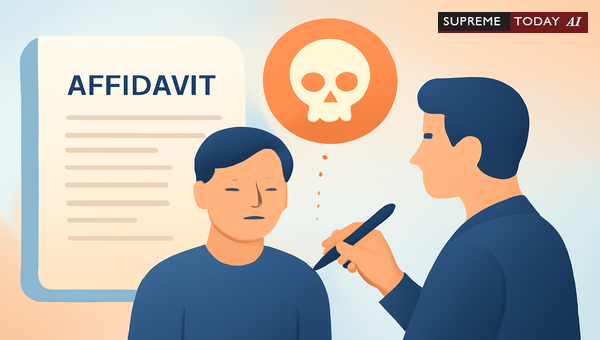
In legal proceedings, unexpected events like a witness's death can raise critical questions about the validity of prior testimony. Imagine a scenario where a key witness, such as Alif, provides evidence via and then passes away before the trial concludes. Is Alif's evidence on admissible? This is a common concern in civil and under Indian law, where affidavits often serve as . This post breaks down the legal principles, drawing from judicial precedents to clarify when such evidence holds weight.
Note: This article provides general information based on established case law and is not a substitute for professional legal advice. Consult a qualified lawyer for case-specific guidance.
Understanding Affidavits as Evidence in Indian Courts
Under Indian law, affidavits are not automatically considered evidence. They must meet strict criteria for relevancy and as per the , and procedural rules like . Typically, an filed as part of can be treated as if the court permits it. However, the opposing party has the right to raise objections on grounds of irrelevancy or inadmissibility.
The Full Bench of a court has clarified: affidavits filed in evidence are not evidence per se unless accepted by the court, and objections to or relevancy can be raised at the time of tendering or during , with the final decision reserved until judgment 2024 0 Supreme(Bom) 520. This ensures procedural fairness while streamlining trials.
Key requirements include:- Court permission for the to stand as 2018 0 Supreme(AP) 95.- Timely objections from the opposing side 2014 0 Supreme(Bom) 1115.- Compliance with Evidence Act provisions on relevancy and opportunities 2018 0 Supreme(AP) 95.
Scenario: Witness Dies After Leading Evidence on
The specific issue arises when a witness like Alif dies after leading evidence on but before or final arguments. Courts have consistently held that such affidavits may be admissible if already taken as . Once accepted, the transforms into , subject to Evidence Act scrutiny.
For instance: Once the court takes an as part of the , it effectively transforms the into evidence, subject to the provisions of the Evidence Act, including the opportunity for 2018 0 Supreme(AP) 95. The court retains discretion to exclude irrelevant or inadmissible portions, but the entire document isn't rejected outright if objections are raised later 2024 0 Supreme(Bom) 520.
In testamentary proceedings, this principle was applied where attesting witnesses filed affidavits but died before . The court noted: Mr. Desai did file an in lieu of in suit, however, he too died before his could be recorded 2018 0 Supreme(Bom) 1815. Despite the deaths, the affidavits were evaluated under , which allows statements by unavailable witnesses (e.g., due to death) in certain circumstances, provided they fall within specified exceptions like those made in expectation of death or relating to the cause of death.
Judicial Precedents on Deceased Witnesses' Affidavits
Several rulings reinforce this position:
Affidavits as : An can be considered as evidence when it is taken as part of the , especially under Court orders or specific procedures 2018 0 Supreme(AP) 95. The opposing party must object timely; failure to do so may waive rights 2022 0 Supreme(Mad) 1796.
Section 32 Evidence Act Application: In a case involving a doctor's postmortem report, the court stressed proper authentication: prosecution failed to bring on record the ingredients where under his evidence could have been admissible in the eye of law more particularly under 2019 0 Supreme(Pat) 51. For affidavits, death post-filing doesn't invalidate if prerequisites are met.
Specific Performance Suit Example: A witness died on after authenticating his evidence on on 2018 0 Supreme(Sikk) 46. The court considered the but ultimately dismissed the suit on unrelated grounds like readiness and willingness under . This highlights that is just one hurdle.
Will Probate Cases: In disputes over wills, affidavits by deceased attesting witnesses were scrutinized for due execution under . Courts demand proof of sound mind and no undue influence, even with death interrupting proceedings 2016 0 Supreme(Bom) 2192.
Courts often defer rulings on objections until judgment, recording them properly to protect parties' rights 2024 0 Supreme(Bom) 520. This balances efficiency with justice.
and Objections: Critical Safeguards
A major concern is the lack of post-death. While Section 32 may apply, courts prefer live testimony. However, if the was court-admitted pre-death:- and remain limited without the witness, akin to presumptions not affecting but mode of proof (noted in Malaysian contexts but analogous)
.- Opposing parties can challenge via other evidence or presumptions under in dowry cases, but principles extend broadly.
In practice:- Raise objections at tendering or during trial 2014 0 Supreme(Bom) 1115.- Courts exclude inadmissible parts using inherent powers 2024 0 Supreme(Bom) 520.- No automatic rejection; merits are judged holistically 2018 0 Supreme(AP) 95.
Practical Implications for Litigants
For plaintiffs or defendants relying on such evidence:1. File affidavits early under CPC rules.2. Seek court orders confirming them as exam-in-chief.3. Prepare for objections and potential Section 32 invocation.4. Corroborate with other witnesses or documents.
In commercial disputes, like payments confirmed via joint affidavits, death doesn't void if contemporaneously supported
. Similarly, in criminal matters, gaps in proof (e.g., ) lead to inadmissibility if not bridged
.
Conclusion and Key Takeaways
Generally, evidence led by from a deceased witness like Alif is admissible if taken as , court-admitted, and objections properly addressed. Judicial discretion ensures only , admissible parts are considered, upholding Evidence Act standards.
Key Takeaways:- Affidavits become evidence upon court acceptance as exam-in-chief 2018 0 Supreme(AP) 95.- Timely objections are essential; courts may defer decisions 2024 0 Supreme(Bom) 520.- Section 32 Evidence Act aids unavailable witnesses, but corroboration strengthens cases 2018 0 Supreme(Bom) 1815.- Always consult counsel to navigate procedural nuances.
Stay informed on evolving precedents—evidence rules protect fairness in Indian jurisprudence.
#LegalEvidence #AffidavitAdmissibility #IndianLaw















